
Holster Wedge Guide: How to Fix Printing and Pain in IWB and Appendix Carry
A holster wedge is a shaped pad that mounts on the body side of an IWB holster to rotate the grip inward, reduce printing, and eliminate pressure-point pain. Wedges work for AIWB and strong-side carry on any handgun, from the Glock 19 to the Sig P365.
Key Takeaways:
- A holster wedge is a pad mounted on the body side of your IWB holster that rotates the grip into your body, reducing printing and eliminating pressure-point pain.
- Wedges work for appendix (AIWB) and strong-side IWB carry positions on virtually any handgun, including the Glock 19, Sig P365, and similar concealed carry firearms.
- Proper wedge selection depends on your body type, carry position, and firearm size. This guide covers placement, body-type tuning, gun-specific setups, and troubleshooting.
What Is a Holster Wedge?
A holster wedge is a shaped pad that attaches to the body-facing side of an inside-the-waistband (IWB) holster, usually near the muzzle end. It creates a lever effect: the wedge pushes the muzzle away from your body, which rotates the grip inward and tucks it tighter against your torso. The result is less visible printing under a cover garment and better pressure distribution so the holster does not dig into your skin.
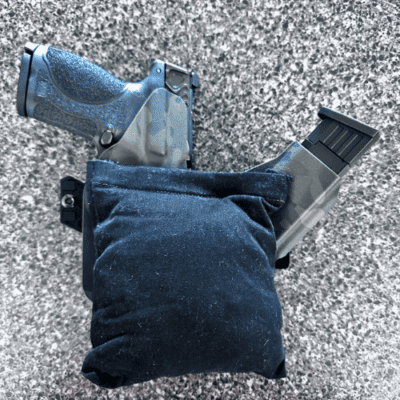
Traditional holster wedges are made from dense foam or rubber. The Cloudster Pillow holster wedge takes a different approach, using medical-grade foam wrapped in a breathable fabric cover. This eliminates the skin irritation and sweat buildup that rigid foam wedges often cause during all-day carry.
How a Wedge Changes Concealment Mechanics
Think of your holster as a lever balanced on your belt line. Without a wedge, the heavy end (the muzzle and slide) drops straight down against your body while the grip end tips outward, creating a visible bulge under your shirt.
A wedge near the muzzle acts as a fulcrum. It pushes that bottom end slightly outward from your body, which forces the top end (the grip) to rotate inward. Even a small amount of rotation, just a few degrees, can dramatically reduce how much the grip prints through a t-shirt or button-down.
Beyond concealment, the wedge also spreads the holster’s contact area across a wider surface of your abdomen or hip, turning a sharp pressure point into a broad, comfortable contact patch.
Holster Wedge vs. Claw vs. Pad: What Is the Difference?
Holster accessories for concealment can be confusing. Here is how the main options compare:
- Holster Wedge: Mounts on the body side of the holster near the muzzle. Pushes the muzzle out and rotates the grip in. Improves comfort and concealment simultaneously. Works in any carry position.
- Claw / Wing: Mounts on the belt side of the holster near the trigger guard. Presses against the inside of your belt to push the grip inward. Primarily helps concealment but does not address comfort or pressure points. Works best in AIWB.
- Soft Pad / Backer: A flat cushion that covers the body side of the holster shell. Adds comfort by padding the Kydex surface but does not change the holster angle or rotation. Minimal concealment benefit.
- Built-In Molded Features: Some holster manufacturers build a slight wedge shape directly into the Kydex shell. These offer a fixed angle that cannot be adjusted after purchase.
For most concealed carriers, the best setup is a wedge combined with a claw. The wedge handles comfort and muzzle rotation from the body side, while the claw handles grip tuck from the belt side. Together they provide the maximum concealment and comfort combination.
When Do You Need a Holster Wedge?
Not every holster setup requires a wedge, but most IWB carriers benefit from one. If you recognize any of the following problems, a wedge is likely the fastest fix.
What Problems Does a Holster Wedge Fix?
- Grip printing through your cover garment: The top of the grip pokes outward and creates a visible outline under t-shirts, polos, or button-downs. A wedge rotates the grip back against your body.
- Muzzle digging into your lower abdomen or pelvis: The bottom of the holster creates a sharp pressure point, especially when sitting. A wedge redistributes that pressure across a wider, softer surface.
- Holster tipping or rocking outward at the top: Heavier setups with weapon lights or red dot optics tend to torque the holster forward. A wedge counteracts that rotation.
- Skin irritation, bruising, or redness: Direct Kydex-to-skin contact causes chafing and hot spots during extended wear. A padded wedge like the Cloudster Pillow puts a soft barrier between the holster shell and your body.
How Do You Know Your Setup Needs Tuning?
Even if you do not notice obvious printing, watch for these signals that your holster positioning could improve:
- You constantly readjust your holster throughout the day.
- Your belt rides up or shifts away from your body on the holster side.
- You avoid sitting or bending because it is uncomfortable.
- You choose not to carry certain days because the setup is annoying.
- You have red marks or indentations on your skin after removing the holster.
Any of these issues suggests that your holster angle, pressure distribution, or both need adjustment. A wedge addresses both at the same time.
What Are the Different Types of Holster Wedges?
Not all wedges are built the same. The material, shape, and density of a wedge determine how it performs against your body during all-day carry. Here is how the main types compare.
What About Foam Block and Universal Wedges?
Basic foam wedges are rectangular or triangular blocks of closed-cell foam that attach to your holster with adhesive-backed hook-and-loop strips. They are inexpensive and easy to trim with scissors to experiment with different shapes and sizes.
The downside is durability and comfort. Cheap foam compresses over time, losing its shape and effectiveness within weeks of daily carry. The rigid surface can also create its own pressure points, especially on bare skin.
Are Molded and Contoured Wedges Better?
Higher-quality wedges use denser foam or rubber molded into a specific contour. These hold their shape longer than basic foam and provide more consistent, repeatable performance day after day.
Some are designed for specific holster brands or models, which limits flexibility if you switch holsters or carry positions. Others use a universal mounting system with hook-and-loop so you can reposition them as needed.
What Are Pillow-Style Fabric-Covered Wedges?
The Cloudster Pillow represents a different category: a medical-grade foam wedge wrapped in a soft, breathable fabric cover. This design eliminates the skin irritation that hard foam and rubber wedges cause during long carry sessions.
The fabric cover wicks moisture away from your skin, stays cool, and is machine-washable. The medical-grade foam inside maintains its shape and density over months of daily use without compressing flat like basic foam wedges.
This style works best for carriers who wear their holster eight or more hours a day and need comfort that lasts through a full workday, gym session, or long drive.
| Wedge Type | Best For | Pros | Cons |
|---|---|---|---|
| Basic Foam | Testing shapes, budget setups | Cheap, easy to trim and experiment | Wears out fast, can create pressure points |
| Molded / Contoured | Dedicated daily carry with one holster | Consistent shape, longer lasting | Less customizable, may not fit all holsters |
| Pillow-Style (Cloudster Pillow) | All-day IWB and AIWB carry, sensitive skin | Breathable fabric cover, medical-grade foam, machine-washable | Premium price point |
Where to Place a Holster Wedge (AIWB and Strong-Side IWB)
Wedge placement is the single biggest factor in how well it works. A few millimeters of adjustment can mean the difference between a setup that conceals perfectly and one that still prints or digs in.
Basic Placement Rules
- The wedge always goes on the body-facing side of the holster, never on the belt side.
- Start with the wedge low, near the muzzle end of the holster. The lower edge of the wedge should be roughly even with or slightly past the bottom of the holster shell.
- Position the thickest part of the wedge toward the area that needs the most rotation or pressure relief. For most people, that is directly behind the muzzle.
- Use hook-and-loop attachment so you can reposition the wedge without replacing it.
Appendix (AIWB) Placement Step by Step
- Clear your firearm. Remove the magazine, lock the slide back, visually and physically confirm the chamber is empty. Do all fitting and adjustment with an unloaded firearm.
- Attach the wedge low on the body side. Place it near the muzzle end, centered on the slide channel, with the thickest edge pointing down.
- Put on the holster at your normal AIWB position (typically between the belt buckle and your strong-side hip bone) and tighten your belt to your usual tension.
- Check the grip. Look in a mirror or run your hand over your cover garment. If the grip still pokes out, slide the wedge slightly lower or try a thicker wedge.
- Check comfort. Sit down, bend over, and twist. If the muzzle digs into your pelvis or thigh crease, move the wedge up slightly so it shifts the pressure point away from that bone.
- Wear it around the house for an hour. Make small adjustments, not big ones. Move the wedge a few millimeters at a time until both concealment and comfort are dialed in.
Strong-Side IWB (3 to 4 O’Clock) Placement
For behind-the-hip carry, the wedge works slightly differently. Instead of rotating the grip into your stomach, it stabilizes the holster against your hip and prevents the grip from flaring outward.
- Attach the wedge on the body side, near the muzzle, angled toward your hip bone.
- Holster up at your normal 3 to 4 o’clock position with your cover garment on.
- The wedge should push the bottom of the holster slightly outward from your hip, which tilts the grip inward toward your back.
- Adjust up or down until the grip sits flat against your side without creating a visible bulge.
How Do You Dial in a Wedge for Your Body Type?
No two bodies carry the same way. A wedge setup that works perfectly for one person may need adjustment for another. Here is how to approach wedge tuning based on your build.
What Wedge Works for Flat and Athletic Builds?
If you have low body fat and a flat stomach, your holster sits close to your body with minimal gap between the belt line and your skin. This means you usually need a smaller, thinner wedge because there is less space to fill.
Be careful not to over-wedge. Too much thickness on a flat build can actually push the grip outward and create printing where there was none. Start with the thinnest wedge option and work up only if you still see grip outline.
What About Medium Builds and Dad Bod?
Carriers with a moderate midsection often get the most dramatic improvement from a wedge. The gap between your belly and belt line creates a natural space where the holster can tip and shift. A medium-density wedge fills that gap, locks the holster angle in place, and distributes pressure across a wider area.
Focus the wedge low near the muzzle to bridge the gap between your belt and the soft tissue below your navel. This is where most carriers in this body type experience the most discomfort and printing.
What Wedge Works for Plus-Size and Larger Builds?
Larger carriers face unique challenges: more tissue between the belt and the body creates a bigger gap for the holster to move in, and pressure from a compact holster concentrates on a smaller area relative to body size.
A larger, softer wedge works best here. The Cloudster Pillow’s fabric-covered medical-grade foam excels in this application because it compresses enough to conform to your body without bottoming out, and the breathable cover prevents the sweat and chafing issues that hard foam wedges cause under a belly fold.
Consider combining a wedge with a slightly higher ride height to keep the muzzle above the thigh crease when sitting.
Does Torso Length Affect Wedge Choice?
Short torso: You have less vertical space between your ribs and your belt. Keep the wedge small and be careful with ride height. A wedge that is too tall can push the grip into your ribs or cause the muzzle to poke into your thigh when seated.
Tall torso: You have more room to work with. You can experiment with larger wedges and more aggressive cant angles without running into the rib or thigh problem. Take advantage of that space to dial in a setup that completely eliminates printing.
What Wedge Setup Works Best for Your Concealed Carry Gun?
Different firearms have different weight distributions, grip lengths, and slide profiles. Here is how to approach wedge setup for the most popular concealed carry handguns.
Glock 19 and Similar Compacts (G23, G32, G45)
The Glock 19 is the most popular concealed carry handgun in the United States for good reason: it balances capacity, size, and shootability. But the relatively long grip and blocky slide profile make it one of the most common guns that prints in AIWB carry.
Recommended wedge setup: Start with a medium-thickness wedge placed low on the body side, centered behind the muzzle. The Glock 19’s grip length means you need enough wedge to rotate that grip inward without creating excessive pressure on your lower abdomen.
If you run a weapon light (Streamlight TLR-7A, Surefire X300, etc.), the added muzzle weight actually helps the wedge work better by giving the lever more force to rotate the grip in. You may be able to use a slightly thinner wedge with a light-bearing setup than without one.
Sig Sauer P365, P365XL, and XMACRO
The P365 family has a shorter grip than the Glock 19, which means less grip printing but a taller, narrower slide that can create a different kind of pressure point against your body.
P365 (standard): The short grip rarely prints badly, but the slide can dig in. A thin to medium wedge near the muzzle solves the comfort problem without over-rotating a grip that is already short enough to conceal.
P365XL and XMACRO: The extended grip and longer slide on these models behave more like the Glock 19 in terms of printing. Use a medium wedge and pay attention to cant angle. A slight forward cant (grip tilted toward your belt buckle) combined with the wedge usually gives the best concealment.
Glock 43X, Glock 48, and Slim Subcompacts
Slim single-stack and slimline guns like the G43X, G48, Hellcat, and Shield Plus are easier to conceal than double-stack compacts, but they still benefit from a wedge. The thinner profile means the holster has a smaller footprint on your body, concentrating pressure into a narrower strip.
A thin wedge is usually sufficient. The primary benefit is comfort and stabilization rather than aggressive grip rotation. These guns print less to begin with, so the wedge’s main job is to keep the holster from shifting and to eliminate the Kydex edge digging into your skin.
Full-Size Carry (Glock 17, Sig P320, M&P 2.0)
If you carry a full-size handgun IWB, a wedge is almost mandatory. The longer slide and grip create significant torque on the holster, and without a wedge the grip will print through anything short of a heavy jacket.
Use a medium to large wedge and pair it with a claw or wing. The wedge handles the muzzle rotation and comfort; the claw handles the extra grip length. Consider a stiffer gun belt as well, since full-size guns need more belt support to keep everything in place.
Troubleshooting: If It Still Prints or Hurts
Sometimes a wedge alone does not completely solve the problem. Here are targeted fixes for the most common remaining issues.
If You Still Print After Adding a Wedge
- Try a slightly thicker wedge or add a second thin wedge on top of the first to increase the rotation angle.
- Add or adjust a claw or wing to complement the wedge. The claw pushes the grip from the belt side while the wedge pushes from the body side. Together they provide maximum grip tuck.
- Check your belt. A soft or stretchy belt lets the holster sag and shift, undoing the wedge’s work. A dedicated gun belt with a stiff core makes a significant difference.
- Evaluate your cover garment. Thin, clingy fabrics show everything. A slightly textured or patterned shirt hides far more than a plain solid-color tee.
- Adjust your cant angle. Sometimes tilting the grip a few degrees forward (toward your belt buckle) or backward eliminates the last bit of printing the wedge cannot reach on its own.
If It Still Hurts After Adding a Wedge
- Move the wedge up or down by a few millimeters to shift the primary contact point away from the bone or nerve that is causing pain.
- Switch to a softer wedge material. Hard foam creates its own pressure points. The Cloudster Pillow’s fabric-covered medical-grade foam was specifically designed to solve this problem.
- Re-evaluate ride height. If the muzzle digs into your thigh crease when sitting, raise the holster slightly on your belt. If the grip pokes your ribs, lower it.
- Give it time. A new wedge position needs at least a few hours of wear before you can judge it accurately. Do not make rapid adjustments based on five minutes of testing.
What Are the Most Common Wedge Mistakes?
- Wedge placed too high on the slide: This reduces the lever effect and may push the muzzle into your body instead of away from it.
- Going too thick too fast: A massive wedge on day one can cause more problems than it solves. Start thin and increase gradually.
- Not wearing it long enough to test: Small adjustments need hours of real-world wear to evaluate. Wear the setup around the house for a full evening before deciding it does not work.
- Ignoring belt quality: A wedge cannot compensate for a belt that does not support the holster. Invest in a proper gun belt before concluding that your wedge is not working.
How to Choose the Right Holster Wedge for Your Setup
Matching the right wedge to your body type, gun, and carry position does not need to be complicated. Use these quick-reference recipes as a starting point:
- Glock 19, AIWB, moderate build: Medium Cloudster Pillow wedge, placed low near the muzzle, slight forward cant. Pair with a claw for maximum concealment.
- Sig P365, AIWB, slim build: Small or thin wedge, focused on comfort and stabilization rather than aggressive rotation. Start thin and increase only if grip prints.
- P365XL or XMACRO, AIWB, any build: Medium wedge, same placement as Glock 19. The longer grip on these models needs similar rotation.
- G43X or Hellcat, strong-side IWB, larger build: Medium soft wedge for comfort and stability. Focus on preventing the holster from shifting during movement.
- Full-size carry (G17, P320), AIWB: Large wedge plus claw plus stiff gun belt. All three are needed to conceal a full-size handgun in appendix position.
If you want a single wedge that works across all of these setups, the Cloudster Pillow is designed as a universal solution. The medical-grade foam and breathable fabric cover adapt to different body types and holster sizes, and the hook-and-loop mounting lets you reposition it instantly when you switch guns or carry positions.
Frequently Asked Questions
Do I need a holster wedge if my holster already has a built-in wedge?
It depends on whether the built-in wedge is thick enough and positioned correctly for your body. Many built-in wedges are minimal and designed as a one-size-fits-all compromise. An aftermarket wedge like the Cloudster Pillow lets you customize the thickness, position, and angle to match your specific anatomy and carry position.
Will a holster wedge work with a Glock 19 or Sig P365?
Yes. Holster wedges are firearm-agnostic. They attach to the holster, not the gun. Whether you carry a Glock 19, Sig P365, P365XL, XMACRO, G43X, Hellcat, Shield Plus, or any other IWB-compatible handgun, a wedge will improve concealment and comfort as long as it is sized and positioned correctly for your setup.
Can I use a holster wedge with a claw or wing attachment?
Absolutely. In fact, using both together gives you the best results. The wedge works from the body side to rotate the grip inward and add comfort. The claw works from the belt side to push the grip even tighter against your body. They address different aspects of concealment and complement each other.
Is appendix carry safe with a holster wedge?
A wedge does not change the safety characteristics of your holster. The firearm remains fully enclosed in the Kydex shell with complete trigger guard coverage. Always use a holster with proper retention and full trigger coverage regardless of whether you add a wedge, claw, or other accessories. Follow the four rules of firearm safety at all times.
How long does a holster wedge last before I need to replace it?
Basic foam wedges may compress and lose effectiveness within a few weeks of daily carry. Higher-quality wedges with denser foam last several months. The Cloudster Pillow uses medical-grade foam that maintains its shape and density through months of daily use, and the fabric cover is machine-washable to keep it fresh.
What is the best holster wedge for concealed carry?
The best holster wedge depends on your body type, gun, and carry position. For most concealed carriers, a wedge that combines durable foam with a breathable, skin-friendly cover offers the best all-day performance. The Cloudster Pillow holster wedge was designed specifically for this purpose, with medical-grade foam and a soft fabric cover that wicks moisture and prevents irritation during extended wear.
Related Holster Wedge Articles
Explore our in-depth guides on specific holster wedge topics:
Buying Guides & Comparisons
- Best Holster Wedge 2026: Complete Buyer’s Guide – Our top picks for appendix carry wedges this year.
- AIWB Holster Claw vs Wedge vs Pillow – Which accessory do you actually need?
- DIY Wedges vs. Pro Gear: Is It Worth the Upgrade? – Homemade vs. commercial wedge comparison.
- 5 Common Myths About Holster Wedges Debunked – Separating fact from fiction.
Installation & Adjustment
- How to Install an IWB Holster Wedge – Step-by-step installation for any holster.
- How to Install and Adjust Your AIWB Holster Wedge – Dial in perfect appendix concealment.
- Mastering Muzzle Torque – Fine-tuning your wedge pillow for AIWB carry.
Performance & Comfort
- How a Holster Wedge Improves Draw Speed & Consistency – The performance benefits beyond concealment.
- Solving AIWB Printing with a Holster Wedge Foam Pillow – Targeted fixes for appendix printing.
- Shredded vs. Solid: The Science Behind Memory Foam Wedges – Why foam type matters.
- The Art of the Pillow Wedge for Holster Users – Comfort meets carry strategy.
Specialized Setups
- Best IWB Holster for Glock 43X with a Wedge – Slimline carry optimized.
- Adjusting Your AIWB Wedge for Layered Winter Clothing – Seasonal carry tuning.
- How Your Holster Wedge Interacts with Your Mag Carrier – Building a balanced rig.
- EDC Check-Up: Is Your Holster Wedge Kit Still Optimized? – Annual carry gear review.
- Holster Wedge Kit Pillow: Solving Grip Kick – Fixing muzzle-end torque issues.
- Appendix Carry Pillow Wedge – Nighttime comfort for daytime security.
- Holster Wedge Kit Pillow for Nighttime Carry – How a wedge changes your bedside routine.
Get Started: Shop Holster Wedges
Ready to eliminate printing and carry pain? Browse the full Cloudster Pillow holster wedge lineup and find the right setup for your gun, body type, and carry position.
Shop Cloudster Pillow Holster Wedges
Have questions about which wedge is right for your setup? Contact us and we will help you dial in the perfect configuration.