
Uncategorized
Concealed Carry Laws Overview: A Clear Roadmap
Concealed carry laws vary dramatically across the United States, and understanding them is essential before you carry. Whether you’re new to firearms or expanding your carry knowledge, navigating permit requirements and regulations can feel overwhelming.
At Cloudster Pillow, we’ve created this roadmap to break down the complex landscape of concealed carry laws into actionable steps. You’ll learn exactly what your state requires, how federal rules apply, and what comes next in your carry journey.
Understanding Your State’s Permit Category
Constitutional Carry States: No Permit Required
The permit landscape splits into three distinct categories, and where you live determines which path you’ll follow. About 27 states have adopted constitutional carry, meaning you can carry concealed without a permit at all. These states include Alaska, Arizona, Arkansas, Georgia, Idaho, Indiana, Iowa, Kansas, Kentucky, Maine, Mississippi, Missouri, Montana, New Hampshire, North Carolina, North Dakota, Ohio, Oklahoma, South Dakota, Tennessee, Texas, Utah, Vermont, West Virginia, Wisconsin, and Wyoming. You can start carrying immediately once you complete your own safety training-no application process required.
Many constitutional carry states still allow you to obtain a permit if you want one, primarily for interstate reciprocity purposes. Georgia illustrates this well: you don’t need a Weapons Carry License to carry at home, but obtaining one enables you to carry legally in other states that recognize Georgia permits. The average cost runs around $75 and varies by county, with the process taking roughly 30 days after your background check begins.
Shall-Issue States: Objective Standards Apply
Shall-issue states require permits but must issue them to any applicant who meets objective criteria like age, background checks, and training completion. These states include California, Colorado, Connecticut, Delaware, Florida, Illinois, Louisiana, Maryland, Michigan, Minnesota, Nevada, New Jersey, New Mexico, New York, Oregon, Pennsylvania, Rhode Island, South Carolina, Texas, Virginia, and Washington. New York represents the stricter end of this spectrum, requiring a 16-hour classroom course and 2-hour live-fire training starting September 1, 2022. Florida takes a different approach with minimal training requirements but charges around $125 for a five-year permit.
May-Issue States: Discretionary Approval
May-issue states like California, Hawaii, and Massachusetts give officials discretionary power to deny permits even if you meet technical requirements. This creates unpredictable outcomes: some counties issue readily while others rarely approve applications. The Supreme Court’s 2022 Bruen decision significantly weakened may-issue frameworks by requiring states to justify restrictions on carrying for self-defense outside the home.
Federal Restrictions Apply Everywhere
Federal law restricts carry in specific locations regardless of your state’s rules. You cannot carry in federal buildings, K-12 schools within 1,000 feet, and certain court facilities. These restrictions apply uniformly across constitutional carry, shall-issue, and may-issue states alike. Understanding which category your state falls into forms your first critical step toward legal carry. Once you know your permit pathway, you’ll want to focus on the practical requirements that come next-documentation, training standards, and timelines that vary significantly by state.
Federal Rules and Multi-State Carry Reality
Federal Restrictions Apply Everywhere
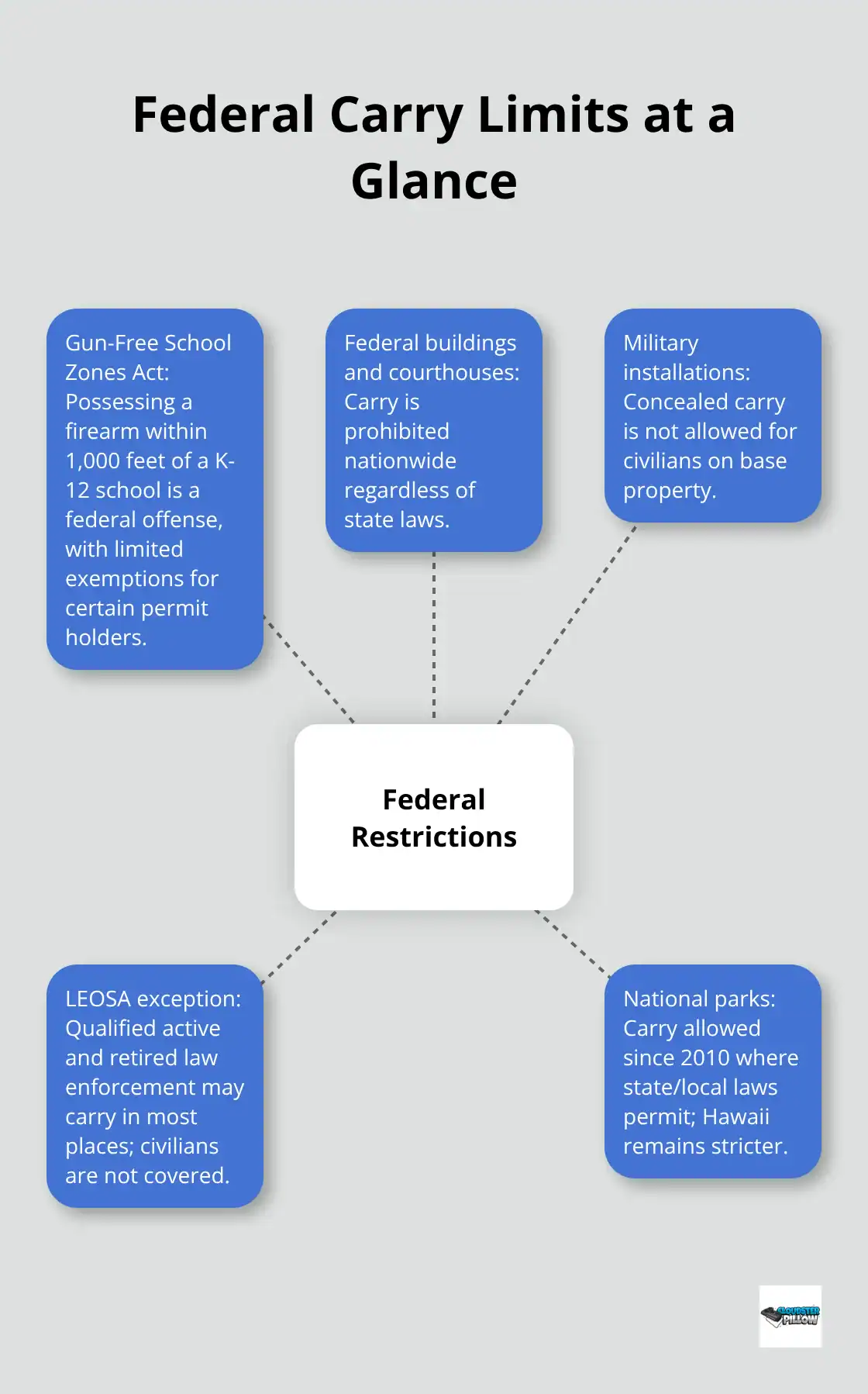
Federal law creates a hard floor of restrictions that applies everywhere, regardless of whether your state permits constitutional carry or requires permits. The Gun-Free School Zones Act makes it a federal offense to knowingly possess a firearm within 1,000 feet of a K-12 school, with limited exemptions for state-permit holders in certain circumstances. Federal buildings, courthouses, and military installations remain off-limits nationwide. The Law Enforcement Officers Safety Act allows qualified retired and active law enforcement to carry in most places, but this exception does not extend to regular civilians. National parks have allowed concealed carry since 2010 as long as state and local laws permit it, except in Hawaii where federal restrictions remain stricter.
State-Level Restrictions Layer On Top
What complicates things is that states add additional restrictions on top of federal rules. New York prohibits carry in government buildings, healthcare facilities, libraries, public parks, places of worship, public transit, bars serving alcohol, theaters, and Times Square. California restricts carry in many similar locations plus additional sensitive areas. Meanwhile, states like Georgia and Texas allow carry in far more venues. Your permit from one state might be worthless in another state’s restricted areas, even if that state technically recognizes your permit through reciprocity agreements.
Understanding Reciprocity Agreements
Interstate reciprocity creates a patchwork that requires active research before traveling. As of 2022, roughly 37 states maintain formal reciprocity agreements with at least one other state, but this does not mean universal recognition. A Georgia permit is recognized in some states but not in California, New York, or Hawaii. The USCCA maintains a reciprocity map showing which permits are recognized in each state, and this resource is essential before any multi-state trip. Roughly 27 states have moved toward constitutional carry, which simplifies things if you travel through those states since you do not need anyone’s permission to carry there.
Navigating Restricted States and Transport Rules
Traveling through restrictive states like New York or California requires careful planning. The Firearm Owners Protection Act permits the interstate transportation of unloaded firearms by any person, protecting you during transit between states where you can legally possess them. This does not authorize concealed carry through restricted states-it only protects you during transit with specific conditions. If you cross state lines regularly, obtaining non-resident permits from reciprocal states gives you legal protection in those jurisdictions. Many carriers obtain permits from multiple states specifically to expand their recognition across regions. The cost varies from $50 to $200 per permit depending on the state, making this a practical investment if you travel frequently.
The Reality of Your Actual Carry Rights
One critical mistake carriers make is assuming their home-state permit works everywhere or that constitutional carry status in their state applies when they travel. It does not. Your actual carry rights depend entirely on where you are at that moment, not where you are from. This is why understanding your legal landscape matters-and why adjusting your carry setup accordingly across different locations and seasons becomes part of your responsibility as a carrier. Once you know which states recognize your permit and where federal restrictions apply, you can focus on the practical steps required to actually obtain that permit in the first place. When you’re carrying across state lines, comfort and security matter just as much as legality-the Cloudster Pillow holster wedge keeps your concealed carry comfortable and stable no matter where your travels take you.
What You Actually Need to Get Your Permit
Documents You’ll Gather First
Getting your concealed carry permit requires three practical components: collecting the right documents, completing required training, and understanding what you’ll pay and how long it takes. The documentation phase is straightforward in most states. You’ll need a valid government-issued ID, proof of residency (utility bill or lease agreement typically works), proof of citizenship or legal residency status, and in some cases a Social Security number.
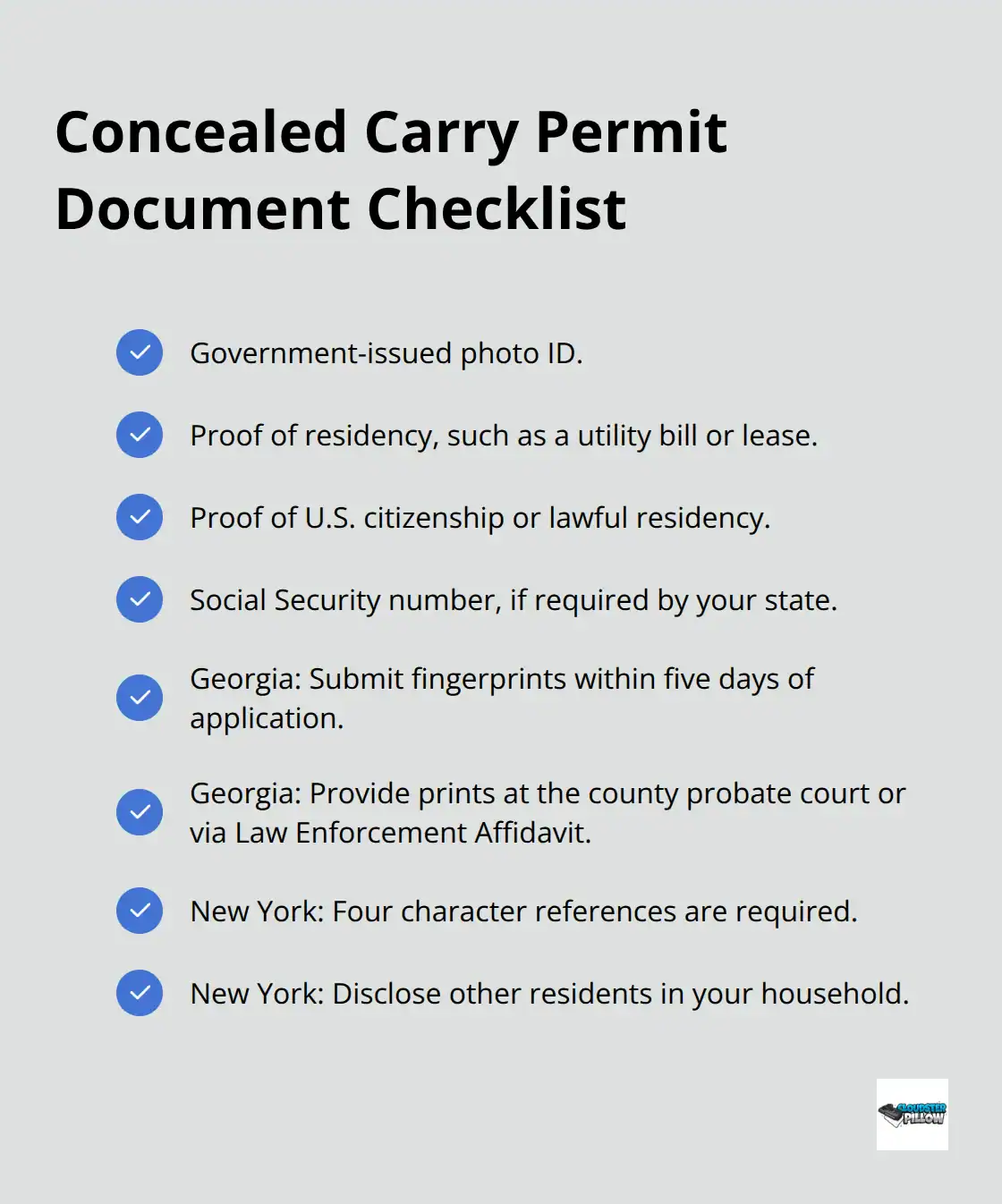
Georgia requires these basics plus fingerprints submitted within five days of your application, which you can provide at your county probate court or through a Law Enforcement Affidavit. New York adds another layer by requiring four character references and disclosure of anyone else living in your home, making the process more intrusive but still manageable if you plan ahead.
The background check itself is handled by law enforcement and typically takes 30 days or less, though New York’s process can extend longer depending on your county. Some states like Florida skip fingerprinting entirely, streamlining the process considerably. The key is contacting your county or state licensing authority early to confirm exact requirements, since variations exist even within shall-issue states.
Training Standards Shape Your Timeline
Training standards represent the biggest variable across jurisdictions, and this directly impacts your timeline and budget. Georgia imposes no civilian training requirement beyond background checks, meaning you can obtain your permit without formal instruction. New York requires classroom firearms safety training plus two hours of live-fire training, a substantial commitment that adds weeks to your timeline and hundreds of dollars to your costs. Florida requires no specific training hours but recommends instruction, leaving the choice to you.
Most shall-issue states fall somewhere between these extremes, typically requiring four to eight hours of classroom instruction or proof of prior military or law enforcement service that satisfies the requirement. Costs vary dramatically: Georgia’s permit averages $75 and varies by county, while New York’s training alone can run $200 to $400 depending on your instructor and location. Florida charges approximately $125 for a five-year permit with minimal training requirements.
Budget and Timeline Expectations
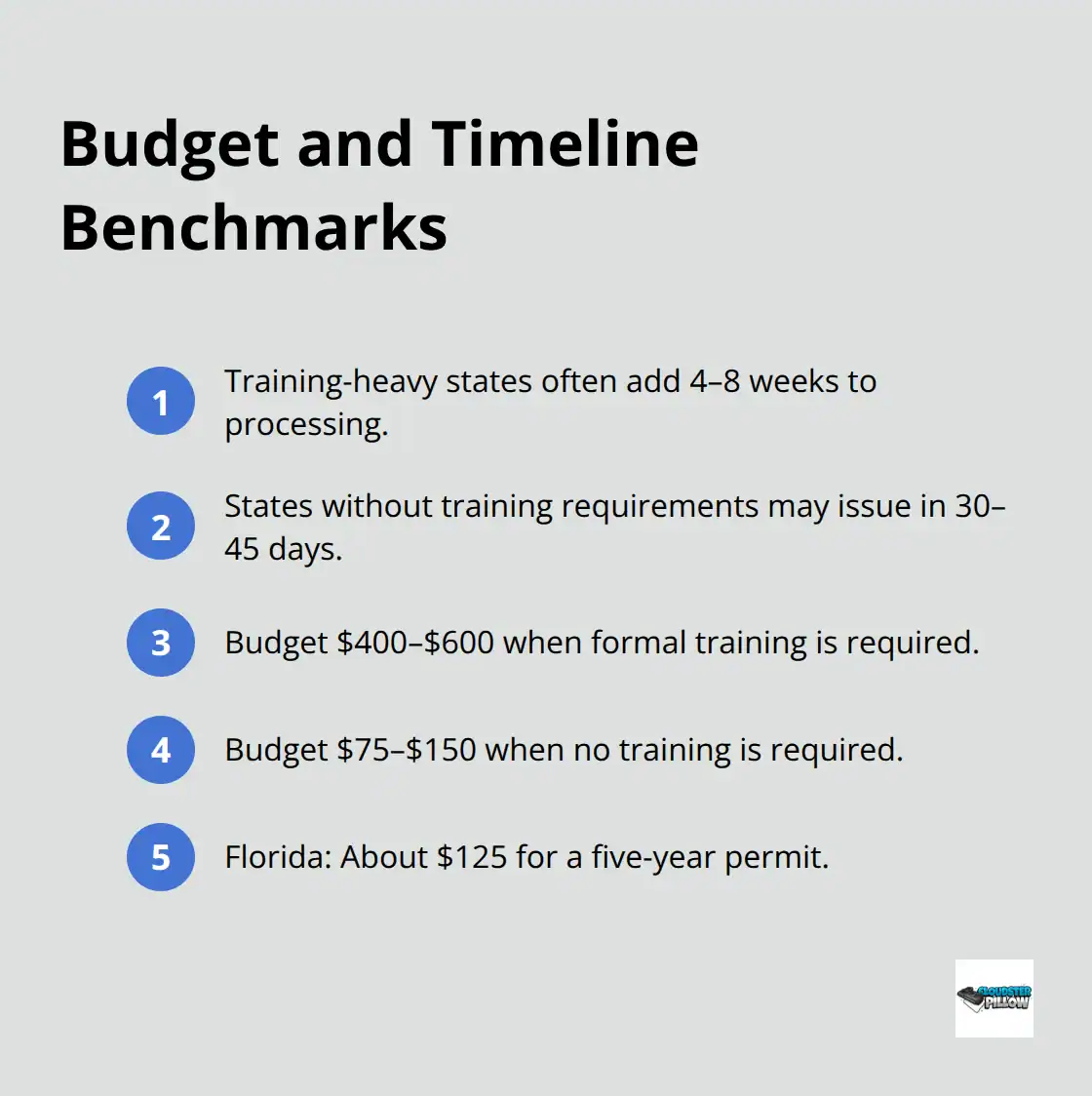
The timeline matters because training-heavy states add 4 to 8 weeks to your application process, while states with no training requirements can issue permits within 30 to 45 days of submitting your paperwork. Try to budget $400 to $600 total if your state requires formal training and $75 to $150 if it does not. Plan for this expense now rather than rushing through the process unprepared, because once you’re approved and carrying regularly, your comfort becomes critical.
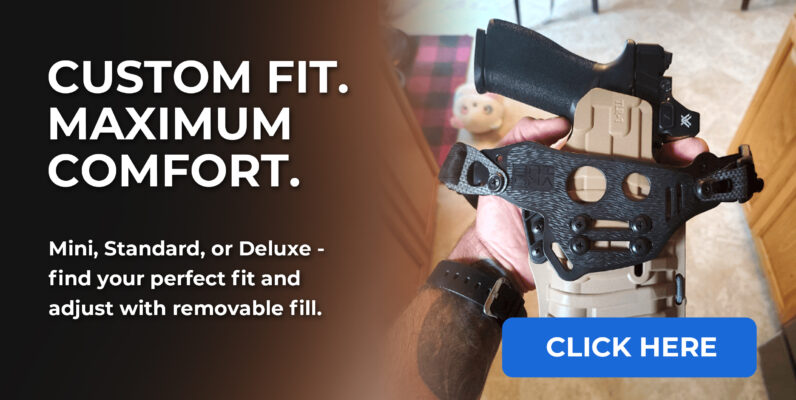
The Cloudster Pillow holster wedge is designed specifically for everyday carriers who need all-day comfort during that long application wait and beyond.
Final Thoughts
You now understand the concealed carry laws overview that matters most: constitutional carry states let you carry immediately, shall-issue states require objective criteria, and may-issue states demand discretionary approval. Federal rules apply everywhere regardless of your state’s framework, and reciprocity agreements create a patchwork you must research before traveling across state lines. Once you verify your state’s requirements and confirm reciprocity for any travel, you move into the practical reality of daily carry.
Comfort determines whether you actually carry consistently or leave your firearm at home on difficult days. Carriers who struggle with all-day concealment often skip carrying in certain situations or switch to inadequate methods that compromise both safety and concealment. Your holster, belt, and clothing all factor into whether you maintain your commitment to carry or abandon it when discomfort sets in.
We at Cloudster Pillow designed our holster wedge specifically for everyday carriers who need real comfort without replacing their entire holster system. Whether you carry AIWB or IWB, our wedge enhances concealment and reduces printing while keeping you comfortable through your entire day. Explore our holster wedge collection to find the comfort solution that supports your carry commitment.
