Licensing and Cost-Saving Tips, CCW Training, Cloudster Pillow News
Concealed Carry Legality Updates: Whats New for CCW Holders
Concealed carry laws are shifting faster than ever, and staying on top of these changes matters for your safety and legal protection. Whether you’re a seasoned carrier or new to CCW, understanding what’s happening in your state and beyond is essential.
At Cloudster Pillow, we know that legal changes directly impact how you carry and what gear works best for your lifestyle. This guide breaks down the recent updates and what they mean for you.
What’s Actually Changing in Concealed Carry Law Right Now
The Permit Landscape Across States
The landscape of concealed carry shifts unevenly across the country. As of 2025, 29 states allow some form of permitless carry, while 21 states still require permits. This patchwork creates real confusion for carriers who travel or relocate. The Constitutional Concealed Carry Reciprocity Act of 2025, introduced with 189 cosponsors in January, aims to create federal reciprocity. It would allow anyone eligible to carry in their home state to carry in any state that permits residents to do so.
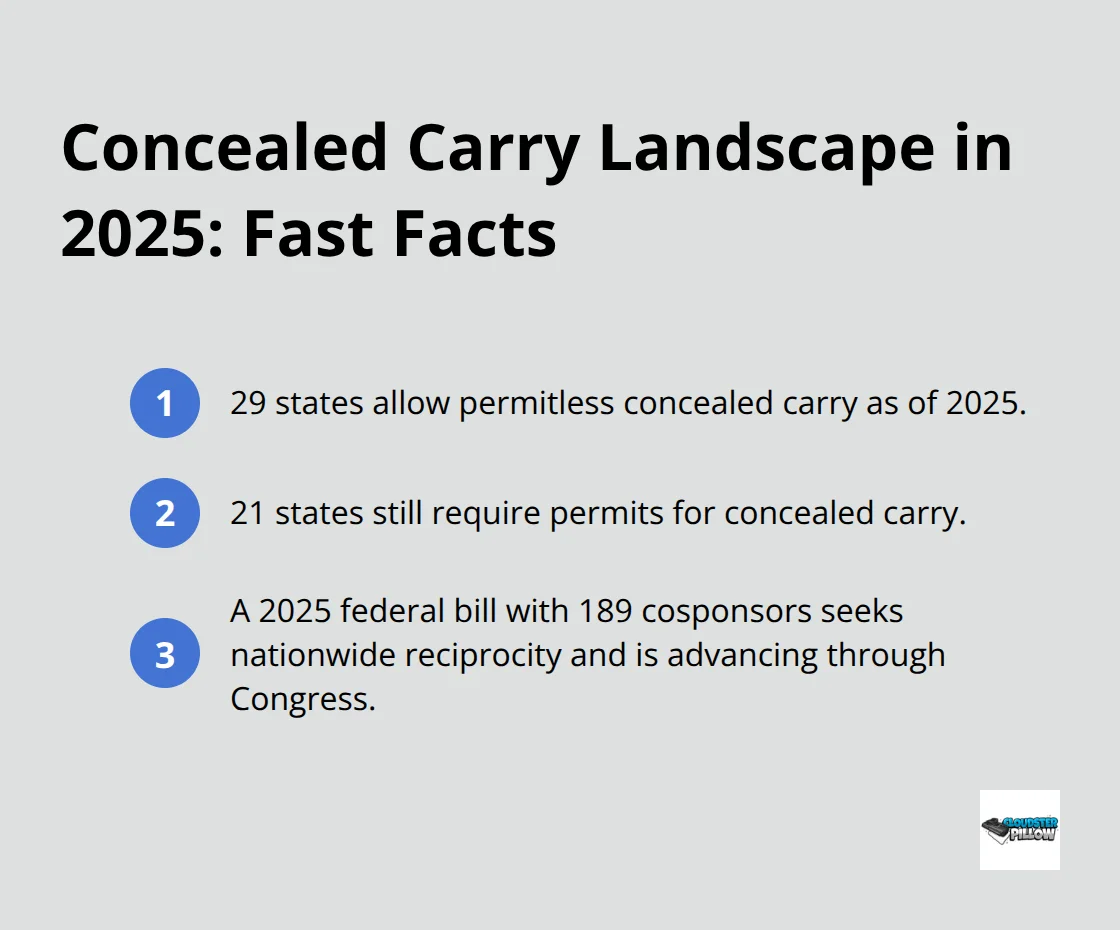
If enacted, this would fundamentally shift how you navigate state lines with your firearm. The bill has already moved through the House Judiciary Committee and was placed on the Union Calendar in October 2025, signaling serious momentum toward passage.
What Federal Reciprocity Means for Your Carry Rights
If you carry in a permitless carry state, federal reciprocity would let you carry in stricter states without obtaining a separate permit. Conversely, if you live in a permit-required state, reciprocity wouldn’t automatically grant you rights in permitless states-the destination state’s rules still apply. The practical reality is that reciprocity only works if the destination state allows its own residents to carry concealed. Under the current proposal, you’d need to carry a valid photo ID and proof that you’re licensed or eligible in your home state. The bill explicitly protects state and private property bans, meaning no law overrides a business’s decision to prohibit firearms on their premises.
Training Requirements Vary Dramatically
New York’s approach illustrates the stricter end of the spectrum: concealed carry licenses require 16 hours of classroom training plus 2 hours of live-fire instruction, and licenses expire every three years in major counties like NYC and Westchester. If you’re a carrier moving between states with vastly different standards, your training and gear setup need flexibility. This is where equipment that adapts to your changing carry method becomes essential-whether you switch between AIWB and IWB positions for different clothing or seasons, or adjust to new state-specific carry restrictions. Carriers who relocate or travel frequently face the most pressure to invest in adaptable solutions that work across multiple carry positions and holster types without requiring a complete system overhaul. The right gear, like the Cloudster Pillow holster wedge at https://cloudsterpillow.com/holster-wedge/, helps you maintain comfort and concealment no matter where you carry or how your circumstances change.
What You Actually Need to Know Before Crossing State Lines
Verify Reciprocity Before You Travel
Your state’s rules do not follow you across the border, and this reality demands specific preparation before you travel. If you hold your home state’s permit or carry under permitless authority, that same legal standing does not automatically apply elsewhere. The Constitutional Concealed Carry Reciprocity Act would change this if passed, but until then, you must verify reciprocity agreements before departure. Start by checking your state’s reciprocity agreements-most states publish official lists of which permits they recognize. If you hold a Florida permit, over 30 states recognize it, but neighboring states might not. The moment you cross into a state that does not recognize your permit, you become technically illegal, regardless of your intentions.
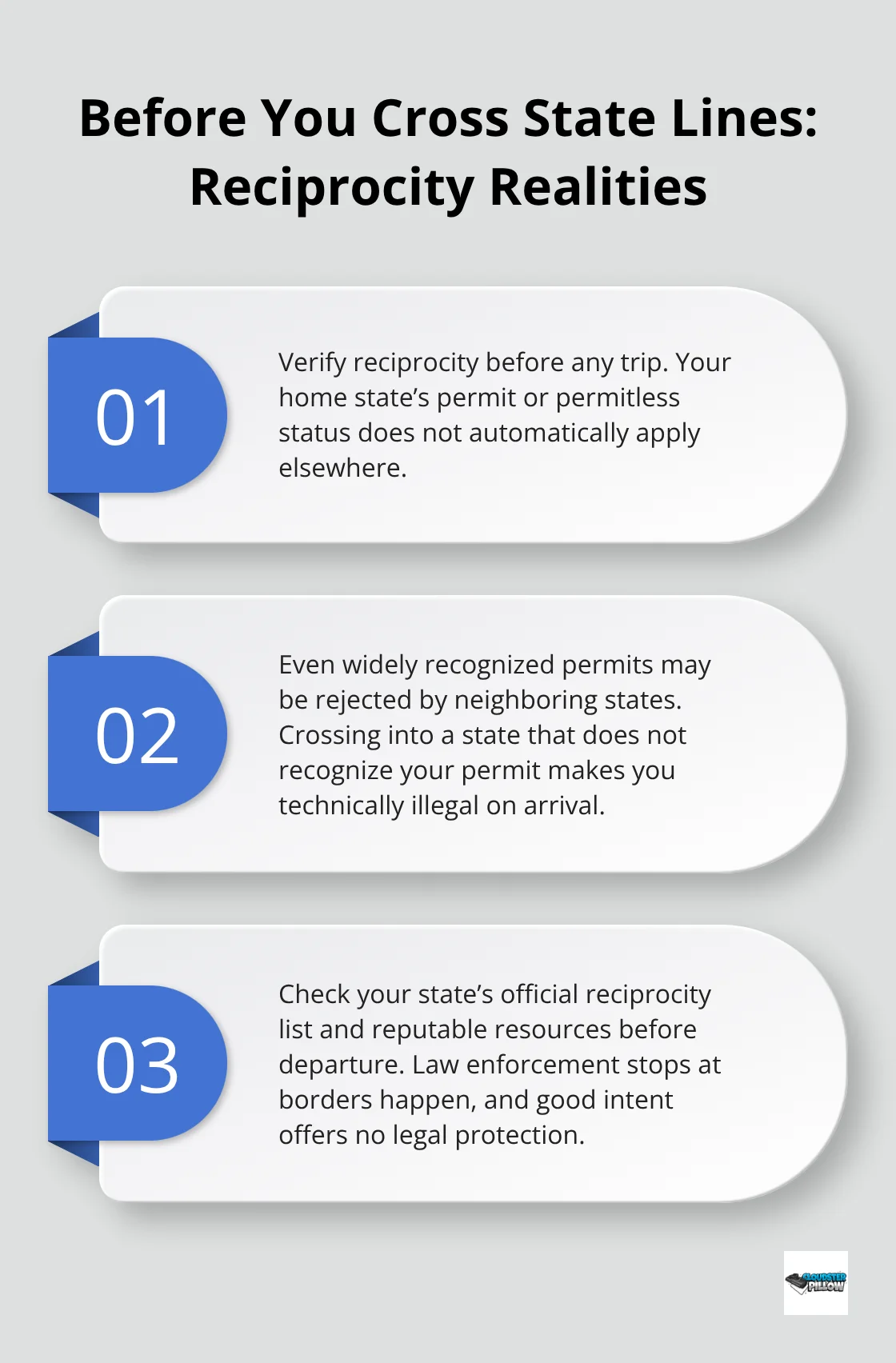
This is not theoretical: law enforcement officers stop carriers regularly at state lines, and ignorance of local law provides no legal protection.
Your best move is to download reciprocity information from your state’s licensing authority or consult resources like the Handgun Law website before any trip. If your destination state requires a permit you do not hold, you have two options: obtain a non-resident permit beforehand or leave your firearm secured at home. Non-resident permits exist in many states specifically for travelers-some cost $50 to $150 and require minimal additional training beyond what you have already completed.
Understand Workplace Carry Restrictions
Workplace carry laws create another layer of complexity that catches carriers off guard. Federal law prohibits firearms in federal buildings, and most employers have explicit bans on workplace carry regardless of state law. New York’s approach reflects this tension: even with a valid concealed carry license, you cannot bring a firearm into hospitals, schools, government offices, bars that serve alcohol, or most public transit systems. Your employer’s property restrictions trump your carry rights entirely-they can prohibit firearms on premises regardless of what your permit allows.
This means your daily carry routine might involve securing your firearm in your vehicle before work, then retrieving it afterward. Some carriers solve this by using off-body carry solutions during work hours or switching to ankle carry in vehicles, though these methods introduce their own risks. The safest approach is to treat your workplace as a no-carry zone and plan your gear setup accordingly.
Know Private Property Restrictions
Private businesses can post no-firearms signs and legally refuse you service if you are armed. Many carriers overlook this detail and face serious consequences. Before selecting your everyday carry setup, verify your workplace policy and primary destinations. If your job requires frequent travel between states with different rules, you need gear that adapts quickly-something that works with multiple carry positions without requiring a complete system change.
The complexity of state-by-state restrictions and workplace policies means your carry method must remain flexible. What works in one location may not work in another, and your equipment choices directly impact how easily you can adjust to these changing circumstances. That’s where the right holster solution makes all the difference-the Cloudster Pillow at https://cloudsterpillow.com/holster-wedge/ provides the comfort and concealment you need across any situation.
How Legal Shifts Shape Your Gear and Training Choices
State-to-State Legal Changes Force Equipment Adaptation
Legal fragmentation across states forces carriers to rethink their entire setup. When you move from a permitless state to one requiring specific training requirements, your carry method often needs to change too. Stricter states impose location restrictions that eliminate certain carry positions-ankle carry in a vehicle becomes risky if your workplace prohibits firearms but you drive through restricted zones. This reality means your holster and belt system must adapt without requiring a complete replacement.
Carriers who invest in flexible solutions avoid the frustration of buying new gear every time they relocate or travel. Your equipment choices directly impact how easily you adjust to these changing circumstances across different legal environments.
Training Standards Vary Dramatically Across Jurisdictions
The USCCA reports over 1 million students trained nationwide in concealed carry education, reflecting how seriously carriers treat preparation across different legal environments. Training standards vary so dramatically that a carrier with certification in one state might face legal exposure in a permitless state where no formal training is legally required-yet that same carrier would be underprepared for stricter states’ street-level realities.
This mismatch means you need training that goes beyond your state’s minimum requirements. Research on permit requirements and gun assault correlation found that states adopting shall-issue CCW laws saw an overall increase in rates of assault with a gun, which tells you that legal standards directly correlate with community safety outcomes. Your training choices matter not just for legal compliance but for the judgment and muscle memory you develop.
Community Adoption Lags Behind Legal Changes
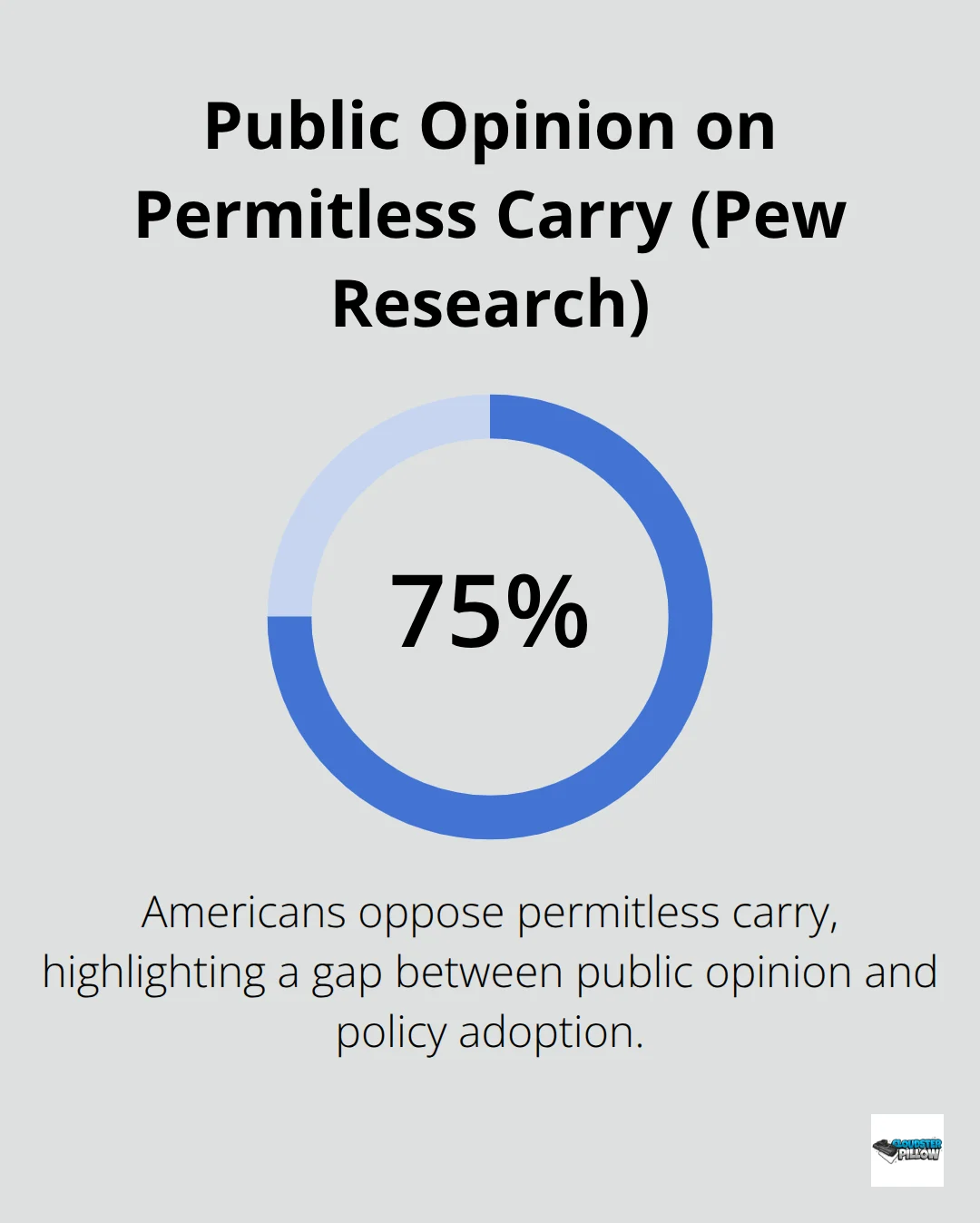
Community adoption of new legal frameworks depends entirely on whether carriers feel confident navigating them. Pew Research Center data shows three in four Americans oppose permitless carry, yet 29 states have already adopted it-this disconnect means legal changes happen faster than public consensus catches up.
Carriers in transition zones between strict and permissive states face the most uncertainty, and they need gear that performs reliably across multiple carry positions and climates without constant adjustment. Comfort directly impacts consistency, and consistency prevents the mistakes that create legal exposure.
Comfort and Consistency Drive Reliable Carry Performance
Your gear should support your training and legal compliance, not complicate either one. Everyday carriers told us they needed comfort across AIWB and IWB positions without replacing their entire holster system. The right equipment helps you maintain confidence and readiness no matter which state’s laws you navigate, allowing you to focus on what matters-your training, mindset, and daily preparedness. That’s exactly why the Cloudster Pillow holster wedge has become essential for so many carriers: it delivers the comfort and concealment you need to stay consistent with your carry routine, regardless of legal changes or travel across state lines. Discover how the Cloudster Pillow can enhance your setup today.
Final Thoughts
Concealed carry legality updates happen constantly, and staying current with them protects both your freedom and your safety. The shift toward federal reciprocity through the Constitutional Concealed Carry Reciprocity Act signals real change ahead, but until it passes, you remain responsible for understanding your state’s rules and any state you travel through. The patchwork of 29 permitless states and 21 permit-required states creates genuine complexity that demands your attention before you carry across borders or relocate.
Your training should exceed your state’s minimum requirements because legal standards vary so dramatically that what satisfies one jurisdiction leaves you underprepared for another. The USCCA’s 1 million trained carriers nationwide show that serious preparation is the norm, not the exception. Your mindset and muscle memory matter far more than owning the latest equipment, and comfort drives consistency while consistency prevents the mistakes that create legal exposure.
We at Cloudster Pillow designed our holster wedge specifically for carriers navigating this complexity, helping you maintain comfort and concealment across different carry positions and legal environments. Your carry setup should feel natural and reliable, allowing you to focus on what truly matters-your training, mindset, and readiness. Explore how the Cloudster Pillow holster wedge can enhance your everyday carry experience.