
EDC Gear
EDC Tray Gun Holder Tips: Keep Your Firearm Accessible and Secure
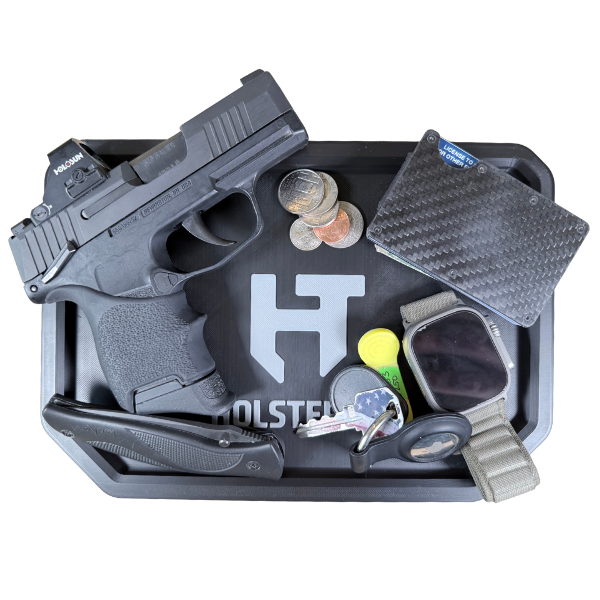
Comfort On-Body. Order Off-Body.
A dialed edc tray with gun holder keeps your nightstand staging consistent. The Cloudster Pillow holster wedge keeps your on-body carry comfortable—so your routine stays reliable from the first clip-on to the last pocket dump.
Every night, thousands of people do the same thing without even thinking about it: belt comes off, pockets empty, and gear lands on the nearest flat surface. That “pocket dump” can be harmless when it’s just keys and a wallet—but when a firearm is part of your daily routine, a messy pile turns into a reliability problem. Loose items can scratch finishes, migrate into the wrong places, snag cables, or simply vanish under yesterday’s receipts. Worst of all, clutter encourages inconsistent handling—exactly what you don’t want when you’re tired, distracted, or half awake.
That’s why an edc tray with gun holder has become a popular upgrade for organized citizens who want their nighttime staging to be repeatable, calm, and deliberate. The goal is simple: give every essential item a dedicated home so you can find it fast, protect your gear, and reduce the “fumble factor” that comes with rummaging through a pile in the dark.
In this guide, you’ll get practical, real-world tips for setting up an edc tray with gun holder so it supports both accessibility and responsible habits. We’ll cover vertical orientation, “safety wall” placement, compartment strategy, cable management, stability, and how to build a two-minute reset routine you’ll actually follow. We’ll also address the most important truth upfront: a tray improves organization, but it does not replace secure storage when access control is needed.
Organization vs. Security: The Rule That Keeps You Honest
Before we talk about speed, talk about responsibility. An edc tray with gun holder is an organizational tool. It is not a safe. It is not childproof. It does not prevent unauthorized access. If you have children, frequent guests, roommates, or any possibility of unauthorized access to your staging area, secure storage should be part of your plan.
A good mental model is the “Safety Station” concept:
- Tray: builds repeatable placement and reduces clutter.
- Secure storage: controls access when needed.
- Routine: keeps handling consistent and minimizes mistakes.
If you want reputable, widely recognized safe-storage guidance, start with Project ChildSafe and the NSSF safety resources. These emphasize preventing unauthorized access and building consistent safety habits at home. Your organization tools should support those habits—not replace them.
Tip 1: Prioritize Vertical Orientation for Speed
The biggest advantage of an edc tray with gun holder compared to a flat dish is orientation. A flat object on a flat surface can rotate, slide, or end up partially blocked by other items. When the room is dark and your brain is groggy, searching becomes the enemy.
A holder feature—often a brass post, polymer post, or a notched cradle—keeps the grip in a repeatable “ready position.” Instead of pinching and lifting from a slippery surface, your hand goes to the same place every time. That repeatability is what reduces the fumble factor.
- The tip: choose a design that keeps the grip upright and consistent.
- The benefit: your hand finds the same index point without “digging” under a flat object.
- The habit: fewer unnecessary touches, less noise, less shifting.
In the broader EDC world, consistency beats complexity. You see that same principle in gear staging, belt setups, and daily checklists. Practical carry education hubs like Lucky Gunner Lounge frequently stress that simple, repeatable habits matter more than fancy accessories.
Tip 2: Use “Safety Wall” Placement to Reinforce Good Habits
A tray doesn’t just hold objects—it builds a ritual. And rituals should reinforce safe habits automatically. When setting up your edc tray with gun holder, think about where the tray sits and how the staged orientation relates to your space.
A common approach is “safety wall” placement:
- Position your staging area so the selected orientation is toward an exterior wall or a direction you’ve intentionally chosen as safer.
- Keep the immediate zone clear of clutter that can shift or interfere—especially cables, loose change, and small objects that migrate.
The point is to remove variables. Variables create surprises. Surprises create sloppy handling. Your tray should help you stay consistent, not tempt you into treating a messy nightstand like a storage bin.
Tip 3: Separate “Clean” and “Dirty” Gear
Your keys and knife are “dirty” items. They carry pocket lint, grit, and sharp edges. Your phone, watch, and staged essentials are “clean” items you want protected. An edc tray with gun holder works best when it includes compartments—or when you create separation using an insert or a second small organizer.
A simple compartment logic:
- Dirty compartment: keys, coins, pocket knife, multi-tool.
- Clean compartment: phone, watch, earbuds, sunglasses.
- Dedicated holder zone: the area meant for the holder feature—kept clear of random clutter.
This separation protects finishes and reduces snag hazards. It also speeds your morning routine because you’re not digging through a mixed pile where everything touches everything. If you’ve ever pulled your phone up and found key scratches, you already understand why this matters.
Tip 4: Integrate Charging Cables Without Creating a Snag Hazard
Modern EDC is full of electronics: smartphone, smartwatch, earbuds, rechargeable flashlights. Nightstands become cable jungles fast. Cords can wrap around gear, drag items off the surface, or get snagged when you reach for something quickly.
That’s why pass-through holes and cable channels are a high-value feature in an edc tray with gun holder. They keep cables routed below or behind the staging surface so your “grab zone” stays clean.
- The tip: route cables the same way every night—no cords draped across the tray surface.
- The benefit: less clutter, fewer snags, and a cleaner, calmer nightstand.
- The outcome: faster access to essentials and fewer “oops” moments.
Tip 5: Choose Materials That Match Your Reality
Materials aren’t just about aesthetics. They affect noise, finish protection, stability, and daily satisfaction. The right edc tray with gun holder should feel good to use—because if it’s annoying, you’ll stop using it.
Leather or Leather-Lined Trays
Leather is popular for good reason: it’s quieter, softer on finishes, and tends to look better as it ages. Dropping keys into leather doesn’t create the sharp clank that echoes through the house. For nightstand use, leather or felt lining is often the best “house friendly” choice.
Wood Trays
Wood offers weight and stability. If the tray has felt lining, it can be a great blend of structure and protection. Wood also tends to stay put better than lightweight plastic.
Metal / Kydex Trays
Metal and Kydex can be rugged and easy to wipe clean, but they can be noisy and harsher on finishes if unlined. If you like the tactical look, consider a lined design so you get durability without the daily “clang.”
Tip 6: Stabilize the Tray (No Sliding, No Tipping)
A tray that slides will eventually frustrate you. If you grab keys quickly and the whole tray skids across the surface, you’ll spill items and break the habit. Stability is a usability feature.
Look for:
- Rubber feet
- A weighted base
- A broad footprint that resists tipping
If you already own a tray you like, adding small rubber pads or felt feet can make a huge difference. The goal is a stable platform that stays where you put it—even when you’re moving fast.
Tip 7: Follow the No-Stack Rule
Stacking is how a tray turns back into a pile. If keys_TRI are on top of your phone, you scratch the phone. If your knife is under your wallet, you slow down. If everything collapses into one corner, your “system” becomes clutter again.
A clean edc tray with gun holder setup follows one rule: every item touches the bottom surface. If you can’t do that, the solution is simple:
- Use a larger tray, or
- Use compartments (or add an insert) to keep items separated.
No-stack staging also boosts accountability. You can glance at the tray and instantly see if something is missing before you walk out the door.
Tip 8: Build a Two-Minute Reset Routine You’ll Actually Keep
The best systems are the ones you can follow when you’re exhausted. That’s why your staging routine should be quick—two minutes, max.
- Empty pockets into the tray using the same compartments every time.
- Plug in phone/watch/earbuds using the same cable routing.
- Do a quick visual check: keys, wallet, phone, light, knife—present.
That’s the whole ritual. If it takes longer, you’ll skip it. When it’s quick and repeatable, it becomes automatic—exactly what you want.
Why On-Body Comfort and Off-Body Order Work Together
Preparedness is a 24/7 cycle. During the day, comfort drives consistency. If your holster is uncomfortable, you’re more likely to remove it early, shift it constantly, or “take a day off” carrying because it’s annoying. Those habits break consistency and increase handling.
That’s where Cloudster Pillow fits the on-body side of the system. A holster wedge helps reduce holster dig, distribute pressure, and improve concealment mechanics—making carry “forgettable” in the best way. When you’re comfortable, you handle your setup less and stick to your routine more reliably.
When the day ends, an edc tray with gun holder supports the off-body side: organized staging, faster mornings, cleaner nightstands, fewer missing items. Together, comfort and organization remove friction from the whole day.
For broader carry mindset and training resources that emphasize consistent habits, responsibility, and preparedness, education platforms like USCCA offer articles and training guidance that aligns with the idea that systems and routines matter as much as gear.
Common Mistakes to Avoid
Mistake 1: Treating a Tray Like Secure Storage
A tray is for organization. If access control is needed, use secure storage and follow safe-storage guidance from reputable sources.
Mistake 2: Putting the Tray in a High-Clutter Zone
If your tray sits where mail, receipts, and random objects accumulate, it will get buried. Choose a clean surface and keep it clean.
Mistake 3: Letting Cables Take Over
Cables shouldn’t cross the staging surface. Route them intentionally or choose a tray with cable pass-throughs.
Mistake 4: Buying Too Small
If you’re stacking items or your phone doesn’t fit flat, you will abandon the system. Size the tray for your real loadout.
Frequently Asked Questions (FAQs)
1) Is an edc tray with gun holder better than a holster on the nightstand?
Many people prefer a holder because it maintains consistent grip orientation and reduces shifting. Your best setup should also consider secure storage needs in your household.
2) What material is best for an edc gun tray?
Leather or felt-lined trays are popular for quiet use and finish protection. Wood is also excellent for stability. Unlined metal can be loud and harder on gear finishes.
3) Can I use an edc tray gun setup with weapon lights or optics?
Some holder designs accommodate optics and lights, but compatibility varies. Prioritize stable placement and confirm fit with your specific configuration.
4) How do I make my staging more secure?
Use secure storage when appropriate (such as a rapid-access safe). An edc tray with gun holder improves organization but does not prevent unauthorized access.
5) Will a brass holder post damage my firearm?
Quality posts are designed to be gentle, but designs vary. Keep the contact area clean and free of grit, and inspect wear points over time.
6) Where is the best place to put an edc tray with gun holder?
Nightstands are common for nighttime staging; desks and entryway tables are common for daily “drop zones.” Always factor in access control and household safety.
7) Does a tray help me get ready faster in the morning?
Yes. It functions like a checklist. If a slot is empty, you notice before you leave the house.
8) Can I stage spare magazines in the tray?
Many trays include secondary slots for spare mags, flashlights, pens, or multi-tools. Aim for a no-stack layout so everything remains easy to grab.
9) How do I keep the tray from sliding?
Choose a tray with rubber feet or a weighted base, or add small pads underneath. Stability keeps the system reliable.
10) Can I travel with an edc tray with gun holder?
Many leather trays unsnap and pack flat, making them easy for travel. If you travel often, collapsible designs provide consistent staging in hotel rooms.
Related Cloudster Pillow Articles
- Dump Trays 101: The Secret to Effortless EDC Organization
- How an EDC Dump Tray with Gun Holder Keeps You Ready in Seconds
A well-set edc tray with gun holder isn’t about looking tactical—it’s about removing friction from your routine. Vertical orientation supports consistent grip placement. Compartments keep clean items protected from dirty items. Cable pass-throughs keep the grab zone clear. A stable base keeps everything in place. And when secure storage is handled responsibly, you get a nightstand system that’s calm, consistent, and dependable.
If you want the best results, treat staging the same way you treat carry: build a system you can repeat every day—without thinking.
Make Your Carry Rig “Forgettable”
Pair a clean edc tray with gun holder routine with all-day comfort from the Cloudster Pillow holster wedge. Comfort builds consistency—and consistency builds readiness.
::contentReference[oaicite:0]{index=0}
