
CCW Courses and Tips
Gun Ownership Legalities 2026: Your Essential Legal Checkpoints

Gun laws 2026 are shifting faster than ever, and staying compliant isn’t optional-it’s essential for responsible ownership. Federal requirements, state regulations, and local ordinances create a complex landscape that catches many gun owners off guard.
At Cloudster Pillow, we’ve put together this guide to help you navigate the legal checkpoints that matter most. Whether you’re a new carrier or seasoned owner, understanding these requirements protects both you and your rights.
Federal Gun Laws and What They Actually Mean for You
Understanding NICS Background Checks
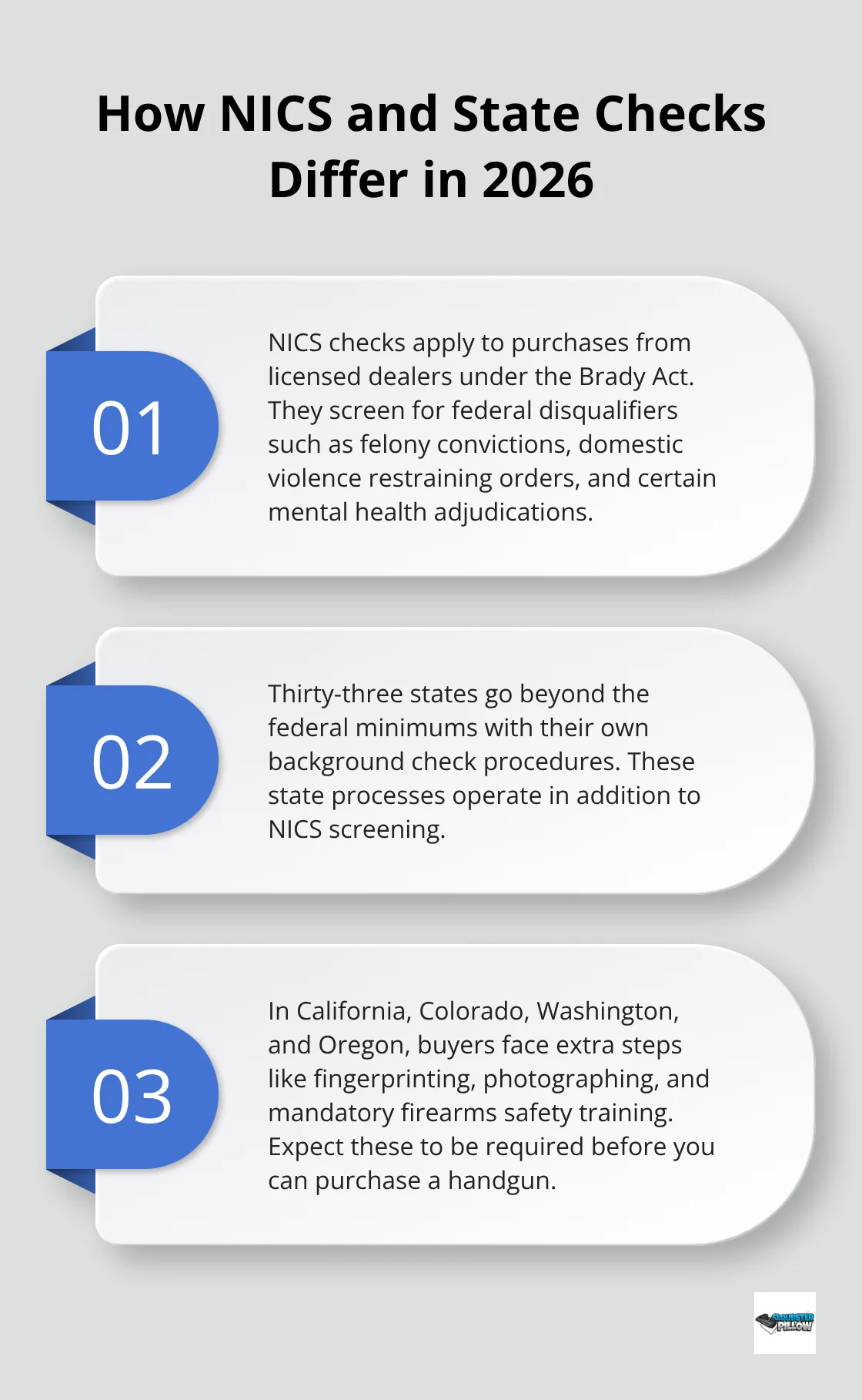
The Brady Act requires licensed firearms dealers to conduct background checks on all gun purchases. The National Instant Criminal Background Check System (NICS) screens against federal prohibitions like felony convictions, domestic violence restraining orders, and certain mental health adjudications. However, 33 states have gone beyond federal minimums with their own background check procedures according to the Giffords Gun Law Scorecard. California, Colorado, Washington, and Oregon now require additional state-level checks that include fingerprinting, photographing, and mandatory firearms safety training before you can purchase a handgun.
State-Level Requirements That Override Federal Standards
Washington state’s new permit-to-purchase system, effective in 2026, adds a five-year permit requirement with fingerprinting and certified training completion. You cannot buy a firearm without first proving training competency to state authorities. This differs fundamentally from federal NICS, which simply screens against disqualifiers. Oregon has eliminated private-sale exemptions entirely, so every firearm transfer must go through a licensed dealer with a state-issued permit-to-purchase. If you carry across state lines, understanding these variations matters because what qualifies you to own a firearm in one state might not in another.
Red Flag Laws Create New Legal Barriers
Red flag laws, formally called Extreme Risk Protection Orders (ERPOs), represent the fastest-growing legal checkpoint affecting gun owners in 2026. Twenty-one states plus D.C. now have functioning ERPO laws that allow law enforcement, medical professionals, or family members to petition courts to temporarily restrict firearm access for individuals deemed at imminent risk of harming themselves or others. Colorado’s HB 1098 takes this further by requiring real-time alerts to law enforcement when someone with an active domestic violence protection order attempts to purchase a firearm-creating an immediate legal barrier.
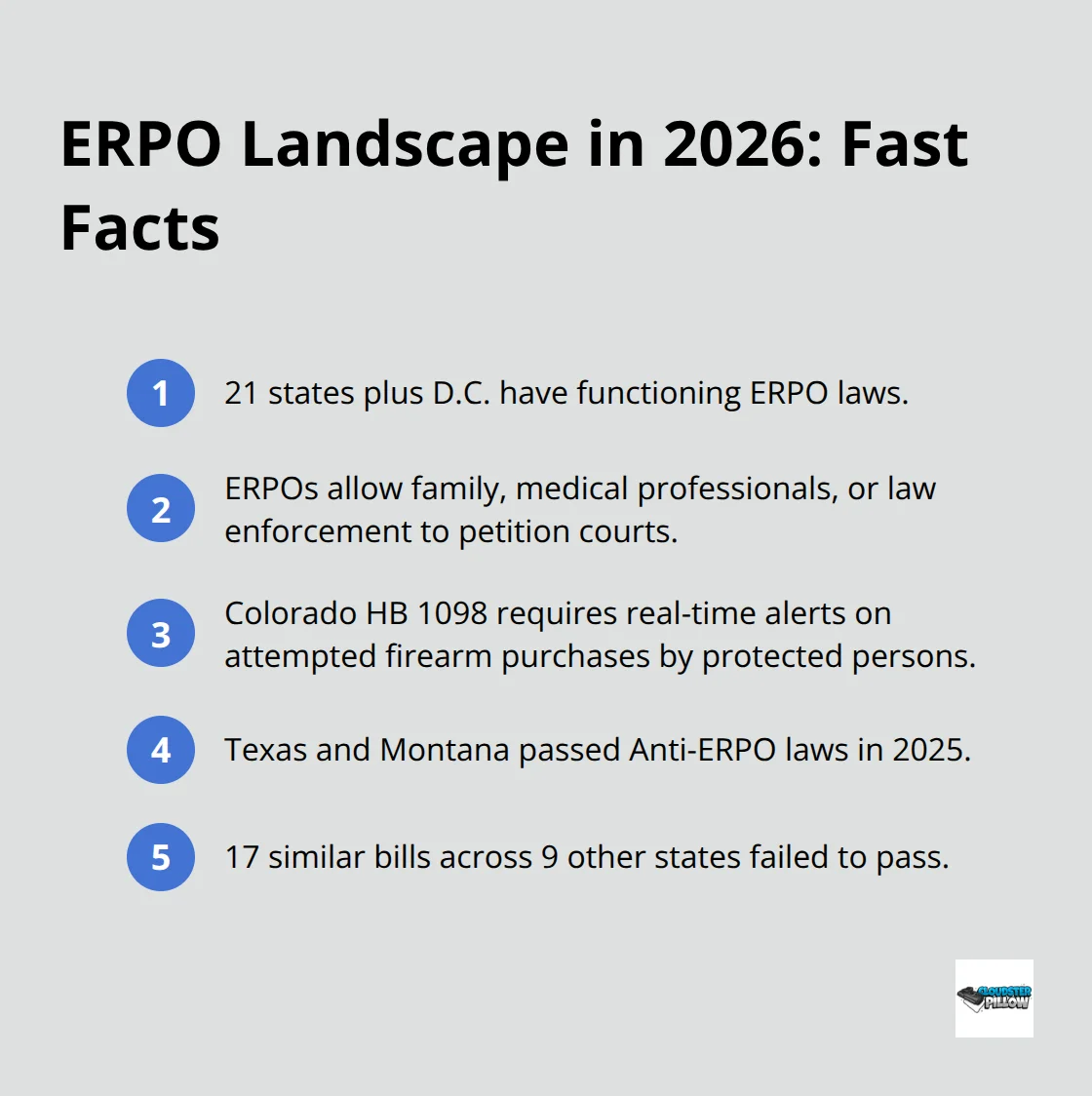
These orders are not convictions; they are civil proceedings with lower evidentiary standards than criminal trials. Texas and Montana passed Anti-ERPO laws in 2025 attempting to prohibit or limit these orders, but 17 similar bills across 9 other states failed to pass, indicating ERPOs are expanding despite opposition. The practical reality is that if someone close to you petitions for an ERPO, authorities can remove your firearms within days, and you will need to navigate a legal process to recover them.
Protecting Your Rights Against ERPO Petitions
For concealed carriers, understanding your state’s specific ERPO procedures matters significantly. Know who can petition against you and recognize that mental health treatment, substance abuse issues, or domestic disputes can trigger these orders. Staying informed about your state’s specific ERPO statute and maintaining clean records in domestic and mental health matters protects your ability to legally carry. Your state’s legal landscape continues to shift, which means the next checkpoint-understanding your state’s specific carry permit requirements and reciprocity rules-demands equal attention.
State-by-State Concealed Carry Permits and Requirements
How Your State Classifies Carry Authority
The permit landscape across America in 2026 splits into three distinct categories, and your state’s classification determines your legal ability to carry. Shall-issue states require law enforcement to issue concealed carry permits to any applicant who meets basic criteria like background checks and sometimes training completion. Constitutional carry states, also called permitless carry states, allow residents to carry concealed firearms without any permit at all. Discretionary-issue states grant authorities broad power to deny permits based on subjective factors like demonstrated need. Your state’s classification directly impacts your rights and responsibilities as a carrier.
Getting Your Permit: Timeline and Process Variations
If you live in a shall-issue state like Texas or Florida, you can expect to receive a permit within days after submitting your application and passing the background check. Washington’s new permit-to-purchase system adds a complication by requiring five-year permits specifically for purchasing, separate from carry permits, creating dual documentation requirements that many gun owners don’t anticipate. Tennessee lowered its concealed carry age to 18 in 2025, expanding who qualifies, while Iowa and Louisiana removed certain restrictions that previously blocked younger carriers. The practical takeaway is straightforward: verify your state’s current permitting status because changes happen frequently and missing a requirement can result in criminal charges even if you’re otherwise lawful.
Training Mandates That Affect Your Eligibility
Colorado, Washington, and Oregon now mandate certified firearms safety training completion before you can obtain a permit or purchase a handgun. Colorado requires an 8-hour concealed handgun training class taught by a verified firearms instructor, with new electronic verification systems tracking training status and eligibility data. Maintain your training certificates in digital and physical form, keeping them with your permits, and verify your specific state’s requirements annually since these rules change. Some states require proof of completion before purchase and some states require refresher training every few years.
Reciprocity Agreements and Interstate Carry
The Constitutional Concealed Carry Reciprocity Act introduced in January 2025 would create federal-level reciprocity allowing nonresidents with valid state licenses to carry concealed across state lines in states permitting resident carry, though it hasn’t become law yet as of October 2025. This proposed federal reciprocity matters because right now, your permit from one state may not be recognized in another, forcing you to either leave your firearm behind when traveling or face serious legal consequences. Multiple states currently have reciprocity agreements with other states, but these agreements vary widely in scope and recognition.
Protecting Yourself When Traveling Armed
If you carry across state lines regularly, you need a written list of which states recognize your home state’s permit and which don’t-relying on memory or assumptions creates unnecessary legal risk. Your training documentation also matters because some states now require proof of completion before purchase and some states require refresher training every few years. Understanding your state’s specific reciprocity rules and maintaining current documentation protects your ability to travel legally. The next checkpoint-storage laws and liability protection-creates equally important legal barriers that affect what happens when you’re not carrying your firearm.
Storage Laws and Liability Protection
Safe Storage Requirements Create Real Legal Consequences
Safe storage laws represent one of the fastest-expanding legal requirements for gun owners in 2026, and they directly impact your liability if someone else accesses your firearm. Safe storage laws mandate firearms remain secured when not in immediate possession; specific requirements vary dramatically by jurisdiction. California requires firearms to be stored with a locking device or in a locked container when not in immediate possession, while Colorado’s storage laws focus on preventing unauthorized access by minors and household members. These aren’t abstract legal requirements-they carry real consequences. If an unauthorized person accesses your unsecured firearm and causes harm, you face criminal negligent storage charges and civil lawsuits even if you didn’t pull the trigger. The legal standard is straightforward: you’re responsible for securing your firearm in a way that prevents unauthorized access.
Investing in Proper Storage Solutions
You need proper storage solutions like gun safes, locked cases, or cable locks if you live in a safe storage state. Many gun owners underestimate this liability because they assume storage laws only apply to households with children, but several states extend liability to any unauthorized access regardless of age. Your storage method must meet your state’s specific standards, which means reviewing your jurisdiction’s exact requirements before selecting a storage solution. Inadequate storage exposes you to both criminal prosecution and civil damages, making this one of the most consequential legal checkpoints for 2026.
Castle Doctrine Protects Your Right to Defend Your Home
Castle Doctrine protects your right to use force in your home without duty to retreat and certain public spaces. Thirty-eight states now have some form of Stand Your Ground law that presumes you have the right to use force if you reasonably believe you face imminent threat of death or serious bodily harm, without first attempting to escape. Your home receives the strongest legal protection under Castle Doctrine, which assumes you have a right to defend yourself and your family inside your residence. If an intruder enters your home and you use defensive force, you’re legally protected from prosecution in most jurisdictions as long as you weren’t the initial aggressor.
Understanding Your State’s Specific Legal Standards
Castle Doctrine protections vary significantly by state, and some states impose duty-to-retreat requirements in public spaces even if you have a valid concealed carry permit. The difference between Castle Doctrine protection and a duty-to-retreat requirement could determine whether you face criminal charges after a legitimate self-defense encounter. You should document your home security measures and maintain clear evidence of forced entry if you ever need to use defensive force. Know your state’s specific legal standard for what constitutes reasonable fear of imminent harm, since this definition directly affects your legal standing in a defensive situation.
Liability Protection Beyond Your Home
Some states extend liability protection to your vehicle and workplace, though these protections remain narrower than Castle Doctrine. You need to verify whether your state recognizes Stand Your Ground protections in your vehicle or at your place of employment, since these locations present different legal challenges than your residence. Understanding these distinctions prevents you from overestimating your legal protection in situations outside your home. Your state’s specific liability framework determines how much legal protection you actually have when you carry, making this knowledge essential for responsible ownership and daily carry decisions.
Final Thoughts
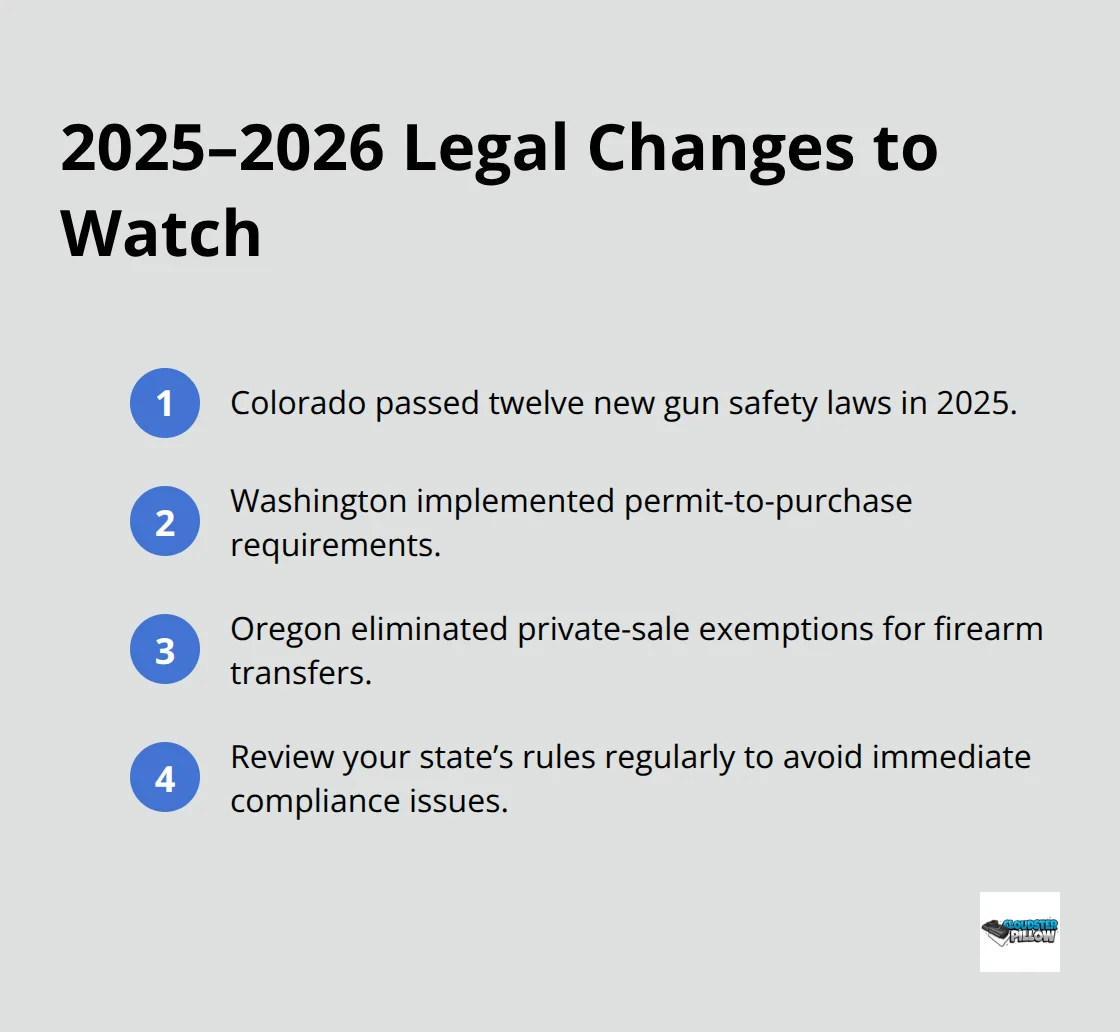
Gun laws 2026 shift constantly, and staying compliant requires active effort rather than passive hope. Colorado passed twelve new gun safety laws in 2025 alone, while Washington implemented permit-to-purchase requirements and Oregon eliminated private-sale exemptions-these changes happen fast and affect your rights immediately.
Document your state’s current permit requirements, training mandates, storage laws, and reciprocity agreements, then review this information annually or whenever you travel across state lines.
Contact your state’s attorney general office or firearms licensing authority directly for accurate guidance rather than relying on secondhand information or outdated sources. Organizations like the Giffords Law Center publish state-by-state legal summaries that track changes as they happen, providing reliable reference material you can trust. Set a calendar reminder to review your state’s gun laws annually and verify reciprocity before traveling to maintain compliance.
Comfort and confidence matter for daily carry, and proper gear combined with legal knowledge creates the foundation for responsible ownership. At Cloudster Pillow, we help concealed carriers achieve real comfort without replacing their entire holster system through our holster wedge solutions, ensuring you carry consistently and stay prepared when it matters most.

Pingback: The hidden shift in concealed-carry training heading into 2026 (and why it matters) - The Avid Outdoorsman