Home Defense
Home Defense Firearm Picks For Safe Home Protection
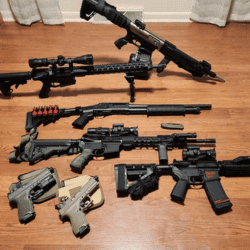
 Your home defense firearm picks matter more than you might think. The right weapon can mean the difference between a secure home and one left vulnerable to threats.
At Cloudster Pillow, we know that choosing the right firearm is only half the battle. You also need to understand reliability, local laws, and how to carry responsibly if you’re protecting your home and family.
Which Firearm Type Works Best for Home Defense
Shotguns: Stopping Power at Close Range
Shotguns dominate close-range home defense because they deliver stopping power without requiring precision aim. The Remington 870 pump-action and Mossberg 590 Shockwave remain industry standards with proven reliability across thousands of deployments. A 12-gauge shotgun with buckshot creates a wider hit zone at indoor distances, typically 7 to 15 yards, making follow-up accuracy less critical than with rifles or handguns. Recoil management improves with modern ammunition designed for home defense, and the psychological deterrent of chambering a round stops many threats before confrontation. However, shotguns require dedicated storage space and demand more training to master recoil control and reload speed compared to other platforms.
Rifles: Accuracy and Low Over-Penetration
Rifles like the AR-15 and Ruger PC Carbine offer superior accuracy and faster follow-up shots than shotguns, with low recoil that lets you stay on target during high-stress situations. The FBI and numerous law enforcement agencies favor rifle platforms for their velocity, capacity, and customization options. Modern home defense rifles use ammunition designed to reduce over-penetration, addressing a legitimate concern about bullets passing through walls. Rifles excel when you have space to maneuver and time to access them from a safe location.
Handguns: Speed and Accessibility
Handguns like the Glock 19 Gen 5, Walther PDP 5-inch, and Smith & Wesson M&P9 M2.0 remain the fastest option for nighttime response because they stay accessible in bedside safes or quick-access storage. The Glock 19 Gen 5 costs around $620 with 15+1 capacity, while budget options like the Canik METE SFT One run $280–$350 with the same 18+1 magazine capacity and an outstanding trigger. Handguns excel for families with multiple defenders since they’re easier to operate under stress, though they demand more accurate shot placement than shotguns. If you carry daily for personal protection, selecting a home defense handgun that matches your concealed carry gun simplifies training and muscle memory.
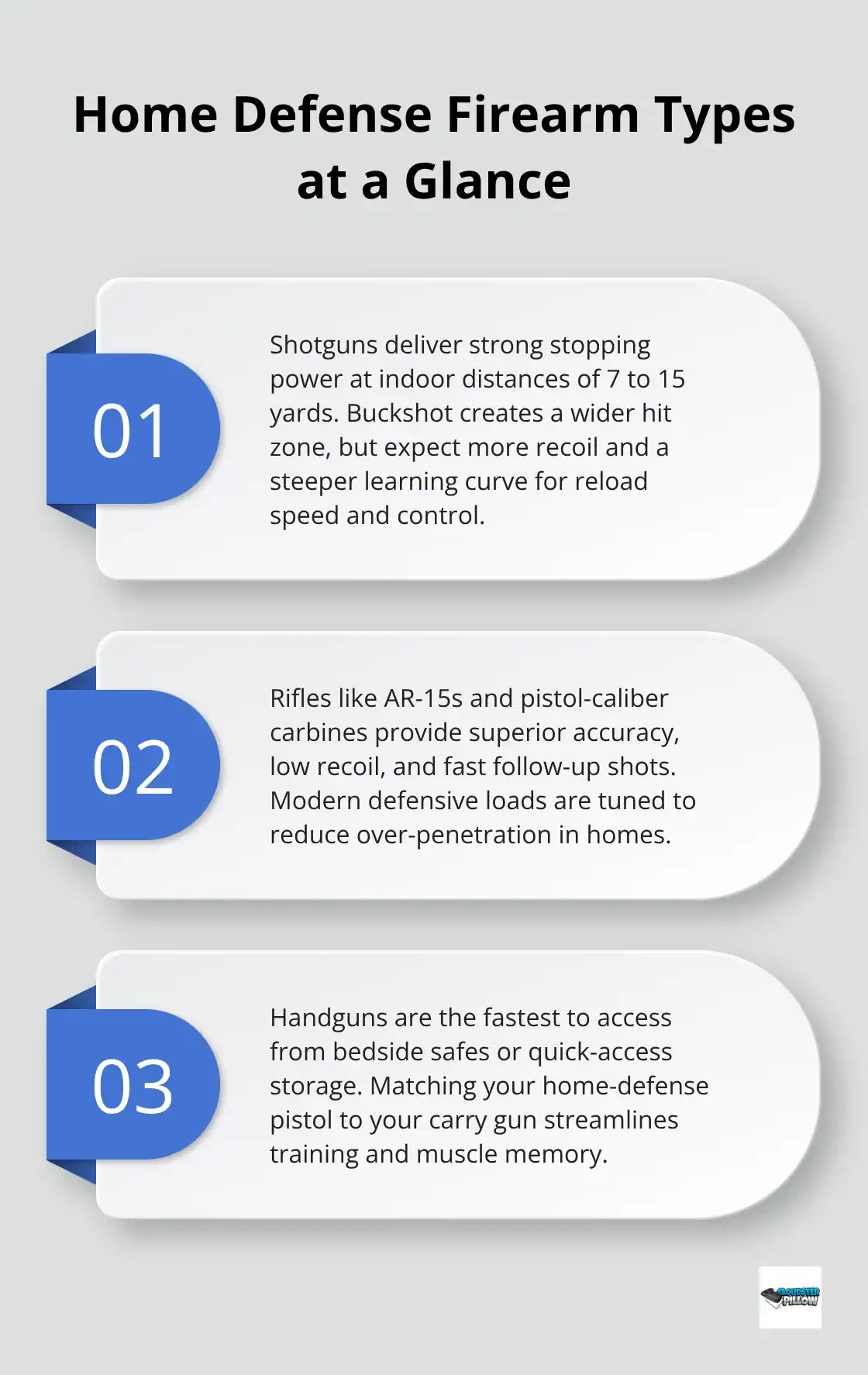
Comfort solutions enhance both everyday carry and bedside readiness without replacing your entire setup, allowing you to maintain consistency across your defense strategy.
What Makes a Home Defense Firearm Actually Reliable
Testing Standards Separate Proven Platforms from Unproven Ones
Reliability trumps everything else when selecting a home defense firearm, and the data backs this up. Law enforcement agencies test firearms with thousands of rounds before adoption-the FBI runs 2,500+ rounds through each candidate pistol during evaluation, and the same rigor applies to shotguns and rifles used by tactical teams. A firearm that fails even once during a home invasion creates a life-threatening liability. The Glock platform maintains a documented failure rate below 0.5% across millions of rounds fired, while the Remington 870 pump-action shotgun has logged over a century of consistent performance across millions of units.
When evaluating a home defense option, prioritize firearms with proven track records over newer models chasing trendy features. Test-fire any candidate weapon if possible-shoot at least 50 rounds through it to confirm feeding, ejection, and sight alignment before committing to storage.
Recoil Control Determines Your Ability to Place Follow-Up Shots
Recoil management directly impacts your ability to place follow-up shots under extreme stress, and this matters far more than raw stopping power. A 12-gauge shotgun with low-recoil buckshot reduces felt recoil compared to full-power loads while maintaining stopping effectiveness at typical home defense ranges. The AR-15 platform produces minimal recoil due to its direct impingement system, allowing faster target reacquisition than a shotgun or handgun-critical when multiple threats exist.
The 9mm cartridge dominates police departments nationwide because it delivers adequate stopping power with controllable recoil, higher magazine capacity, and cheaper training ammunition than .45 ACP or .40 S&W.
Ammunition Selection Prevents Over-Penetration Risks
Over-penetration concerns are legitimate in homes with family members in adjacent rooms, so select ammunition designed to expand and fragment on impact rather than pass through walls. Federal HST and Speer Gold Dot hollow-points are industry standards because ballistic testing confirms they stop threats while minimizing wall penetration.
If you carry concealed daily, selecting a home defense handgun that matches your carry gun eliminates the burden of learning multiple platforms under pressure. Comfort solutions enhance both your everyday carry setup and your bedside readiness, allowing you to maintain muscle memory and confidence across every defensive scenario. This consistency matters when you transition between your daily carry holster and your bedside storage-your body responds faster to familiar equipment under stress, and that familiarity extends to how your gear fits and feels throughout the day.
Legal Considerations and Safe Storage
Your home defense firearm is legal in your state, but that doesn’t mean every storage method or carry option complies with local regulations. At least 31 states recognize no duty to retreat when you’re lawfully present in your home, which fundamentally changes how self-defense laws protect you. Florida’s 2005 stand-your-ground law explicitly allows deadly force if you reasonably believe it’s necessary to defend against imminent unlawful force in your dwelling. However, New Jersey and Rhode Island restrict this protection to your home only-stepping outside eliminates your legal shield. Eight additional states including California, Colorado, and Virginia permit deadly force through judicial decisions rather than statute, creating gray areas that demand research before you act. The three elements that justify deadly force everywhere are proportionality (you face deadly force), necessity (deadly force prevents death or great bodily harm), and reasonable belief (a reasonable person would think force was needed).
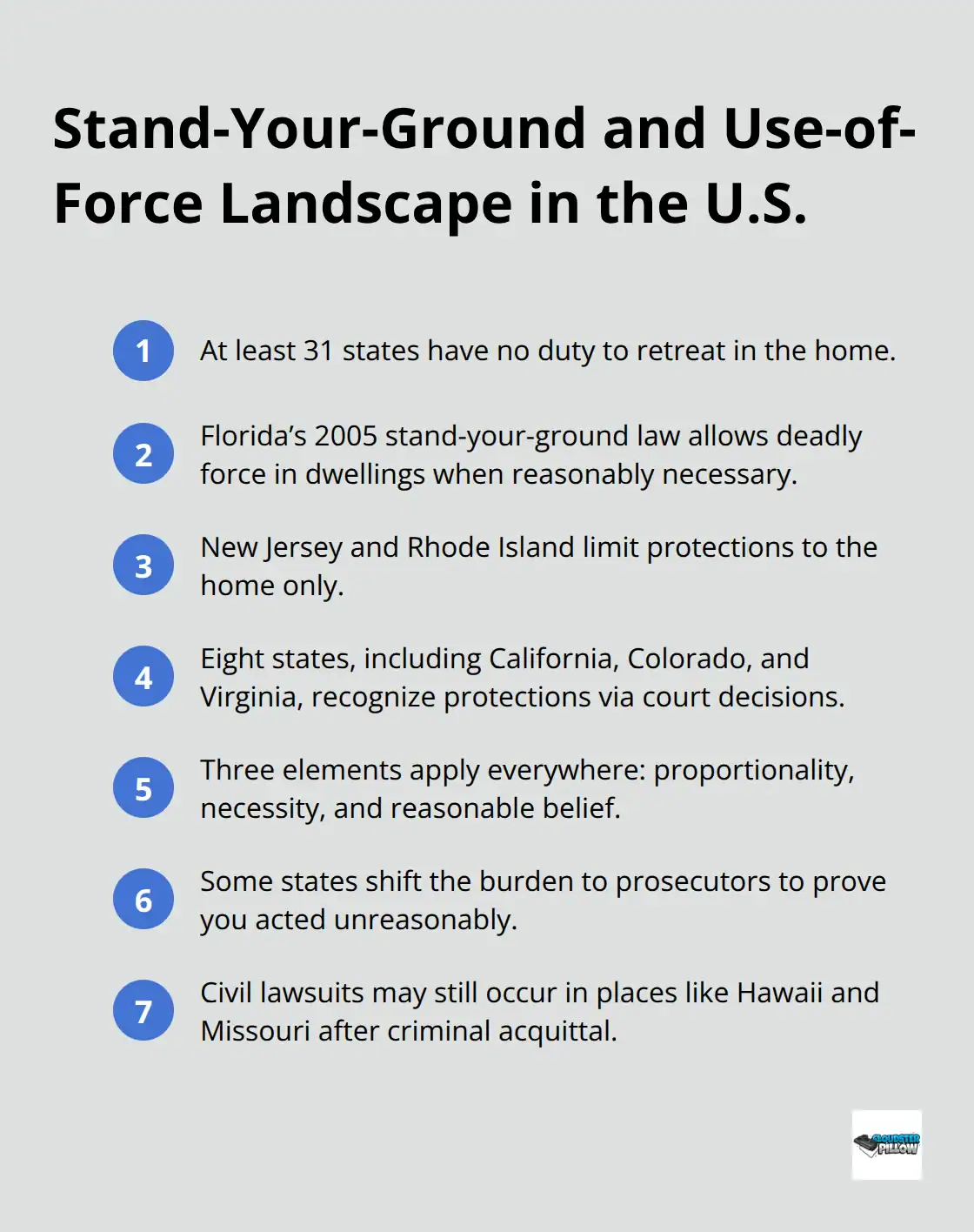
Some states like Arizona, Florida, and Kansas have shifted the burden to prosecutors to prove you acted unreasonably, while others like Hawaii and Missouri still allow civil lawsuits even when you’re acquitted criminally. This legal landscape changes how you train, store your firearm, and respond to threats-ignorance costs you everything.
Quick-Access Safes Prevent Unauthorized Access
Quick-access bedside safes are non-negotiable if you live with children, roommates, or guests. The safe must open in under five seconds when you’re alert but stay locked against casual access. Biometric safes from reputable manufacturers like Fort Knox or Hornady cost $200–$400 and have documented response times under three seconds, making them faster than fumbling with keys or remembering combinations during an adrenaline spike. Store your firearm with a round chambered for home defense readiness, which means your safe must absolutely prevent unauthorized handling.
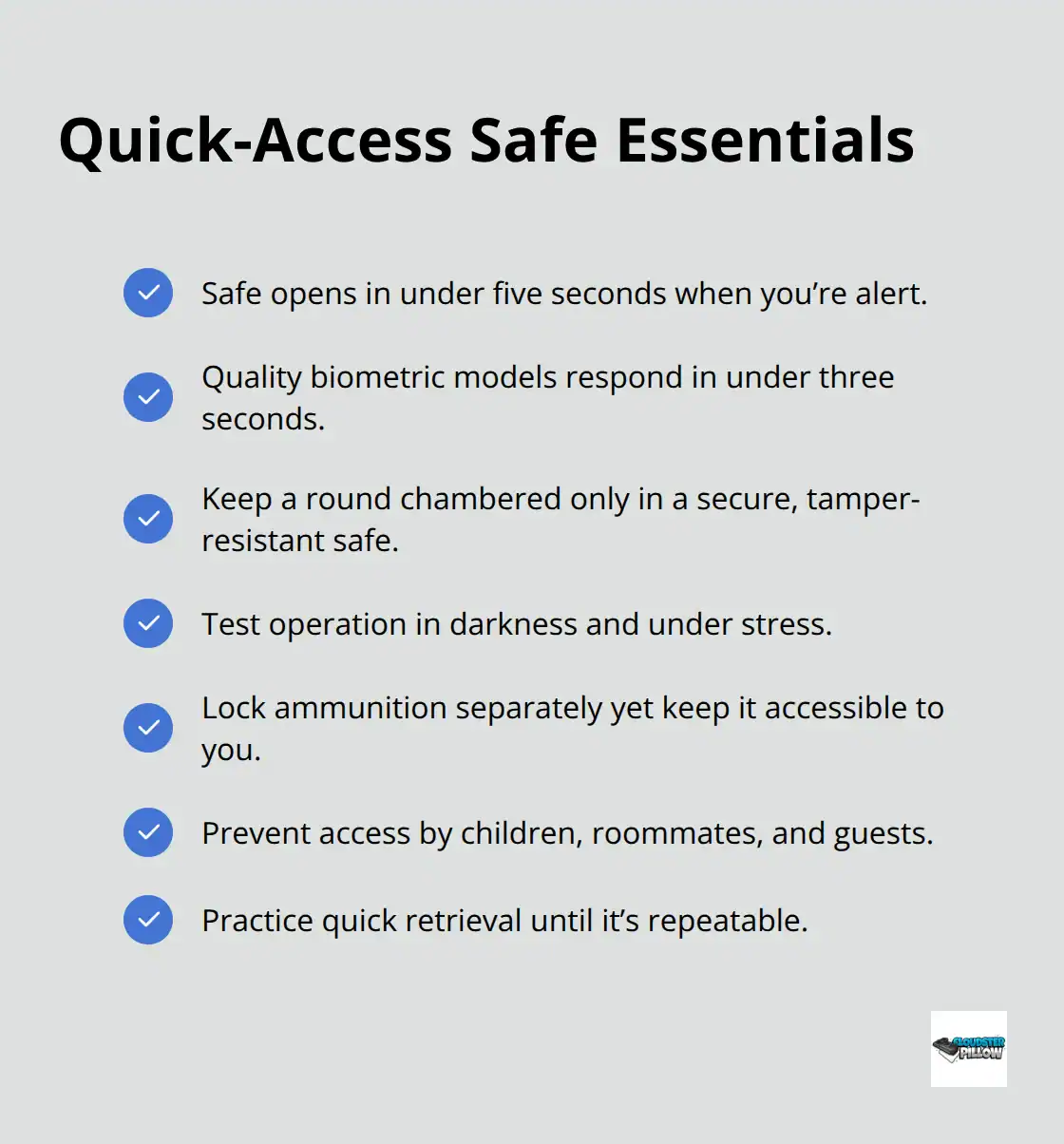
Test your safe repeatedly in darkness and under stress to confirm you can operate it reliably before an actual threat appears. Keep your ammunition in a separate locked container away from children but accessible to you-the CDC reports that firearms used in unintentional injury deaths were often stored loaded and unlocked, creating preventable tragedy.
Match Your Bedside Firearm to Your Carry Gun
If you carry concealed daily, your bedside firearm should be the same model you carry-muscle memory matters when you’re half-asleep and disoriented. Your body responds faster to familiar equipment under stress, and that familiarity extends to how your gear fits and feels throughout the day. This consistency matters when you transition between your daily carry holster and your bedside storage-your hands know exactly where the controls are and how the trigger breaks. Carrying the same firearm for both daily protection and home defense eliminates the burden of learning multiple platforms under pressure.
Certified Training Separates Confidence From Liability
The USCCA has trained over one million students in concealed carry and home defense, and their data shows that trained carriers make faster, more accurate decisions than untrained ones. Your state’s concealed carry permit requirements often demand a basic safety course, but that four-hour class covers legal minimums, not practical readiness. Seek certified instruction that covers low-light shooting, movement through your home layout, and what to do immediately after firing in self-defense. The psychology of violent encounters matters as much as marksmanship-your body’s stress response under threat differs completely from range shooting, and training that ignores this gap leaves you unprepared. Federal HST ammunition performs differently in ballistic gelatin than it does through drywall and furniture, so understand your home’s actual ballistic environment rather than assuming range data applies. Practice dry-fire drills monthly in your bedroom with your specific firearm, safe, and lighting conditions to build muscle memory that survives adrenaline dump. Document your training dates and instructors in case you ever need to justify your actions legally-prosecutors scrutinize whether you acted reasonably, and formal training demonstrates responsible ownership.
Final Thoughts
Your home defense firearm picks determine how quickly you respond to threats and whether your family stays protected when it matters most. The Glock 19 Gen 5, Remington 870, and AR-15 platforms represent proven reliability across millions of deployments, but the best firearm is the one you’ll actually train with and maintain responsibly. None of these choices matter if you skip training, because shotguns deliver stopping power at close range without demanding precision aim, rifles offer superior accuracy and faster follow-up shots with manageable recoil, and handguns provide the fastest access from bedside safes when seconds count.
The USCCA has trained over one million students in home defense, and their data confirms that trained carriers make faster, more accurate decisions under stress than untrained ones. Seek certified instruction that covers low-light shooting, movement through your actual home layout, and what to do immediately after firing in self-defense. Practice dry-fire drills monthly with your specific firearm and bedside safe to build muscle memory that survives adrenaline, and document your training dates because prosecutors scrutinize whether you acted reasonably.
Start your home protection plan by selecting a firearm that fits your hand comfortably and matches your daily carry gun if you’re a concealed carrier. Store it in a quick-access safe that opens in under five seconds, and invest in certified training before you ever need it. A holster wedge designed for everyday carriers enhances comfort during all-day carry while improving concealment, allowing you to maintain the muscle memory and confidence that transfers directly to your home defense readiness.