
CCW Training
Mace Pepper Spray Use: Everyday Nonlethal Defense Considerations
Mace pepper spray remains one of the most accessible nonlethal defense tools available to everyday carriers. Whether you’re new to self-defense or expanding your protection strategy, understanding the legal landscape and practical application of pepper spray is essential.
At Cloudster Pillow, we believe that informed carriers make safer choices. This guide covers what you need to know about carrying pepper spray responsibly and effectively.
Know Your State’s Pepper Spray Laws Before You Carry
Pepper Spray Legality Varies Dramatically Across States
Pepper spray is legal in all 50 states, but that blanket legality masks a patchwork of restrictions that vary dramatically by location. The NRA and USCCA emphasize that carriers must verify their specific state and local laws before purchasing or carrying, because what’s legal in one state can be illegal in another. California caps canisters at 2.5 ounces and prohibits possession by minors and felons. Florida limits you to 2 ounces, while Hawaii bans online sales entirely and restricts canisters to just 0.5 ounces, making it nearly impossible to carry meaningful protection.
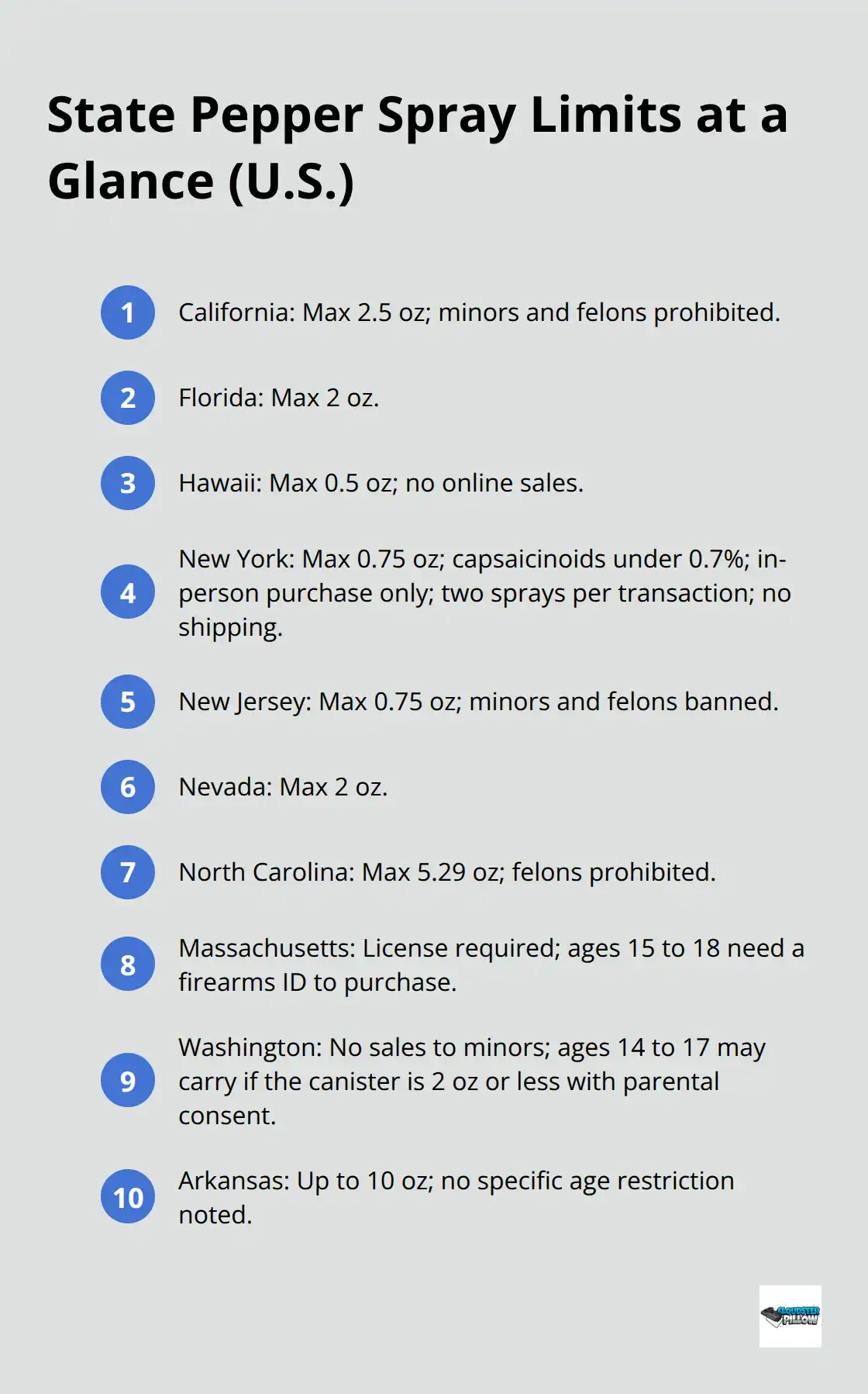
New York imposes some of the strictest rules in the nation: canisters cannot exceed 0.75 ounces and capsaicinoids must stay below 0.7%, you can only purchase in person from licensed firearms dealers or pharmacists, and you’re limited to two sprays per transaction with no shipping allowed. New Jersey restricts canisters to 0.75 ounces and bans possession by minors and felons entirely. Michigan requires the SABRE RED formula specifically; SABRE 3-in-1 is not legal there. Nevada caps canisters at 2 ounces, meaning SABRE 3-in-1 over 2 ounces is prohibited.
Age Requirements and Purchase Restrictions
Age requirements shift constantly across jurisdictions. Many states allow carriers at 14 years old, but some require you to be 18, and a few demand parental permission for minors. Delaware requires guardian permission for anyone under 18, while Minnesota prohibits possession by anyone under 16 without written guardian approval. Illinois, Maryland, and Rhode Island restrict sales to minors completely. Massachusetts requires a license to carry or sell pepper spray, and ages 15 to 18 need a firearms ID to purchase. Washington bans sales to minors outright, though ages 14 to 17 can carry with parental consent if the canister doesn’t exceed 2 ounces. Arkansas allows canisters up to 10 ounces with no specific age restriction mentioned, giving carriers more capacity than most states.
How Self-Defense Laws Affect Your Pepper Spray Use
Self-defense laws themselves vary significantly. Some states recognize pepper spray use as justified self-defense only when you face an imminent threat of bodily harm, while others have broader protections. The USCCA notes that your state’s duty-to-retreat standard or stand-your-ground principle affects how legally defensible your pepper spray use becomes. If you travel between states regularly, research each jurisdiction’s rules independently rather than assuming reciprocity.
North Carolina restricts canisters to 5.29 ounces and prohibits possession by felons. Check your state’s official resources or the manufacturer’s guidance before you buy, because laws change frequently and penalties for carrying illegally can include fines or criminal charges. Carriers who take time to understand these specifics avoid legal complications and carry with genuine confidence-which sets the stage for understanding how to actually deploy pepper spray effectively when it matters most.
How Pepper Spray Actually Stops an Attacker
Oleoresin capsicum, the active ingredient in pepper spray, doesn’t work the way most people think. It’s not just pain-neurogenic inflammation caused by capsaicinoid is the major pathophysiology at work. When pepper spray contacts an attacker’s face, it causes immediate eye capillary dilation leading to temporary blindness, swelling of mucous membranes in the throat and nasal passages, coughing, choking, and nausea. The oil-based nature of OC spray means it lasts significantly longer than tear gas and is harder to wash off, making it more reliably effective on attackers under the influence of drugs or alcohol-a scenario where older CN mace formulations often failed completely.
The concentration matters tremendously here. Most defensive sprays contain between 0.18 percent and 1.33 percent major capsaicinoids, though some premium brands push higher. Higher concentrations mean faster onset and more severe effects, so you should avoid bargain-basement options when your safety depends on reliability.
Distance and Accuracy Determine Real-World Effectiveness
Real-world testing shows spray range varies wildly depending on the product and pattern. Fox Labs 5.3 Keychain reaches 10 feet, Sabre 3-in-1 reaches 10 feet, Mace Police reaches 12 feet, Sabre Dog reaches 15 feet, and Mace Pepper Gun 2.0 stretches to 20 feet.

Stream patterns offer superior accuracy and distance compared to fog patterns, which cover broader areas but suffer from wind blowback and potential inhalation by the user. The USCCA emphasizes adopting a defensive stance when you deploy-step back to increase distance, lower your center of gravity, keep both hands elevated, and try the attacker’s face with one to two second bursts while fanning the spray to account for wind conditions. After deployment, don’t stand frozen; create noise to attract witnesses and use those critical seconds to move toward safety.
Muscle Memory Beats Raw Potency Every Time
Most pepper spray accidents happen because carriers never practiced before carrying live product. You should test your specific canister’s spray pattern, recoil, and safety mechanism in an open area where wind won’t blow spray back toward you or bystanders. Expired canisters make excellent training tools-they remain pressurized but contain inert contents, so you can practice draw speed, aim, and safety disengagement without risk. Wear long sleeves, goggles, and gloves during live testing. Some manufacturers offer training packs that include instructional materials plus one inert practice spray and one active spray, giving you structured guidance before you rely on the tool for actual defense.
This hands-on approach reveals whether your carry method allows fast access, whether the safety disengages smoothly under stress, and whether you can actually aim the device effectively. Carriers who skip training often discover too late that their chosen canister doesn’t fit their hand well or that wind conditions completely change the spray’s effectiveness. The investment in training reduces legal liability, builds genuine confidence rather than false confidence, and ensures your pepper spray actually works when you need it instead of becoming a liability you didn’t understand. With proper training complete, you’re ready to explore how pepper spray fits into your broader self-defense strategy alongside other nonlethal tools and your everyday carry setup. Consider pairing your less-lethal options with a comfortable carry method-the Cloudster Pillow holster wedge enhances both comfort and concealment for all-day carry confidence.
Pepper Spray Outperforms Tasers for Most Everyday Carriers
Tasers and stun devices occupy a fundamentally different role in nonlethal defense compared to pepper spray, and the differences matter far more than marketing suggests. A Taser X2 costs between 400 and 500 dollars and requires direct contact or successful probe deployment from 15 to 30 feet away. If your aim falters under stress or your probes miss, you’ve expended your tool with no backup. Stun devices demand you make contact with an attacker’s body, closing the distance precisely when you want maximum separation. Pepper spray costs 15 to 40 dollars for quality brands like SABRE or Fox Labs, requires no aiming precision beyond the general direction of a face, and works from 10 to 20 feet depending on your chosen product.
The price difference alone means you can afford multiple canisters for your car, purse, nightstand, and gym bag without financial strain. USCCA data shows pepper spray remains the most popular nonlethal everyday carry option specifically because it delivers distance, low cost, and reliability without the training complexity or single-use limitation of electrical devices.
Pepper Spray Succeeds Where Electrical Devices Fail
Tasers and stun guns both rely on muscular incapacitation through electrical current, and this mechanism breaks down catastrophically against certain attackers. An individual under the influence of drugs or alcohol often shrugs off electrical stimulation that would incapacitate a sober person. Pepper spray’s inflammatory mechanism bypasses this problem entirely. The capsaicinoid attacks mucous membranes and causes eye capillary dilation regardless of intoxication level, making it far more reliable on substance-impaired attackers.
Someone wearing thick winter clothing, multiple layers, or a heavy jacket can shield themselves from stun gun contact, but pepper spray reaches the face and exposed skin with equal effectiveness. Electrical devices also fail against attackers with certain cardiac conditions or pacemakers, creating liability concerns that don’t exist with chemical irritants. Pepper spray’s oil-based formulation provides longer-lasting effects than tear gas alternatives, and this durability translates to more reliable incapacitation during the chaotic seconds when you’re escaping.
Real Limitations of Pepper Spray in Specific Environments
Pepper spray performs poorly in high wind conditions, particularly coastal areas or open terrain where gusts exceed 15 miles per hour. Stream pattern mitigates this better than fog patterns in high wind conditions, but wind remains a genuine concern if you live or work near the ocean or in consistently breezy regions. Tasers and stun devices face no wind vulnerability, making them viable supplements in these specific environments.
Pepper spray also depletes quickly when you face multiple attackers because a single canister holds limited bursts. Someone carrying a Taser can theoretically reload faster, though the practical reality of managing multiple simultaneous threats favors escape over engagement with any single tool. Indoor environments with poor ventilation present another complication; pepper spray lingers in enclosed spaces and affects everyone present, potentially incapacitating bystanders or trapping you in the residual irritant. Tasers and stun devices avoid this collateral effect.
When to Pair Pepper Spray With Backup Options
If you work in an office, retail environment, or anywhere with significant foot traffic, the collateral risk of pepper spray escalates beyond acceptable levels. Most everyday carriers who face these specific limitations pair pepper spray with a backup option rather than replacing it entirely, because the cost and reliability advantages remain compelling for standard self-defense scenarios.
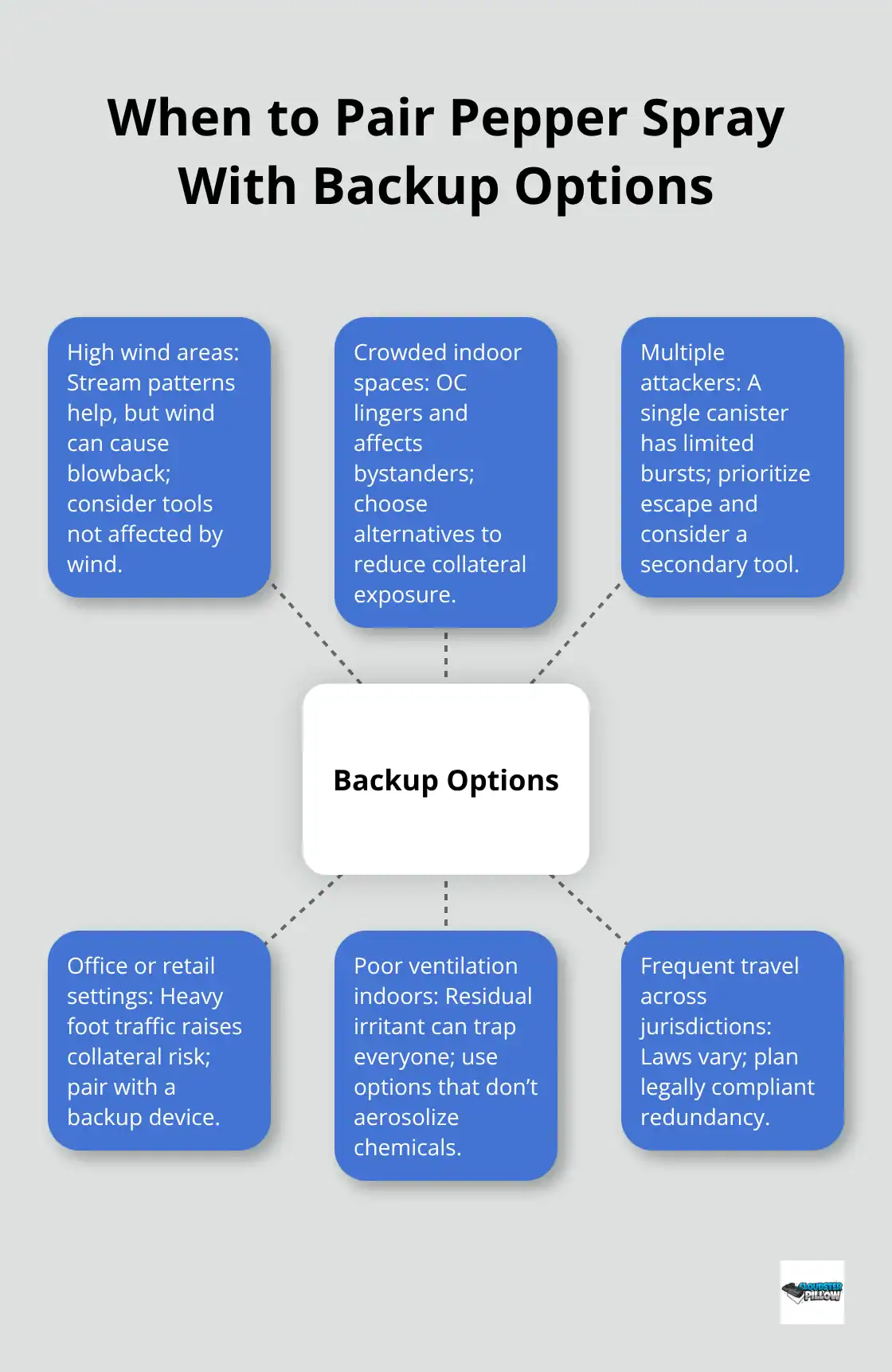
This layered approach to nonlethal defense reflects how professional carriers think about protection-not as a single tool but as a system that adapts to your environment and threat profile.
Final Thoughts
Mace pepper spray earns its reputation as the most practical nonlethal defense tool for everyday carriers because it combines low cost, reliable effectiveness, and minimal legal complexity compared to electrical devices or firearms. A quality canister costs between 15 and 40 dollars, so you can afford multiple units for different carry locations without financial strain. The inflammatory mechanism of oleoresin capsicum works regardless of an attacker’s intoxication level or physical conditioning, making it far more dependable than tasers in real-world scenarios.
Training separates carriers who actually protect themselves from those who carry false confidence. Practicing with expired canisters in open areas reveals whether your chosen product fits your hand, whether the safety disengages smoothly under stress, and how wind affects your spray pattern. This hands-on preparation takes a few hours but eliminates the guesswork when seconds matter most.
Pepper spray fits into a complete self-defense strategy as your primary nonlethal option, potentially supplemented by backup tools in specific environments like high-wind coastal areas or crowded indoor spaces where collateral exposure becomes a genuine concern. Most everyday carriers pair pepper spray with situational awareness, escape planning, and a comfortable carry method that keeps their primary firearm accessible without printing or causing all-day discomfort. The Cloudster Pillow holster wedge enhances both concealment and comfort for all-day readiness, letting you focus on training and mindset rather than fighting your gear.
