
CCW Courses and Tips
Conceal Carry Law Basics 2026: What Every Gun Owner Should Know
Conceal carry laws 2026
Conceal carry laws 2026 are more complex than ever, with rules shifting across state lines and new regulations emerging constantly. At Cloudster Pillow, we know that understanding these laws isn’t optional-it’s essential for responsible gun ownership.
Whether you’re a seasoned carrier or new to CCW, this guide breaks down the legal landscape you need to navigate. From permit requirements to self-defense protections, we’ll cover what matters most for staying compliant and safe.
Understanding Your State’s Carry Rules
The 2026 carry-law landscape breaks into two distinct camps: constitutional carry states and permit states. As of early 2026, about 25 states allow permitless carry, meaning you can carry concealed without government approval if you’re legally eligible. Alaska, Wyoming, Montana, and Idaho lead this group. The remaining states require permits, with two primary models: shall-issue states like Florida and Georgia must grant a permit if you meet basic criteria, while may-issue states like New Jersey and Maryland give authorities discretion to deny your application even if you check all the boxes. This distinction matters enormously. In shall-issue states, your path is straightforward-submit your application, pass a background check, and you’ll receive your permit within weeks or months. In may-issue jurisdictions, officials can reject you without strong justification, which means thousands of law-abiding citizens never get approved. If you live in or travel through may-issue territory, expect a slower process and less certainty.
Where Open and Concealed Carry Differ
Open carry rules vary wildly across state lines. Alaska, Wyoming, and Vermont allow open carry without restriction. California and Illinois effectively ban it in public spaces. Most states fall somewhere between, permitting open carry in rural or hunting contexts but restricting it in cities. Concealed carry, by contrast, is increasingly normalized through permits or constitutional carry laws. The practical reality: concealed carry is your safest legal bet nationwide because it avoids the confrontation and legal gray areas that open carry invites. Many law enforcement agencies report more stop-and-frisk incidents involving openly carried firearms, even in permissive states. If you’re carrying in unfamiliar territory, concealed is the conservative choice. Most carriers prefer concealment anyway-it maintains situational awareness without broadcasting your defensive tool.
Reciprocity and Interstate Travel
Federal reciprocity remains incomplete as of 2026. The Constitutional Concealed Carry Reciprocity Act, introduced in January 2025, aims to allow residents with valid home-state permits or constitutional carry status to carry in any state that permits concealed carry. If enacted, this would transform interstate travel for millions of carriers. However, it’s not law yet. Until then, your home permit may not work across state lines. Florida and Texas permits earn recognition in many states but not all. Georgia permits carry in fewer jurisdictions. Before traveling, verify each state’s reciprocity rules using official state attorney general websites or reciprocity maps, which track recognition agreements. Don’t assume your permit works everywhere-crossing a state line with an unrecognized permit is a felony in some jurisdictions, carrying mandatory prison time. Private property bans and government facility restrictions also persist regardless of reciprocity, so even where your permit is recognized, businesses can still prohibit carry on their premises.
What Reciprocity Actually Protects
The reciprocity act, if passed, would not override private property prohibitions or restrictions on firearms at state or local government facilities. This means your permit protects you on public land managed by the BLM, Forest Service, and National Wildlife Refuges, but not inside a restaurant or retail store that posts a no-carry sign. You’ll still need to respect business policies and signage in every state. The act also requires you to carry a valid photo ID plus your state-issued license or permit (or proof of constitutional carry status in your home state). Prosecution must prove beyond a reasonable doubt that you failed to meet these conditions, and facially valid documents count as prima facie evidence of compliance. If you face charges and prevail under the act, the court must award your reasonable attorney’s fees-a meaningful protection for carriers wrongly accused.
Planning Your Travel Strategy
Before crossing state lines, research each destination’s specific rules using official government sites rather than blogs or secondhand sources. Verify whether your home permit is recognized, understand private-property restrictions, and know which federal lands allow carry. Many carriers travel with a printed copy of their permit and a summary of the destination state’s laws. This preparation prevents costly mistakes and keeps you compliant. The landscape will likely shift once federal reciprocity legislation moves forward, but until then, state-by-state verification remains your responsibility. Your next step involves understanding exactly where you can and cannot carry your firearm-and what happens when you cross those legal boundaries.
Where You Can and Cannot Carry
Federal law prohibits firearms in specific locations regardless of your permit status or state regulations. Schools and school grounds are completely off-limits under the Gun-Free School Zones Act, with rare exceptions for law enforcement and armored car personnel. Federal buildings, courthouses, and airports beyond security checkpoints remain prohibited zones. National Parks allow carry on trails and in vehicles if your permit is recognized in that state, but visitor centers and ranger stations often post restrictions.
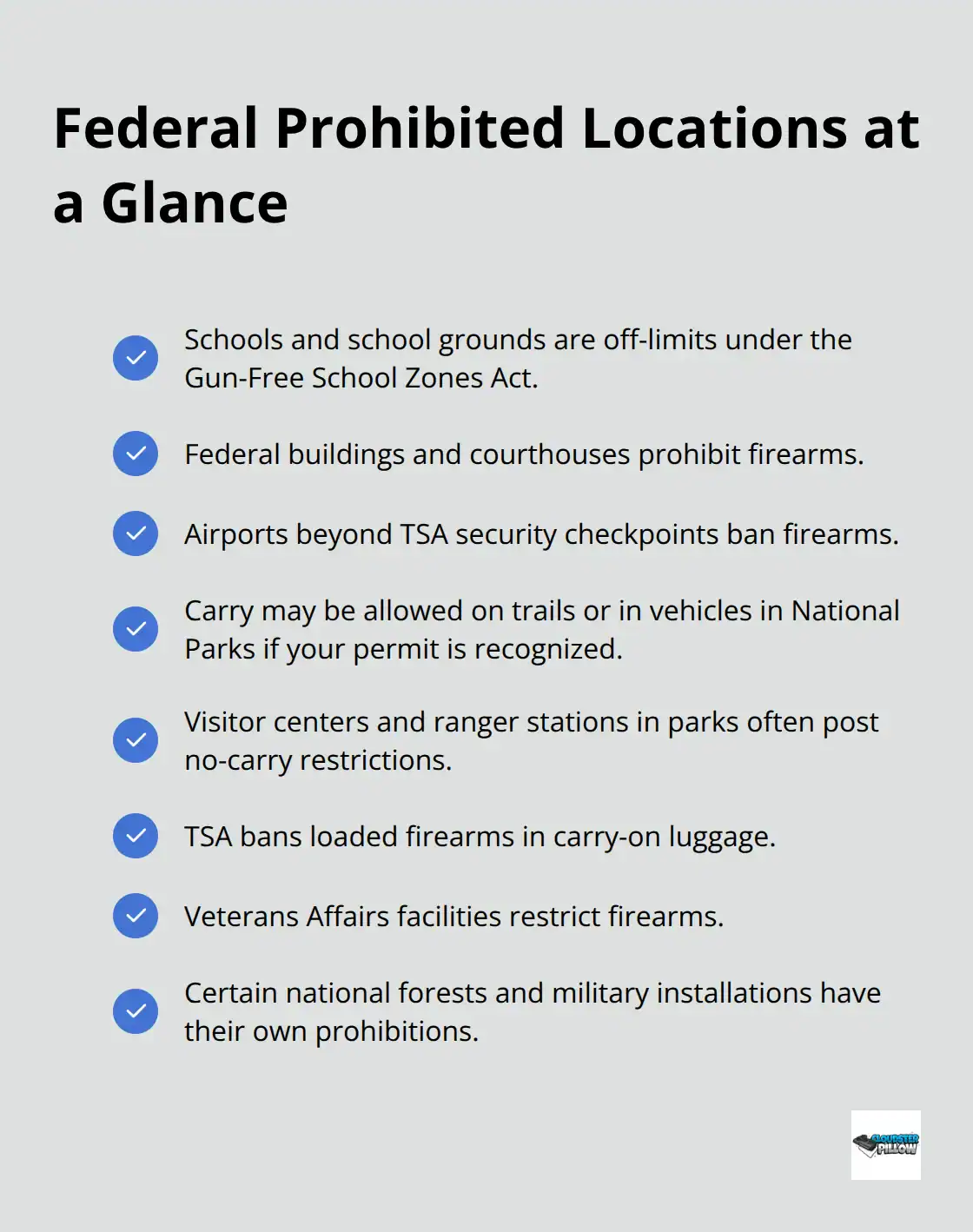
The TSA prohibits loaded firearms in carry-on luggage, though you may transport unloaded firearms in checked baggage with advance notification and compliance with airline policies. Veterans Affairs facilities, national forests in certain states, and military installations maintain their own restrictions. Your permit doesn’t grant universal access-it grants permission in specific zones where state law allows it. Federal property overrides state permits entirely. Before visiting any federal facility, call ahead or check the agency’s website for current policies.
State and Local Government Restrictions
State and local governments add their own layers of restriction beyond federal law. Some states prohibit carry in courthouses even when federal law doesn’t explicitly ban it. County jails, detention facilities, and police stations typically prohibit carry. Public parks vary wildly across jurisdictions-some allow carry, others don’t. The safest approach is to contact the specific facility or municipality before you carry there. Many carriers assume that absence of signage means permission exists, but this assumption creates legal danger. Facilities can enforce no-carry policies through trespass laws, meaning you face criminal charges if you refuse to leave after officials ask you to do so.
Private Property and Business Policies
Private property owners hold absolute authority over carry policies on their land or in their establishments. A restaurant owner can prohibit carry with a simple posted sign, regardless of your permit. Retail stores, offices, apartment complexes, and shopping centers set their own rules. Some states allow businesses to post signs that carry legal weight; violation results in penalties. Others treat violations as simple trespass. Know the difference in your state. Businesses can enforce no-carry policies through trespass laws, and you face criminal charges if you refuse to leave after being asked.
Workplace and Educational Carry Restrictions
Your employer can prohibit carry on company property even if state law permits it elsewhere. Federal contractors and healthcare facilities often ban carry as a condition of employment. Schools and colleges universally prohibit carry, with college campuses in particular enforcing strict policies regardless of state law. If you work in any of these environments, you must leave your firearm at home or in your vehicle. Carrying in violation exposes you to termination and criminal charges. The practical reality: your legal right to carry ends the moment you step onto someone else’s property and they’ve prohibited it. Compliance isn’t optional-it’s the foundation of responsible carry.
Understanding Your Carry Boundaries
Federal restrictions, state laws, local ordinances, and private property rules create a complex web of boundaries that shift constantly. What’s legal in one location becomes illegal fifty miles away. What’s permitted on public land may be prohibited inside a business on that same land. This complexity demands that you verify rules before you enter unfamiliar territory. Staying compliant with carry laws protects you legally and builds the discipline that separates responsible carriers from reckless ones. When you’re carrying concealed, comfort matters too-a quality holster wedge like the Cloudster Pillow keeps your firearm secure and comfortable throughout the day, whether you’re navigating complex carry zones or simply staying prepared at home.
Self-Defense Laws and Your Legal Liability
Self-defense laws shift dramatically across state lines, and understanding where you stand legally matters more than understanding your firearm. Most states recognize your right to use force to protect yourself, but the conditions and consequences vary enough to create serious legal exposure. Your state falls into one of two camps: stand your ground jurisdictions that allow you to use force without retreating first, or duty to retreat states that require you to escape if safely possible before you deploy defensive force.
Stand Your Ground vs. Duty to Retreat
Stand your ground states like Florida, Texas, and Georgia protect you legally when you use force against an aggressor in any location where you have a lawful right to be. You face no legal obligation to run, hide, or de-escalate before you act. Duty to retreat states like New York and Connecticut demand that you attempt to escape before you use force, even if retreat puts you in greater danger. The legal standard shifts from your right to stand and defend to your responsibility to avoid confrontation.
This distinction creates vastly different liability outcomes. In stand your ground states, prosecutors bear the burden of proving you weren’t acting in self-defense. In duty to retreat jurisdictions, you may need to prove you couldn’t safely escape. That burden reversal costs money, time, and legal risk even when you’re ultimately vindicated.
Castle Doctrine and Home Defense
Castle doctrine laws protect you inside your own home, removing any duty to retreat and presuming you acted reasonably when you use force against an intruder. Most states recognize this protection, though specifics vary. Your home is legally treated as your final refuge where force is presumed justified. This protection extends to your vehicle in many states, creating a legal safe zone during road incidents.
However, castle doctrine doesn’t mean you can use unlimited force against any person on your property. Invited guests, family members, and emergency responders occupy different legal categories than armed intruders. Your legal protection applies specifically to threats that justify defensive action.
Proportional Force and Legal Consequences
Proportional force requires that your response match the severity of the threat you face. If someone threatens you with a knife and you respond with lethal force, courts scrutinize whether that response was reasonable. Deadly force applies only when you face imminent threat of death or serious bodily harm. Lesser threats require lesser responses.
Courts examine whether a reasonable person in your position would have perceived the same threat level, and whether your response aligned with that perception. Self-defense incidents carry financial consequences that extend far beyond criminal charges. Civil suits from the aggressor or their family can bankrupt you even if you’re criminally acquitted. Medical bills, property damage, and legal defense costs often exceed $50,000 in contested cases.
This reality explains why concealed carry insurance matters-members report access to legal defense funds and attorney networks that navigate both criminal and civil exposure. Your state’s specific laws determine whether you can claim self-defense immunity in civil court, but many states allow it only after criminal acquittal, leaving you exposed to civil liability during the criminal process.
Legal Preparation Across State Lines
Carrying a firearm obligates you to understand your state’s exact use of force standards before you ever need them. Consult a firearms attorney in your jurisdiction, not an online forum or general guide. Your attorney can clarify whether your state recognizes stand your ground protections, what retreat obligations exist, and what documentation you should carry to prove self-defense claims.
Traveling across state lines with a firearm means you carry different legal protections in each jurisdiction. A defensive shooting that’s legally justified in one state might constitute manslaughter in another. This complexity demands that you stay mentally prepared through regular training and scenario-based practice that emphasizes de-escalation and situational awareness before force becomes necessary. Responsible carry means you accept that using your firearm creates legal jeopardy regardless of justification, and that preparation includes legal knowledge alongside marksmanship and tactical training.
Final Thoughts
Carry laws 2026 demand your attention because they directly determine whether you stay legal or face criminal charges. The landscape shifts constantly across state lines, with constitutional carry states, shall-issue jurisdictions, and may-issue territories each operating under different rules. Federal restrictions override everything else, private property owners control access to their establishments, and self-defense protections vary enough to create serious legal exposure.
Your first responsibility involves knowing your home state’s specific rules and verifying reciprocity agreements using official state attorney general websites before you travel across state lines. Confirm which federal lands allow carry, identify private property restrictions, and understand what happens if you cross a boundary with an unrecognized permit. Stay current on legal changes by subscribing to official state law updates and consulting a firearms attorney in your jurisdiction.
Responsible carry extends beyond marksmanship and tactical training-it means accepting that your firearm creates legal jeopardy regardless of justification, and that preparation includes legal knowledge alongside everything else. Comfort during daily carry matters too, and when your holster setup feels natural and secure, you maintain the consistency that separates responsible carriers from reckless ones. We at Cloudster Pillow designed our holster wedge specifically for everyday carriers who refuse to compromise between comfort and concealment, helping you stay focused on training and readiness rather than gear discomfort.
