
AIWB Holster Wedge, Holster Wedge, Holsters and Gear Recommendations, IWB Holster Wedge
Holster Wedge Placement: Where to Put a Wedge on Your IWB Holster
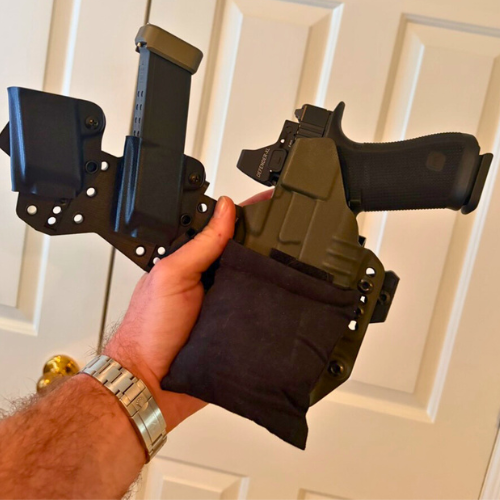

Where Should You Place a Holster Wedge?
Holster wedge placement determines whether your wedge actually improves concealment or just adds bulk. The wrong position can push your grip out further, create pressure points, or do nothing at all. The right position tucks the grip into your body, eliminates printing, and makes all-day carry comfortable.
This guide covers exactly where to mount a wedge on your IWB holster based on your carry position, body type, and the specific problem you are trying to solve.
How Holster Wedge Placement Works
A holster wedge works by creating a pivot point against your body. When mounted on the back of the holster shell, the wedge pushes the bottom of the holster away from your body. This leverage tilts the grip inward, pressing it flat against your torso. The National Shooting Sports Foundation recommends always practicing safe handling when adjusting your carry setup.
The location of the wedge on the holster shell determines where this pivot happens and how much the grip tucks. Moving the wedge even half an inch up or down changes the angle and pressure distribution.
Key Placement Principles
- Lower placement creates more grip tuck but less muzzle stability
- Higher placement provides less grip tuck but better overall holster stability
- Centered placement balances concealment and comfort for most carriers
- The wedge should contact your body directly — if there is a gap, it is not working
Holster Wedge Placement for AIWB Carry
Appendix carry is where wedge placement matters most. The holster sits in the natural crease between your abdomen and thigh, and the grip tends to cant outward when you sit or bend.
Standard AIWB Placement
For most appendix carriers, mount the wedge on the lower third of the holster shell, centered horizontally. This positions the thickest part of the wedge right where the holster meets the bend point of your body.
Step-by-step:
- Hold the holster with the muzzle pointing down and the body side facing you
- Identify the bottom third of the shell where the trigger guard area begins
- Attach the wedge so the thickest edge sits at the very bottom of the shell
- The wedge should taper toward the middle of the holster
- Put the holster on and check grip tuck in a mirror
AIWB Placement Adjustments
| Problem | Adjustment | Why It Works |
|---|---|---|
| Grip still prints | Move wedge lower toward muzzle end | Increases pivot leverage for more tuck |
| Muzzle pokes when sitting | Move wedge higher toward trigger guard | Tilts muzzle closer to body |
| Holster digs into thigh crease | Use a thinner wedge or shift wedge up 1/2 inch | Reduces pressure at the fold point |
| Wedge feels too bulky | Trim the wedge width or switch to a tapered option | Less material means less pressure |
| Holster shifts during movement | Add a second small wedge higher on the shell | Two contact points stabilize the holster |
Holster Wedge Placement for Strong-Side IWB (3-5 O’Clock)
Strong-side IWB carry has different geometry than appendix. The holster sits along the curve of your hip, and the grip tends to push outward at the beltline rather than at the abdomen.
For strong-side carry, place the wedge in the middle third of the holster shell. This pushes the holster tighter against the curve of your hip and reduces the gap between the grip and your body.
- Mount the wedge centered vertically on the shell
- The thickest part should face the body side, not the bottom
- You may need a wider wedge than for AIWB since the contact area along the hip is broader
Holster Wedge Placement by Body Type
| Body Type | Recommended Placement | Wedge Thickness | Notes |
|---|---|---|---|
| Athletic/lean | Lower third, close to muzzle | Medium (1/2 inch) | Less body padding means the wedge does most of the work |
| Medium build | Lower to middle third | Medium (1/2 inch) | Standard placement works well for most setups |
| Plus-size/stocky | Middle third, slightly higher | Thicker (3/4 inch) | Higher placement avoids the deeper abdominal crease |
| Short torso | Lower third, narrow wedge | Thin (1/4 inch) | Less real estate on the holster so keep the wedge compact |
| Tall/long torso | Lower third, full width | Medium to thick | More room to work with allows standard or larger wedges |
For a deeper dive into body-type-specific setups, read our complete holster wedge guide.
Placement for Specific Firearms
Compact Pistols (Glock 19, Sig P320, S&W M&P 2.0 Compact)
Compact frames have enough grip length to benefit from a wedge in the standard lower-third position. The Glock 19 AIWB setup works best with the wedge mounted at the bottom of the trigger guard area.
Subcompact and Micro Pistols (Sig P365, Glock 43X, S&W Shield)
Smaller guns produce less grip printing, so the wedge can be thinner. Place it in the lower third but use a narrower wedge to match the shorter holster shell. See our Sig P365 wedge setup guide for specific instructions.
Full-Size Pistols (Glock 17, Sig P320 Full, 1911)
Full-size guns need more aggressive grip tuck. Mount the wedge at the very bottom of the shell and consider using a thicker option. A purpose-built wedge like the Cloudster Pillow handles the extra leverage better than DIY foam for larger firearms.
Common Holster Wedge Placement Mistakes
- Mounting the wedge too high on the shell: This reduces the pivot effect and barely changes the grip angle. The wedge needs leverage, which comes from distance between the wedge and the grip.
- Using the same placement for different carry positions: AIWB and strong-side have completely different geometry. What works at 1 o’clock will not work at 4 o’clock.
- Ignoring the wedge taper direction: The thick end should always face toward the muzzle end for AIWB. Reversing it creates pressure in the wrong spot.
- Permanent adhesive before testing: Always use Velcro first so you can reposition the wedge. Once you find the right spot, you can switch to permanent adhesive if you want.
- Not re-checking after belt changes: A different belt thickness or stiffness changes how the holster sits, which can shift your ideal wedge position.
How to Test and Dial In Your Wedge Placement
- Start with the wedge at the bottom of the holster shell — this is the default starting position for most setups
- Wear the holster for 30 minutes around the house — sit, stand, bend, and walk to test comfort in real positions
- Check concealment in a mirror — look for grip printing from the front and side
- Move the wedge up or down in 1/2 inch increments — small changes create noticeable differences
- Test again for another 30 minutes — repeat until the holster feels stable and the grip stays flat
- Lock in the position — once you find the sweet spot, mark it with a pencil on the holster shell for reference
If you have tried multiple positions and still cannot get the concealment or comfort you want, the issue may be the wedge material itself. A DIY foam wedge compresses over time and loses its shape. Upgrading to a purpose-built wedge like the Cloudster Pillow with memory foam and a neoprene cover provides consistent performance regardless of placement.
Frequently Asked Questions
Where is the best place to put a holster wedge?
For AIWB carry, the lower third of the holster shell is the best starting position. This gives the wedge maximum leverage to tuck the grip into your body. For strong-side IWB, the middle third works better because the hip curve requires a different pressure point.
Does holster wedge placement change by gun size?
Yes. Larger firearms like the Glock 17 or Sig P320 Full need the wedge placed lower and thicker to compensate for the longer grip. Subcompact pistols like the Sig P365 need thinner, narrower wedges since there is less grip to manage.
Can I use two wedges on one holster?
Yes. Some carriers use a primary wedge at the bottom for grip tuck and a smaller secondary wedge higher on the shell for additional stability. This is common with longer holsters for full-size pistols.
How do I know if my wedge is in the wrong spot?
Signs of incorrect placement include: the grip still prints after adding a wedge, the holster creates a pressure point that causes pain, the muzzle pokes outward when sitting, or the holster feels less stable than without the wedge.
Final Thoughts
Holster wedge placement is not one-size-fits-all. Your carry position, body type, and firearm all affect where the wedge should sit on the holster shell. Start with the lower third for AIWB or the middle third for strong-side, then adjust in small increments until the grip sits flat and the holster feels comfortable all day.
If you want a wedge that holds its position and shape through months of daily carry, the Cloudster Pillow is built specifically for this. Its tapered memory foam design and integrated Velcro let you dial in placement and keep it there.
Ready to get your wedge placement dialed in? Browse our holster wedge collection and start carrying more comfortably today.
