
AIWB, AIWB Holster Wedge, Appendix Carry, Holster Wedge, Holsters and Gear Recommendations, IWB Holster Wedge
AIWB Holster Claw vs Wedge vs Pillow: Which Do You Need?
AIWB Holster Claw vs Wedge vs Pillow: Which Do You Need?
If you carry appendix inside the waistband, you already know the holster shell is only part of the equation. The real difference between a setup that prints and digs versus one that disappears and stays comfortable all day usually comes down to the AIWB holster claw vs wedge decision—and increasingly, whether a pillow-style wedge belongs in the mix.
This guide breaks down holster claws, traditional foam wedges, and pillow wedges side by side. You will learn what each accessory actually does, when you need one versus two versus all three, and how the Cloudster Pillow holster wedge bridges the gap between hard wedges and dedicated comfort pads. Whether you are picking your first AIWB accessory or fine-tuning a carry rig you have worn for years, this comparison will help you choose the right combination for your body, gun, and lifestyle.
The Three AIWB Holster Accessories Explained: Claw, Wedge, and Pillow
Before you can settle the AIWB holster claw vs wedge debate for your own setup, you need to understand what each accessory actually does mechanically.
Holster Claw (Wing)
A holster claw—sometimes called a wing—is a small lever that mounts to the holster body and sits behind the belt. When you cinch your belt, the claw presses against the belt’s inner surface and uses that leverage to rotate the grip of the pistol inward, toward your centerline. The result is reduced side-profile printing, especially visible when someone looks at you from a 45-degree or side angle.
Claws address horizontal grip rotation. They do very little to change the muzzle angle or relieve pressure against your body. For a solid overview of how claws and wings interact with belt tension, PHLster’s educational breakdown of holster wedges and claws is worth reading.
Holster Wedge (Hard Foam or Molded)
A holster wedge is a block—typically cut from dense foam, rubber, or molded polymer—attached to the body side of the holster near the muzzle end. By pushing the muzzle outward, it levers the grip inward on a vertical axis, similar to a teeter-totter. Wedges also spread contact pressure across a wider area, reducing the single-point hotspot many carriers feel at the muzzle tip.
Traditional wedges are effective for concealment and angle, but they are usually a fixed shape and density. For a deep dive into how they work, see our holster wedge 101 basics guide. Want to try the concept cheaply first? Here’s how to make a DIY holster wedge before you buy.
Holster Pillow / Pillow Wedge
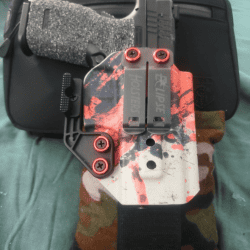
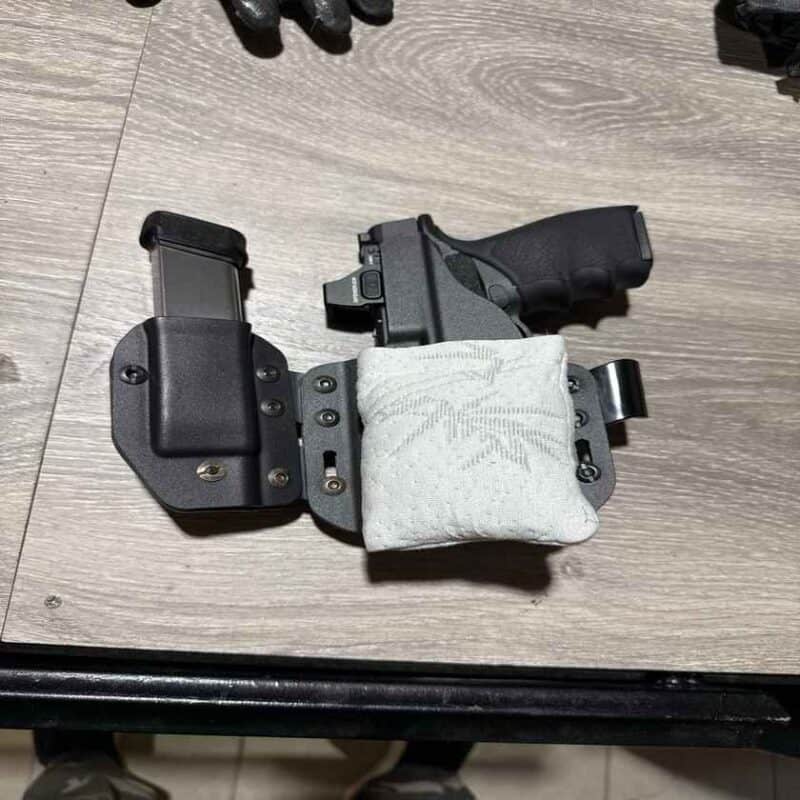
A holster pillow—or pillow wedge—does the same rotational job as a standard wedge but adds a cushioned, breathable, and often adjustable interface between the holster and your body. The Cloudster Pillow holster wedge is the clearest example: shredded cooling gel memory foam inside a soft cover that you can shape, thin out, or build up to dial in the exact thickness and angle you need. Think of it as a wedge and comfort pad fused into one accessory.
All three accessories solve different parts of the comfort and concealment puzzle, and understanding those differences is the key to building a setup that works.
How Each Accessory Changes Concealment and Comfort
The AIWB holster claw vs wedge comparison becomes clearer once you map each accessory to the specific problem it solves:
| Factor | Claw / Wing | Foam Wedge | Pillow Wedge (Cloudster-style) |
|---|---|---|---|
| Part of gun affected | Grip (horizontal rotation) | Muzzle & slide (vertical tilt) | Muzzle & slide (vertical tilt) |
| Side-angle printing | Major reduction | Moderate reduction | Moderate reduction |
| Front-angle printing | Minimal change | Noticeable reduction | Noticeable reduction |
| Pressure / hotspots | No relief | Spreads pressure but can feel brick-like | Spreads pressure and cushions it |
| Long-day comfort | Neutral | Moderate improvement | Significant improvement |
| Heat / breathability | No impact | Can trap heat (closed-cell foam) | Better airflow (gel foam + breathable cover) |
A claw attacks the grip printing problem. A wedge or pillow wedge attacks the muzzle angle and body-side comfort problem. That is why experienced AIWB carriers often run a claw plus a wedge or pillow together—each covers what the other cannot. For a more detailed look at how wedge placement and shape affect concealment, read the ultimate holster wedge guide.
AIWB Holster Claw vs Wedge vs Pillow: Pros, Cons, and Best Use Cases
Claw / Wing
>Pros: Low profile, lightweight, often included with the holster, dramatically reduces side printing.
>Cons: Does nothing for muzzle-end pressure or comfort; cannot compensate for a top-heavy setup on larger guns.
>Best for: Carriers whose main issue is grip printing from the side, especially with compact or subcompact pistols.
Hard Foam / Molded Wedge
>Pros: Strong rotational force, durable, widely available, easy DIY option (yoga-block foam).
>Cons: Fixed shape and density; can feel rigid against the body; closed-cell foam traps heat; limited adjustability once cut.
>Best for: Carriers who prioritize maximum grip tuck and do not mind trading some comfort for a firm, set-it-and-forget-it wedge.
Pillow Wedge (Cloudster Pillow)
> Pros: Similar concealment rotation as a hard wedge; shredded fill conforms to your body; adjustable thickness for different guns and positions; breathable covers reduce sweat and irritation; longer comfort window for all-day or multi-hour wear.
>Cons: Slightly bulkier at maximum fill than a thin foam wedge; requires occasional fluffing if fill compresses.
>Best for: Anyone who already knows they need a wedge but also wants pillow-level comfort—especially hot-climate carriers, long-shift workers, and those with sensitive skin.
Best Combo Pairings
>Claw only: Slim build, micro or subcompact pistol, light fabric, minimal printing to begin with.
>Wedge only: Muzzle hotspot is the main complaint; side printing is already controlled.
>Pillow only: Same scenario as wedge only, but comfort and breathability matter more than maximum rigidity.
>Claw + wedge: Full-size or compact gun, moderate to heavy printing from multiple angles, carrier tolerates firm pressure.
>Claw + pillow: Same concealment goals as claw + wedge, but the carrier wants cushioned contact, heat management, and the ability to tune thickness on the fly.
For a broader look at wedge options across the market, our Best Holster Wedge 2026 buyer’s guide compares materials, sizing, and real-world performance.
When to Use Claw vs Wedge vs Pillow (and When to Combine Them)
Choosing the right accessory—or stack of accessories—depends on your body, your gun, and your daily routine. The AIWB holster claw vs wedge choice is rarely one-size-fits-all. Here are common scenarios:
>Slim build, light gun (e.g., Sig P365, Shield Plus), minimal printing: A claw alone may be all you need. The gun is light enough that muzzle pressure is tolerable, and the claw handles grip tuck.
>Average build, compact gun (e.g., Glock 19, P320 Compact), noticeable printing and hotspots: A claw plus a wedge or pillow is the standard recommendation. The added mass of a compact slide creates pressure that a wedge addresses, while the claw keeps the grip tucked.
>Larger midsection, full-size gun, or deep concealment requirement: Claw + Cloudster Pillow holster wedge in Standard or Deluxe size. The adjustable fill lets you build up thickness to bridge the gap between your body and the holster without resorting to stacking multiple foam pieces.
>Sensitive skin, long shifts, or hot climate: A pillow wedge outperforms hard foam here. Shredded cooling gel memory foam dissipates heat instead of trapping it, and bamboo or flannel covers prevent the skin irritation that bare foam or Kydex cause over 8-plus-hour days.
>Strong-side IWB at 3–4 o’clock: Claws are less effective outside the appendix window. A wedge or pillow alone—placed at the muzzle end—gives the best comfort and tuck improvement.
Hard foam wedges are usually a fixed shape once you cut or buy them. The Cloudster Pillow, by contrast, lets you add or remove shredded fill and reposition the pillow on the Velcro strip to fine-tune angle and pressure in seconds. If you want guidance on matching wedge size to your frame, see our guide on choosing a holster wedge for your body type.
Compatibility Chart: Which Accessory for Which Setup?
Use the table below to quickly narrow down the AIWB holster claw vs wedge decision based on your body type, firearm size, and carry position:
| Body Type | Gun Size | Carry Position | Recommended Combo |
|---|---|---|---|
| Slim | Micro / subcompact | AIWB | Claw only or Claw + Mini pillow |
| Slim | Compact | AIWB | Claw + Standard pillow wedge |
| Average | Compact | AIWB | Claw + Standard pillow wedge or foam wedge |
| Average | Full-size | AIWB | Claw + Standard or Deluxe pillow wedge |
| Larger midsection | Compact | AIWB | Claw + Deluxe pillow wedge |
| Larger midsection | Full-size | AIWB | Claw + Deluxe pillow wedge (max fill) |
| Any | Any | Strong-side IWB (3–4 o’clock) | Pillow wedge only (claw less effective here) |
Example combos:
>Glock 43X, slim build, AIWB: Claw from your holster maker +
Cloudster Pillow Mini for light muzzle cushioning.
>Glock 19 with optic, average build, AIWB: Claw + Cloudster Pillow Standard — remove a bit of fill in summer for a thinner profile.
>Sig P320 Full, larger midsection, AIWB: Claw + Cloudster Pillow Deluxe (camo) at max fill to bridge the body-to-holster gap.

Pingback: Minimal Printing: 4 Holster Setups That Actually Work
Pingback: Holster Pillow vs. Wedge: Which Actually Stops the Printing? (2026)