
Carry Techniques and Optimization, CCW Courses and Tips, Firearm Tips and Tricks
10 Essential Concealed Carry Tips for Beginners
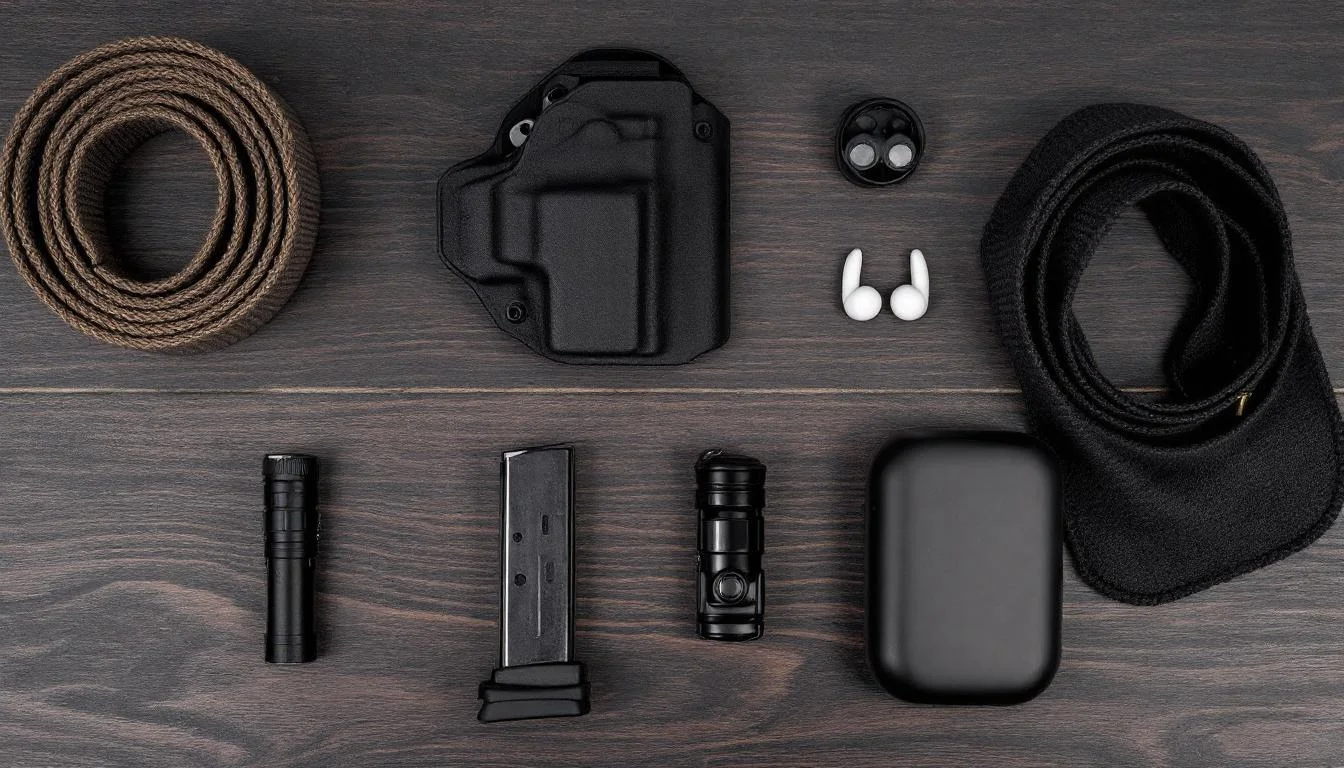
Starting your concealed carry journey can feel overwhelming with so many decisions to make. The right preparation makes all the difference between confident, safe carrying and constant worry about comfort or legality.
We at Cloudster Pillow understand that new carriers need practical, actionable concealed carry tips for beginners. These ten essential guidelines will help you build the foundation for responsible, comfortable everyday carry.
Here are essential concealed carry tips for beginners that will enhance your confidence and safety.
1. Choose the Right Holster for Your Body Type and Lifestyle
Your holster choice determines whether you carry comfortably every day or abandon concealed carry within weeks. Appendix carry places the holster inside your waistband, in the front of your body – usually between the 12 o’clock and 2 o’clock position and works best for people who spend most of their time sitting, while traditional IWB at 3-4 o’clock suits those who drive frequently or bend over regularly. Kydex holsters are better for durability, retention, and active use but can dig into your hip bone during long sessions. Leather holsters are ideal for comfort and extended wear but require a 2-3 week break-in period and lose retention over time.
Choosing the proper holster is one of the most crucial concealed carry tips for beginners to ensure comfort and accessibility.
Your daily wardrobe dictates holster compatibility more than any other factor. Fitted business shirts reveal printing from thick hybrid holsters, while loose casual wear accommodates bulkier options without issue. Winter carry allows larger firearms with heavy jackets, but summer demands compact pistols and minimal holster profiles (especially for AIWB positions). Test your setup by wearing it for 8 hours straight while you perform your normal activities before you commit to any holster system.
Most new carriers buy 3-4 holsters before they find their perfect match, so start with a basic model and upgrade based on actual experience rather than online reviews. Choosing the right holster requires balancing your body type, lifestyle, and firearm specifications. Once you select your holster, proper gun safety and handling become your next priority for safe daily carry.
2. Master Proper Gun Safety and Handling Fundamentals
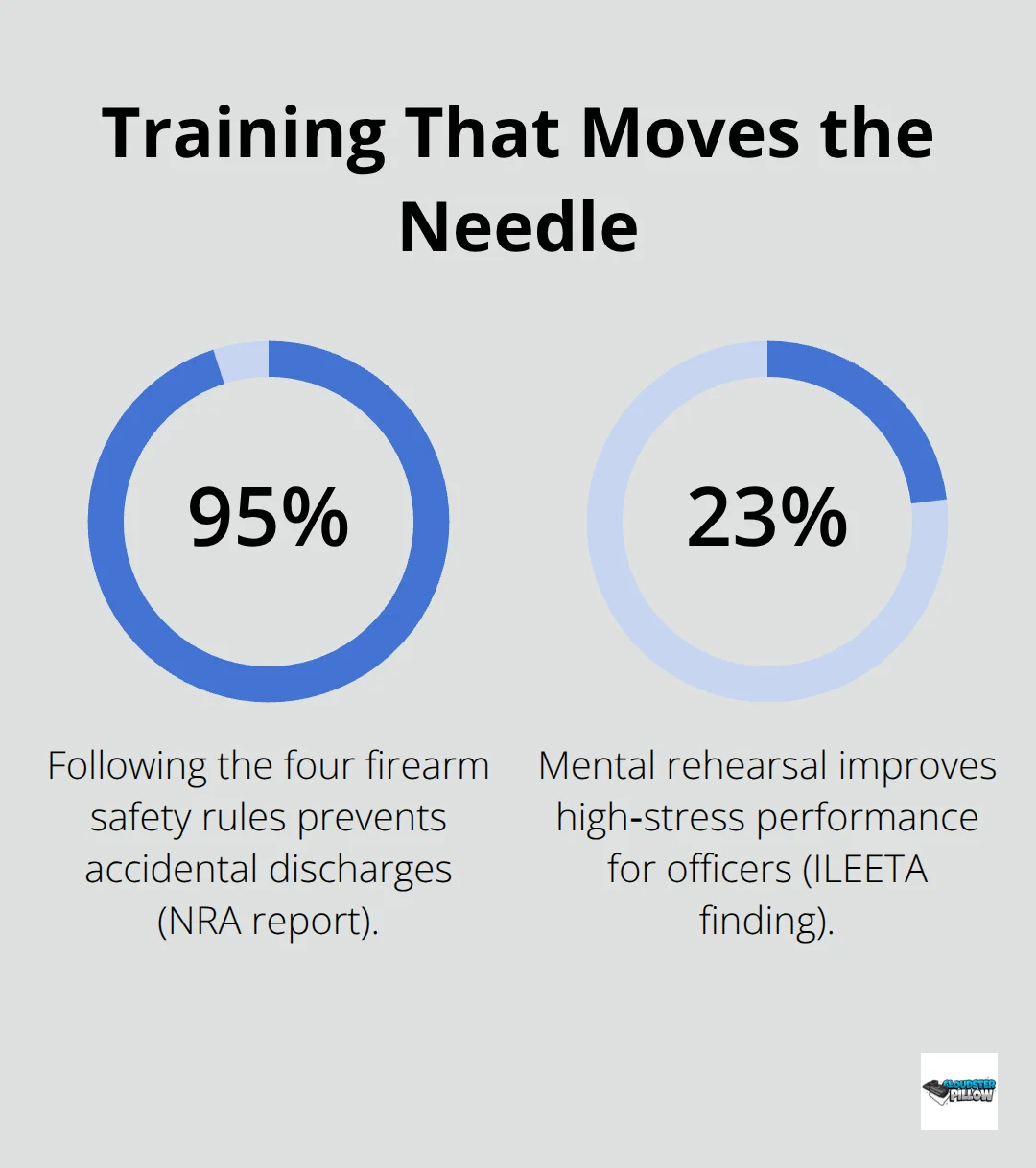
The four fundamental firearm safety rules form the foundation of responsible carry: treat every firearm as loaded, never point the muzzle at anything you don’t intend to destroy, keep your finger off the trigger until ready to shoot, and know your target and what lies beyond it. The National Rifle Association reports that these rules prevent 95% of accidental discharges, yet many new carriers rush to holster their pistol without they master these habits first. Spend two weeks with an unloaded firearm before you carry live ammunition. Handle your pistol daily while you follow each rule precisely until these actions become automatic responses rather than conscious thoughts.
These gun safety rules are foundational concealed carry tips for beginners to ensure responsible firearm handling.
Practice these fundamentals until they feel natural in your hands.
Dry fire practice builds the muscle memory that saves your life in high-stress situations. Police departments emphasize the importance of balancing time and resources for pistol qualification with proper firearms training to maintain marksmanship skills. Set aside 10 minutes each evening to practice your draw from the holster with an unloaded firearm in a safe direction. Focus on the same grip every time with your support hand thumb positioned consistently and your trigger finger indexed along the frame. Modern striker-fired pistols handle thousands of dry fire cycles without damage, which makes this the most cost-effective training method available.
Master your draw stroke and sight alignment through repetition before you ever load your firearm for carry. Once you develop solid safety habits and muscle memory, you need to understand the legal framework that governs where and how you can carry your firearm.
3. Understand Your State’s Concealed Carry Laws and Regulations
Knowing your state’s concealed carry laws is one of the most important concealed carry tips for beginners that can protect you legally.
Concealed carry laws change dramatically between states, and ignorance will cost you your freedom. Texas allows permitless carry for residents over 21, while New York requires extensive background checks and restricts carry locations severely. Over 50 percent of the U.S. has passed laws permitting constitutional or permitless carry, but you face felony charges when you cross state lines without proper research. You must download your state’s official concealed carry handbook and study prohibited locations (which typically include schools, government buildings, and establishments that derive 51% of revenue from alcohol sales). Most states update their laws annually, so you should check your state attorney general’s website every six months for changes that affect your carry rights.
Reciprocity agreements determine where your permit works outside your home state, but these change frequently based on political shifts. Florida recognizes permits from 36 states, while California recognizes none outside their borders. You can check reciprocity maps online, but you must always verify with official state sources before you travel. You should plan your route through carry-friendly states when possible and secure your firearm properly when you enter restricted areas.
Permit renewal requirements vary significantly by state, so you need to set calendar reminders six months before expiration to avoid lapses that make carry illegal. Once you understand the legal framework, you need to select the right ammunition that will perform reliably in your specific firearm for personal protection.
4. Select Appropriate Self-Defense Ammunition
Hollow point ammunition expands upon impact to create larger wound channels and transfers maximum energy to the target while it reduces over-penetration risks. Federal HST 147-grain and Speer Gold Dot 124-grain consistently rank as top performers in FBI ballistic testing, with expansion rates that exceed 1.5 times original diameter and penetration depths between 12-18 inches in ballistic gelatin. Full metal jacket rounds pass through targets without expansion, create smaller wound channels and pose higher risks of hitting unintended targets behind your attacker. Law enforcement agencies nationwide have adopted hollow point ammunition as standard issue because it stops threats more effectively than ball ammunition. You should carry the same ammunition type that your local police department uses for consistency in performance expectations.
Understanding the types of ammunition is critical, as selecting the right self-defense ammunition is among the vital concealed carry tips for beginners.
Your specific firearm requires testing with your chosen ammunition to verify reliable feeding, ejection, and accuracy before you stake your life on it. The most effective way to check reliability is through basic functionality, ammunition compatibility, and magazine reliability tests. Fire at least 200 rounds of your selected hollow point ammunition through your carry gun without malfunctions before you trust it for self-defense. Some firearms struggle with certain bullet shapes or weights (particularly compact pistols with shorter barrels that affect powder burn rates). Test your ammunition at distances you might encounter in self-defense situations, typically 3-7 yards for most civilian encounters. Replace your carry ammunition every six months because repeated chambering can damage bullet tips and affect expansion characteristics, while temperature changes in your vehicle can degrade powder performance over time.
Once you select reliable ammunition, you need to establish consistent daily routines that make carrying your firearm second nature.
5. Develop a Consistent Daily Carry Routine
Your daily carry routine must become as automatic as you put on your watch or grab your keys, because inconsistency creates dangerous gaps in your preparedness. Carry your firearm in the same position every single day at the exact same cant angle, whether that’s AIWB at 1 o’clock or strong-side IWB at 3:30. Use the same holster, belt, and magazine carrier configuration without variation, because muscle memory depends on identical placement for effective draws under stress. Police officers follow identical gear placement protocols for this exact reason – their duty holster, handcuffs, and radio occupy the same positions every shift to maintain tactical consistency. Change your clothing to accommodate your carry setup rather than you adjust your setup to match different outfits, because comfort compromises lead to you leave your firearm at home when you need it most.
Establishing a daily carry routine is one of the essential concealed carry tips for beginners to create consistency.
Establish a pre-departure inspection ritual that takes 30 seconds but prevents catastrophic failures throughout your day. Check these essential elements before you leave home:
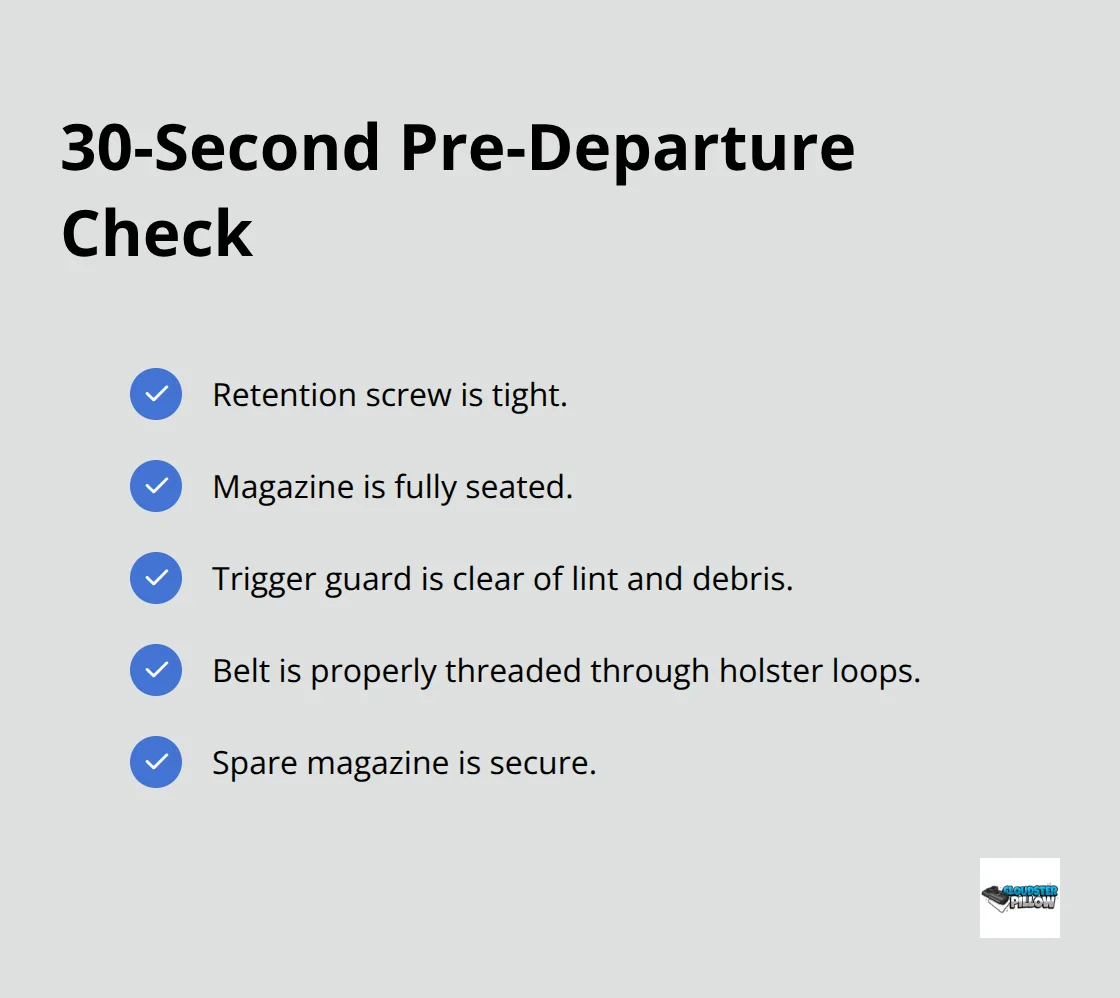
- Your holster retention screw remains tight
- Your magazine seats properly in the pistol
- No lint or debris blocks your trigger guard
- Your belt threads properly through holster loops
- Your spare magazine carrier holds ammunition securely
When you return home, immediately secure your firearm in the same location every time with a quick-access safe or dedicated storage area (because routine prevents accidents and maintains positive control of your weapon). This systematic approach eliminates the guesswork that causes new carriers to abandon concealed carry within their first month. Once you establish these daily habits, you need to develop the awareness skills that help you identify potential threats before they escalate into dangerous situations.
Securing your firearm after every outing is an important concealed carry tips for beginners to prevent unauthorized access.
6. Practice Situational Awareness and Threat Assessment
Practicing situational awareness daily is necessary, making it one of the most important concealed carry tips for beginners.
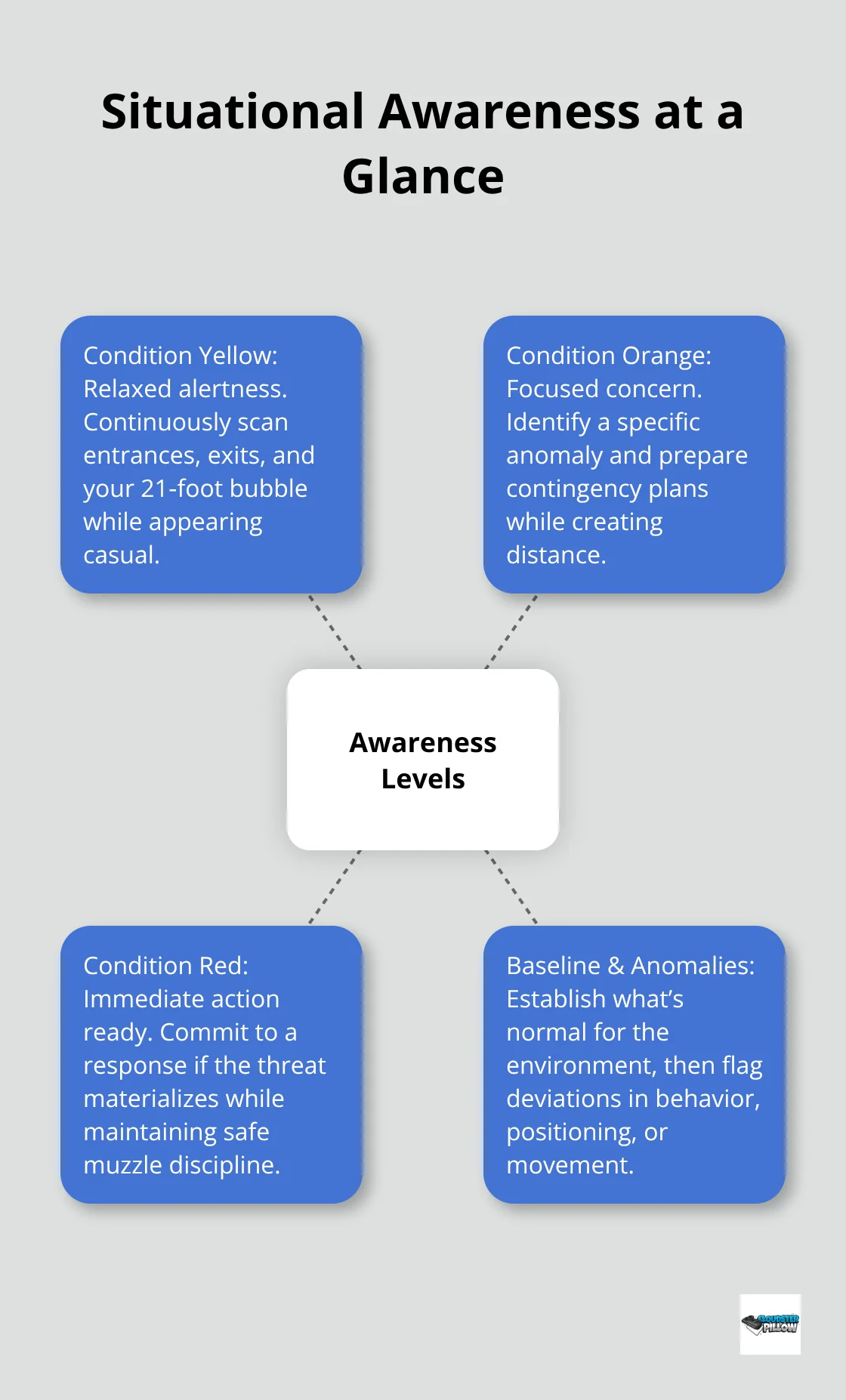
Effective situational awareness requires you to maintain a 360-degree mental map of your environment while you appear relaxed and natural to others around you. The Cooper Color Code system provides a practical framework: Condition White represents complete unawareness (never acceptable for carriers), Condition Yellow maintains relaxed alertness with general scanning, Condition Orange focuses on specific potential threats, and Condition Red prepares for immediate action. Most experienced carriers operate in Condition Yellow throughout their day, which means you scan entry and exit points when you enter any building, you position yourself with your back to walls when possible, and you maintain awareness of people within a 21-foot radius around you. Military and law enforcement personnel use the baseline and anomaly method, where you establish what appears normal for each environment and then you identify anything that deviates from that baseline pattern.
Your scanning technique must appear natural while you gather tactical information about potential threats and escape routes in crowded spaces. Focus on hands rather than faces because weapons appear in hands, not eyes, and you can spot aggressive postures or concealed objects more easily through hand positioning and body language.
The most dangerous individuals often display pre-attack indicators like clenched fists, rapid breathing, target glancing, or positioning themselves to block your exit routes. When you encounter verbal aggression, use de-escalation phrases like “I understand you’re upset” or “Let’s work this out” while you create distance and identify your nearest exit path. Your goal remains to avoid confrontation rather than to win arguments that could escalate into deadly force situations, which makes quality training your next essential investment for defensive preparedness.
7. Invest in Quality Training Beyond Basic Requirements
Investing in quality training is among the key concealed carry tips for beginners for ensuring you are well-prepared.
Your concealed carry permit represents the minimum legal requirement, not adequate preparation for life-threatening situations. The National Shooting Sports Foundation reports that more than 22.4 million Americans had become first-time firearm owners in recent years, yet many never receive professional training beyond their initial permit class, which typically covers only basic safety and legal requirements rather than defensive shooting skills. Advanced training courses cost $200-500 but provide irreplaceable skills that basic permits classes cannot teach. Thunder Ranch and Gunsite Academy offer intensive programs where you practice draws from concealment under time pressure with shot timers and stress inoculation exercises. These courses teach proper shooting stances like the Weaver and Isosceles positions, target acquisition techniques under low light conditions, and malfunction clearing procedures that could save your life during a critical incident.
Live fire defensive shooting scenarios prepare you for real-world encounters that differ dramatically from static range practice. Most civilian defensive shootings occur within 7 yards at distances where traditional marksmanship becomes less important than speed and accuracy under stress. Professional instructors create realistic scenarios with moving targets, multiple attackers, and environmental obstacles that force you to make split-second decisions while you maintain safe muzzle direction. Force-on-force training with simulated ammunition allows you to experience the adrenaline dump and tunnel vision that accompanies violent encounters without actual danger (this training reveals whether your equipment works under stress and whether your draw stroke remains consistent when your heart rate exceeds 150 beats per minute). Many concealed carry insurance providers also offer educational resources and training materials to supplement your formal instruction. Once you complete advanced training, you need to select clothing that accommodates your carry setup without compromising concealment or comfort.
8. Plan Your Wardrobe Around Concealed Carry Needs
Your clothing choices determine whether your concealed carry setup works effectively or fails completely when you need it most. Fitted shirts reveal the outline of even the slimmest holsters, while patterns like plaids and flannels break up your firearm’s silhouette better than solid colors that show every bulge. Loose-fitting polo shirts and button-downs provide the best concealment for IWB carry, but avoid shirts that are too baggy because they slow your draw stroke and can catch on your holster during critical moments. Dark colors hide shadows and print better than light colors, which makes navy blue and charcoal gray your best options for professional environments where concealment matters most. Untucked shirts work perfectly for casual carry, but tuckable holsters become necessary for business settings where tucked shirts are required.
Choosing the right clothing for concealed carry is one of the practical concealed carry tips for beginners.
A quality gun belt makes the difference between comfortable all-day carry and constant adjustments that compromise your setup. Cheap belts sag under your firearm’s weight and create print issues that defeat concealment efforts entirely. Leather gun belts from companies like Hanks Belts support your firearm’s weight consistently without stretch, while tactical nylon belts offer quick adjustment for weight changes throughout the day (your belt width should match your holster clips exactly – typically 1.5 inches for most concealed carry holsters). Winter clothing allows larger firearms and thicker holsters because heavy jackets provide natural concealment, but summer carry demands compact pistols and minimal holster profiles that work with lightweight clothing layers.
Once you select appropriate clothing and gear, you must prepare mentally for the psychological challenges that come with carrying a firearm for personal protection.
9. Prepare Mentally for High-Stress Defensive Situations
Preparing psychologically for situations is critical, making mental readiness one of the essential concealed carry tips for beginners.
Mental preparation determines whether you respond effectively or freeze completely when seconds count in a life-threatening encounter. The International Law Enforcement Educators and Trainers Association found that officers who practiced mental rehearsal performed 23% better in high-stress scenarios compared to those who relied solely on physical training. Spend 10 minutes each week to visualize specific situations like parking garage encounters, home invasions, or retail store robberies while you walk through your exact response sequence from threat identification through aftermath procedures. Focus on realistic scenarios that match your daily routine and geographic area rather than Hollywood-style shootouts that rarely occur in civilian encounters. Mental rehearsal must include the legal and emotional aftermath because deadly force changes your life forever, regardless of justification.
The aftermath of any defensive incident involves immediate police response, potential arrest, legal proceedings that can cost $50,000-$150,000 even when justified, and psychological trauma that affects you and your family for years. You will face criminal investigation, possible civil lawsuits from the attacker’s family, media scrutiny if the incident gains attention, and mandatory counseling in most jurisdictions (these consequences occur even in clear-cut self-defense cases). Confidence comes from consistent training that proves your equipment works and your skills remain sharp under pressure, not from wishful thinking about your abilities. Schedule monthly range sessions focused on defensive distances rather than precision targets, practice your draw stroke daily until it becomes automatic, and maintain your equipment in perfect working condition because equipment failures during critical incidents can be devastating. Once you develop mental readiness and confidence through preparation, you must maintain both your equipment and skills through regular practice to stay prepared for any situation.
10. Maintain Your Equipment and Skills Through Regular Practice
Your firearm needs weekly inspection and cleaning to function reliably when your life depends on it. Remove all ammunition from your pistol and holster, then check for lint accumulation in the trigger guard, corrosion on metal surfaces, and wear patterns on your holster that could affect retention. Clean your barrel with a quality solvent like Hoppes No. 9, lubricate parts according to your manufacturer’s specifications, and inspect your magazines for bent feed lips or weak springs that cause feed failures. Replace your recoil spring every 5,000 rounds for most striker-fired pistols, and change your holster when the retention becomes loose or the material shows cracks that could lead to complete failure.
Regularly maintaining your firearm and equipment is one of the critical concealed carry tips for beginners that ensures reliability.
Monthly range sessions maintain the accuracy and confidence that separate effective defenders from liability risks. Fire 50 rounds at defensive distances between 3-7 yards rather than waste time on 25-yard precision shots that have no relevance to civilian encounters. Practice draws from concealment with a shot timer to track your progress – try for consistent 2.5-second draws from holster to first accurate shot. The FBI reports that most defensive encounters last less than 3 seconds, which means speed matters more than perfect groups at extended distances. Replace worn equipment before it fails you during a life-threatening situation (because a $50 holster replacement costs far less than the consequences of equipment failure when you need your firearm most). These maintenance habits form the foundation of responsible carry, but true comfort comes from addressing the physical challenges that make many new carriers abandon their commitment to daily protection.
Dry fire practice at home supplements your range time by building muscle memory without ammunition costs. Practicing dry-fire in short, focused sessions of 10 to 15 minutes several times per week is more effective than one long monthly session for maintaining proficiency. Regular practice develops the skills necessary for effective self-defense while keeping your equipment in peak condition.
Final Thoughts
These concealed carry tips for beginners provide the foundation for safe, confident daily carry. Your success depends on the right holster selection for your body type, mastery of fundamental safety rules, understanding of your state’s laws, reliable ammunition choices, and consistent daily routines. Situational awareness and quality training beyond basic requirements separate prepared carriers from those who simply own permits.
These concealed carry tips for beginners will help you establish a strong foundation for safe carrying.
Concealed carry represents a lifelong commitment to continuous learning and skill development. Laws change, equipment wears out, and skills deteriorate without practice. You must stay connected with training opportunities, update your knowledge regularly, and maintain your equipment in perfect working condition (because the responsibility you accept when you carry a firearm extends far beyond the moment you strap on your holster each morning).
Stay informed about changes in laws and practices as part of your journey with these concealed carry tips for beginners.
Comfort plays a vital role in consistent daily carry. Many new carriers abandon their commitment because their setup causes pain or printing issues. We at Cloudster Pillow understand that real comfort and confidence come from addressing these physical challenges through our #1 holster wedge that makes carrying feel natural rather than burdensome. When your setup works properly, you focus on training, awareness, and readiness instead of constant adjustments and discomfort.
Our concealed carry tips for beginners focus on comfort, allowing you to concentrate on essential skills.
