
Appendix Carry
AIWB Holster Meaning: What It Is, How It Works, and Setup Guide
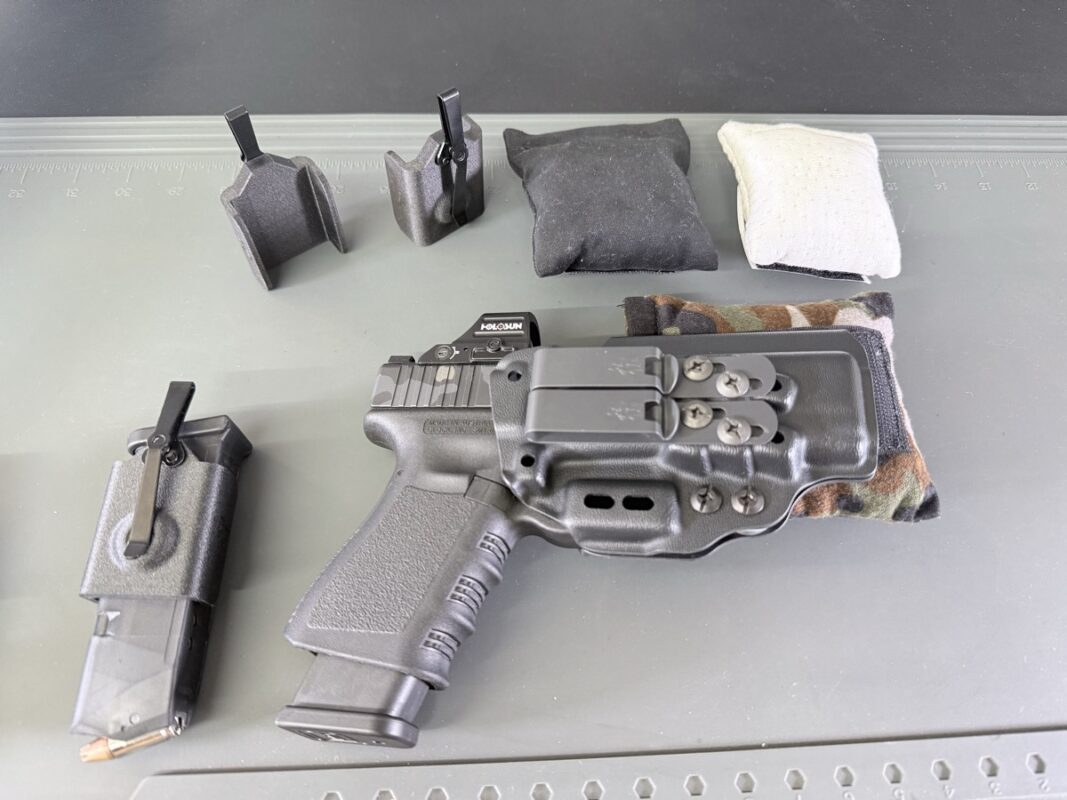
The AIWB holster meaning is simple: AIWB stands for “Appendix Inside the Waistband” — a concealed-carry position where the holster sits between roughly 12 o’clock and 1 o’clock on the front of your body, inside your waistband. An AIWB holster is a Kydex or hybrid holster designed to be worn in that position, usually with a single belt clip, a “claw” attachment to push the grip into the body, and often a wedge or foam pillow to soften the bottom of the holster.
If you’ve heard the term “AIWB” thrown around in concealed-carry forums, YouTube videos, or holster product pages and weren’t sure what it actually meant — that’s the short answer. The longer answer (and the one that matters if you’re choosing your first holster) is below: the full AIWB holster meaning, how it differs from regular IWB, why so many serious carriers prefer it, and the gear and setup tweaks that make it actually comfortable for all-day carry.
AIWB Holster Meaning vs Standard IWB — What’s the Difference?
“IWB” means “Inside the Waistband” and refers to any carry position where the holster is tucked between your body and your pants. “AIWB” is a specific subtype of IWB carry — the appendix variant. So all AIWB is IWB, but not all IWB is AIWB.
| Feature | AIWB (Appendix IWB) | Standard IWB (3-5 o’clock) |
|---|---|---|
| Holster position | 12 o’clock to 1 o’clock (front, between belt buckle and hip bone) | 3 o’clock (strong-side hip) to 5 o’clock (kidney area) |
| Concealment | Excellent — flat front profile, no rear bulge | Good — but rear bulge can print under fitted shirts |
| Draw speed | Fast — straight up, no twist | Slower — requires arm sweep around to hip |
| Comfort while sitting | Challenging — pressure on stomach and groin | Easier — holster sits behind hip |
| Comfort while standing/walking | Excellent with proper wedge setup | Good — minimal pressure points |
| Re-holstering | Requires care — muzzle is pointed at femoral artery | Easier — muzzle pointed away from body |
| Best for | Daily concealed carry, fast access, fitted clothing | Beginners, casual carry, looser clothing |
Why AIWB Has Become the Default for Serious Carriers
Twenty years ago, almost everyone carried at 3 or 4 o’clock — the strong-side hip. AIWB existed but was considered a fringe position, partly because of safety concerns (muzzle direction during re-holster) and partly because the gear hadn’t caught up. That changed in the early 2010s when companies like PHLster, Tier 1 Concealed, and Tenicor started making purpose-built AIWB holsters with claws, wings, and foam wedges that solved the historic comfort problems.
Today AIWB is the dominant position for daily concealed carry among trained shooters because:
- It conceals better than any other position. Your hands cover the holster naturally when standing or sitting. The grip doesn’t print against the back of a fitted shirt the way 3-5 o’clock carry does.
- The draw is faster and more consistent. A straight-up draw from the front beats reaching around to your hip every time on the timer.
- You retain control of the firearm in close-quarters scenarios. Both hands can defend the gun if someone tries to grab it.
- Modern Kydex holsters with claws and wedges have solved the comfort problem. What used to be an “expert only” position is now accessible to anyone willing to set up the gear correctly.
The Three Comfort Problems Every AIWB Carrier Hits — And How to Fix Them
Almost every new AIWB carrier runs into the same three issues in the first few weeks. Solving them isn’t expensive or complicated, but it does require the right gear.
Problem 1: The grip prints under your shirt
When you bend forward, sit down, or move your arms, the top of the gun can push outward and create a visible bulge in your shirt. This is the #1 reason new AIWB carriers give up on the position.
Fix: Use a holster with a “claw” — a small Kydex tab that levers the grip inward when your belt tightens. Combine it with a body-side holster wedge or pillow at the bottom of the holster to angle the grip even further into your body. Together, a claw + wedge eliminates most grip printing.
Problem 2: The bottom of the holster digs into your hip flexor or groin
A flat, hard Kydex edge pressed against soft tissue all day long is a recipe for a bruised crease. Most carriers describe it as “feeling like you’ve been kicked” after 6-8 hours.
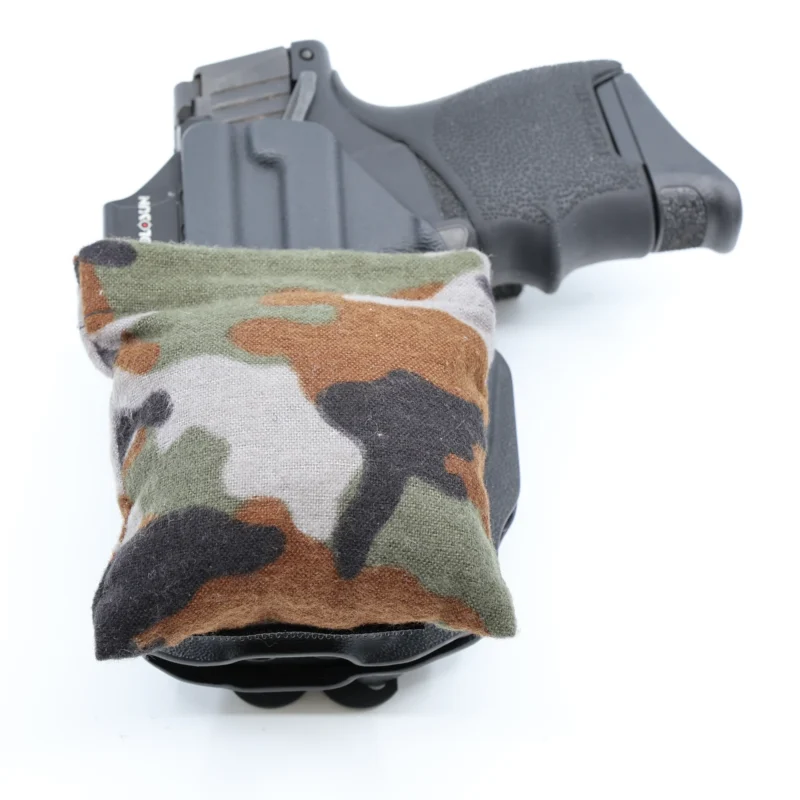
Fix: A soft, contoured wedge at the bottom of the holster distributes the pressure across a wider surface area. Foam wedges are okay; adjustable cooling-gel memory foam pillows (like the Cloudster Pillow) are dramatically better because you can dial in the exact thickness your body and holster need.
Problem 3: It’s miserable when you sit in a car for more than 30 minutes
Long drives are where AIWB carriers most often switch back to strong-side carry. The seatbelt presses the gun into your stomach, and the holster body itself can dig into your thigh.
Fix: A combination of a slightly cantered holster (5-10 degrees of forward tilt), a wedge that’s softer on the bottom corners, and properly fitted pants (not too tight at the waist). Some carriers also slightly loosen their belt one notch for long drives.
What Makes a Good AIWB Holster — The 5 Features That Matter
- Single, adjustable belt clip or loop. Most AIWB holsters use one clip in the center; the best ones let you adjust ride height and cant.
- Claw attachment. Non-negotiable for serious AIWB use. The claw is what tucks the grip in.
- Wedge mount points. Either built-in or with Velcro-friendly flat back panels so you can attach a holster wedge or pillow.
- Sweat shield. A Kydex extension above the slide that protects your skin from sharp edges and your gun from sweat. Some prefer no sweat shield for faster draws — it’s a personal preference.
- Quality construction. Heat-formed Kydex (.080 thickness is standard) with smooth edges, audible click on holster, and consistent retention. Avoid soft-shell or nylon AIWB holsters — they collapse after the draw and create re-holstering hazards.
The Most Popular AIWB Holsters in 2026
Across thousands of customer setups we’ve seen, these are the holsters that come up most often in serious AIWB carry:
- PHLster Floodlight 2 / Enigma — gold standard, modular, works with any pants/no pants (the Enigma chassis carries without a belt)
- Tenicor Velo / Sagax — minimalist, no-claw design that uses geometry instead of accessories
- Tier 1 Concealed Axis Slim / Xiphos / Sidecar — premium hybrid with deep concealment
- T.Rex Arms Sidecar 2.0 — sidecar concept that integrates a spare-mag carrier
- Vedder LightTuck — affordable, no-frills Kydex with a built-in claw
- Werkz M6 / M3 — custom-fit hybrid for niche guns
- Crossbreed SuperTuck — leather-backed hybrid (more for IWB than AIWB, but some use it appendix)
Whichever holster you choose, plan to add a holster wedge to the bottom of the body-side panel. It’s the single biggest comfort upgrade you can make.
AIWB Setup Checklist for Beginners
- Buy a quality AIWB holster with a claw and Velcro-friendly back (most modern Kydex holsters qualify).
- Add a holster wedge or pillow to the bottom-rear of the holster. Adjust thickness until the grip presses into your body but the bottom doesn’t bruise you.
- Set the cant to about 5-10 degrees forward. This makes the draw cleaner and reduces “muzzle dig” on the femoral artery.
- Wear a stiff belt — at least 1.5 inches wide, with reinforcing material. A floppy belt lets the holster sag and ruins concealment.
- Practice your draw and re-holster slowly for the first week, eyes always on the holster mouth when re-holstering. Never re-holster fast at AIWB — the muzzle is pointed at major arteries.
- Adjust ride height so the grip is concealed by the bottom of your shirt, but the holster mouth is high enough that you can get a full firing grip without fishing.
Frequently Asked Questions
What does AIWB mean?
AIWB stands for “Appendix Inside the Waistband.” It’s a concealed-carry position where the holster sits at the front of the body, between roughly 12 and 1 o’clock, inside the waistband of your pants. That’s the AIWB holster meaning in one line — the rest of this guide covers the gear and setup that make it work.
Is AIWB safer than IWB?
Both positions are safe with proper training and the right holster. AIWB requires more careful re-holstering because the muzzle is pointed at the femoral artery during the re-holster motion — but a quality Kydex AIWB holster with a rigid mouth and trigger guard fully protects against accidental discharge, as long as you follow the universal rules of firearm safety. The single biggest safety practice for AIWB is to always look the gun back into the holster, never re-holster blindly or in a hurry.
What’s the difference between an AIWB holster and a regular IWB holster?
An AIWB holster is purpose-built for the appendix position — typically with a single center clip, a claw attachment to tuck the grip inward, a slight forward cant, and mount points for a body-side wedge. A standard IWB holster is built for hip carry (3-5 o’clock) and usually has two clips spaced wider apart, a steeper cant, and no claw. You can carry an IWB holster at the appendix position, but you’ll get better concealment and comfort with a holster designed for AIWB specifically.
Why do AIWB holsters have a “claw”?
The claw is a small Kydex tab attached to the front of the holster. When your belt tightens, it presses the bottom of the holster outward, which levers the top (and the gun grip) inward toward your body. The result is a flatter front profile and dramatically less grip printing. It’s the single most important feature on any AIWB holster.
Do I need a holster wedge for AIWB carry?
Technically no, but practically yes if you want to carry comfortably for more than 2-3 hours at a time. A wedge softens the bottom of the holster, distributes pressure across more skin surface, and angles the grip into your body for better concealment. The Cloudster Pillow uses adjustable cooling-gel memory foam so you can tune the thickness to your body and holster combination — see our holster wedge guide for sizing.
Is AIWB safe for women?
Yes, with the same caveats as for men — quality holster, careful re-holstering, and a properly fitted belt. Women carriers sometimes prefer slightly different positions (further toward 1 o’clock or closer to 11 o’clock depending on body shape) and may benefit from a thinner wedge. The principles are the same.
Can I AIWB carry a full-size pistol like a Glock 17 or 1911?
Yes, though it’s harder to conceal a longer slide and requires a larger wedge. Most AIWB carriers settle on a compact (Glock 19, Sig P365 X-Macro, S&W M&P 9 Compact) as the sweet spot of capacity and concealability. Full-size pistols are very doable in colder weather with a jacket; in summer with a fitted t-shirt, a compact will conceal much better.
The Bottom Line on AIWB
The practical AIWB holster meaning comes down to this: it’s a concealed-carry position at the front of the body that has become the default for serious daily carriers because it conceals better, draws faster, and protects the gun from being snatched. The historical comfort problems are now solvable with a quality AIWB holster (claw + wedge mount points) and a softening accessory like the Cloudster Pillow at the bottom of the holster — here’s how a claw, wedge, and pillow compare.
If you’re switching to AIWB from another position, plan to spend a few weeks dialing in the gear — claw position, wedge thickness, ride height, cant. Most carriers find that once it’s tuned, AIWB is the most comfortable and concealable position they’ve ever used.
Ready to set up your AIWB carry? Browse our Cloudster Pillow holster wedges (the comfort fix that 4.9-star reviewers swear by) or read our complete guide to choosing the best AIWB holster.
Related: best AIWB holster wedge — Cloudster Pillow vs Mastermind, Tier1 & Vedder.

Pingback: AIWB Positioning Comfort Tips: Getting the Setup Right
Pingback: AIWB Holster Guide: Best Appendix Carry Holster (2026)
Pingback: AIWB Gear Positioning Tips: Comfort & Speed | Cloudster Pillow