
Articles and Blogs, CCW Awareness & Mindset, Licensing and Cost-Saving Tips
Carry Law Basics Every Gun Owner Should Know
Carrying a firearm comes with serious legal responsibilities that vary dramatically across the country. Understanding carry law basics isn’t optional-it’s the foundation of responsible gun ownership.
At Cloudster Pillow, we believe every CCW carrier needs to know the rules that govern where, when, and how they can legally carry. This guide breaks down the constitutional protections, permit requirements, and legal boundaries you need to understand.
Constitutional Foundations and the Legal Landscape for Carry
What the Second Amendment Actually Protects
The Second Amendment protects your right to bear arms, but that protection isn’t absolute or uniform across the country. The Supreme Court’s 2008 decision in District of Columbia v. Heller affirmed an individual’s right to possess firearms for lawful purposes like self-defense, but it explicitly stated that right is subject to regulation. This matters directly for you as a CCW carrier because it means states and the federal government have wide latitude to impose licensing requirements, training mandates, and location restrictions. The 2022 New York State Rifle & Pistol Association v. Bruen decision shifted the legal landscape by requiring that gun regulations align with historical tradition, which actually tightened scrutiny on some state carry laws but didn’t eliminate permit systems or prohibited locations.
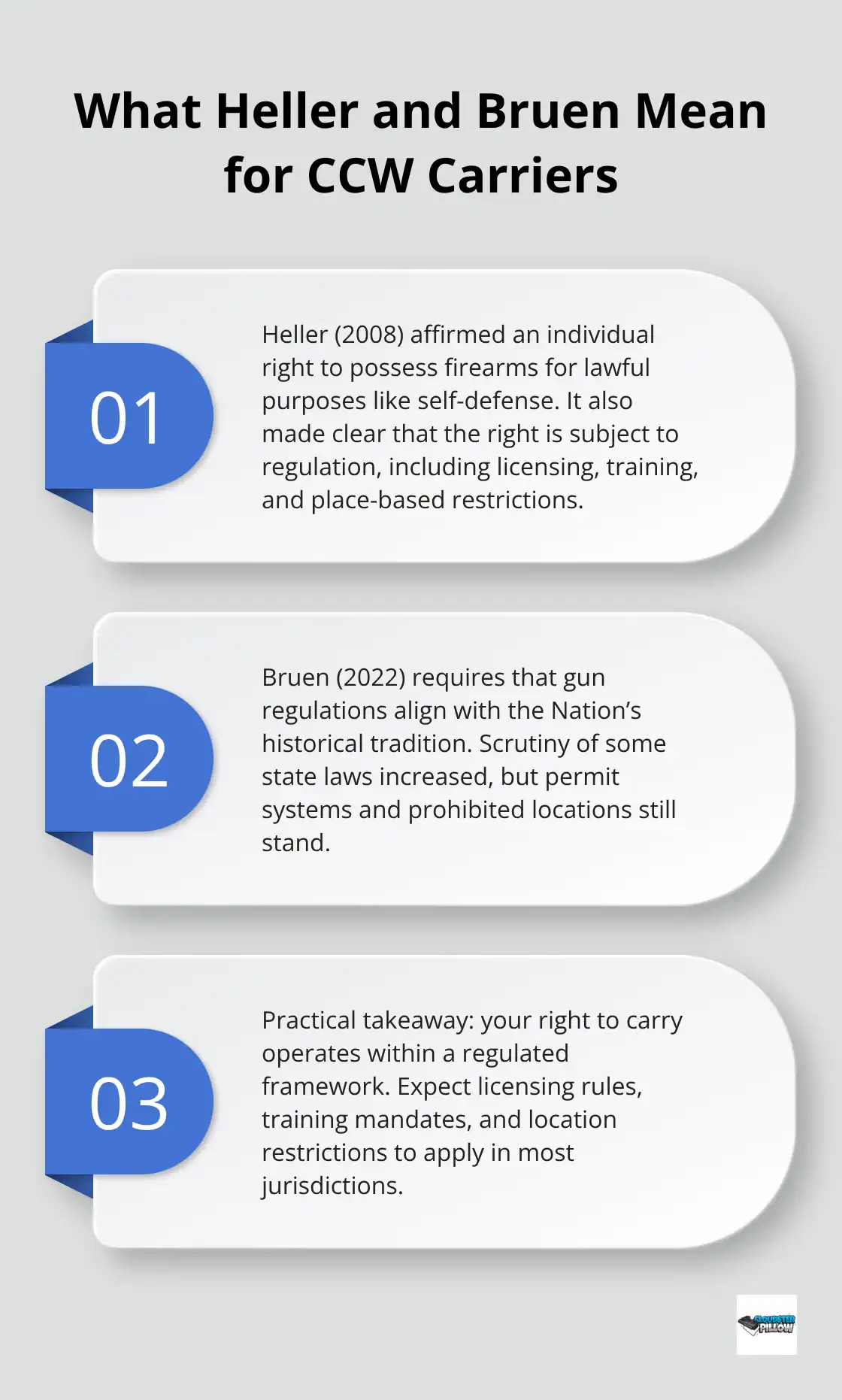
In practice, your constitutional right to carry doesn’t override state-specific licensing schemes, federal gun-free zones, or local restrictions on where you can legally carry your firearm.
How Federal and State Laws Overlap
Federal and state regulations operate on different tracks, and understanding how they overlap is essential for staying legal. Federal law establishes baseline prohibited areas like federal buildings, courthouses, and schools, while states layer their own requirements on top. This creates a patchwork system where your carry permit in one state may not be valid in another. Some states operate on shall-issue versus may-issue permit systems, where shall-issue authorities must grant permits to qualified applicants, while may-issue frameworks give officials discretion to deny permits. As of 2024, 29 states allow permitless carry for law-abiding citizens, meaning no permit is required to carry concealed, but even in those states federal restrictions still apply.
Why You Can’t Assume Your Rights Are the Same Everywhere
You can’t assume your rights are the same everywhere, which is why serious carriers invest time in understanding their home state’s specific laws and the laws of states they travel to regularly. Your training and gear choices should align with your jurisdiction’s legal framework, and that framework directly influences how you carry, where you can carry, and what documentation you need to have on you at all times. The next section covers the specific permit systems and licensing requirements that govern whether you can legally carry in your state.
Concealed Carry Permits and Licensing Requirements
Understanding Permit Systems Across the Country
The permit system you navigate depends entirely on where you live, and this distinction fundamentally shapes your path to legal carry. Twenty-seven states operate as permitless carry jurisdictions as of 2025, meaning you can carry concealed without any permit at all.

The remaining states require permits, and their processes vary wildly. In shall-issue states like Florida, Texas, and Ohio, authorities must issue permits to applicants who meet basic qualifications such as passing a background check and meeting residency requirements. May-issue states like California, New York, and Massachusetts give officials discretion to deny permits even when applicants meet technical requirements, often requiring you to demonstrate a specific need for self-defense that officials find compelling.
The Application Process and What You’ll Need
The application process itself demands precision. You’ll need to provide personal information, consent to background checks that examine criminal history and mental health records, and in some states complete mandatory training before approval. Training requirements vary significantly-some states like Florida require no formal training for permit issuance, while others like Maryland mandate 8 hours of live-fire instruction before you can legally carry. Processing times range from same-day approvals in permitless states to months of waiting in jurisdictions with heavy application volumes. If you’re serious about carrying, research your specific state’s requirements before you buy your first defensive firearm because permit availability directly affects whether carrying is practical in your location.
Reciprocity: What Your Permit Actually Covers
Reciprocity matters most when you travel, and this is where many carriers make expensive legal mistakes. Concealed carry permit reciprocity agreements are selective and constantly shifting. Your Florida permit, recognized in 38 states, becomes worthless the moment you cross into California, which recognizes no out-of-state permits. The best approach involves consulting official resources like the state attorney general’s website or organizations tracking reciprocity agreements before traveling with your firearm.
Some carriers maintain multiple permits from different states to expand their legal carry range, which requires managing applications in multiple jurisdictions and staying current on permit renewals. Interstate travel with firearms demands additional caution: federal law prohibited carry locations include federal buildings, post offices, and airports beyond security checkpoints.
How Permit Status Affects Your Carry Setup
Your carry method-whether you use an AIWB holster, IWB setup, or pocket carry-must remain consistent with your state’s legal framework. Gear comfort becomes secondary to legal compliance, and your holster choice should support both your jurisdiction’s requirements and your daily routine. Many experienced carriers use tools like permitless carry maps from constitutional carry tracking sites to verify their legal status in unfamiliar states before departing.
The specific restrictions in your state also influence what you can carry and where you can carry it. Federal restrictions apply everywhere, but state and local laws layer additional boundaries on top of those baseline rules. Understanding these boundaries before you select your carry position and holster setup prevents costly legal problems down the road. The next section covers exactly where those boundaries exist and what penalties apply when carriers cross them.
Restricted Locations and Legal Boundaries
Federal Prohibited Spaces Apply Everywhere
Federal law creates a hard baseline of prohibited spaces that applies everywhere in the United States, regardless of your state’s permit status or constitutional carry laws. Federal buildings, including courthouses and post offices, remain completely off-limits for armed civilians. Schools and school grounds stay federally prohibited, and this restriction extends beyond K-12 to college campuses in most states. Airports present a specific challenge: you can carry through public airport terminals up to the TSA security checkpoint, but attempting to bring a firearm through security or onto an aircraft violates federal law with potential 10-year prison sentences.

Federal law also prohibits carry in certain national parks and wildlife refuges, though this varies by specific location and you should verify restrictions before visiting.
State and Local Restrictions Layer Additional Boundaries
Beyond these federal restrictions, your state and local jurisdictions add their own prohibited areas, and this is where serious carriers make costly mistakes. Some states prohibit carry in bars and restaurants serving alcohol, while others allow it. California prohibits carry in any location where the owner posts a 25.6 sign, and violating this restriction results in misdemeanor charges. New York restricts carry in sensitive locations including libraries, public transit, and theaters. Texas prohibits carry in certain private businesses that post 30.06 signs for handguns or 30.07 signs for open carry. Many states also restrict carry in courthouses, government buildings beyond federal facilities, and psychiatric facilities. The specific list for your state determines whether your daily commute route remains legal or puts you at constant legal risk.
Understanding Escalating Penalties for Violations
Penalties for carrying in restricted spaces escalate quickly and vary dramatically by jurisdiction. Federal violations result in felony charges, but state and local violations range from misdemeanors to felonies depending on the location and your state’s statutes. A first offense for carrying in a prohibited state location might result in a misdemeanor charge, fines up to $1,000, and potential jail time of 30 to 90 days. Repeat violations or carrying in particularly sensitive locations like courthouses often result in felony charges, which permanently damage your ability to own firearms through federal prohibition on felons possessing guns. Some states treat carrying in schools as a felony regardless of first or repeat offense status.
The Permanent Consequences Beyond Criminal Charges
A violation creates a permanent record that affects employment prospects, housing applications, and security clearance eligibility. Ignorance provides no legal protection, and your responsibility as a carrier is to know the specific restrictions in every location where you regularly carry. Many experienced carriers maintain a written list of prohibited locations in their jurisdiction and review state-specific carry laws before traveling. Your holster choice and carry position should support legal compliance first, because no comfort gain justifies legal exposure. Selecting the right IWB or AIWB holster setup matters, but only after you’ve confirmed that your carry location is legal in your jurisdiction.
Final Thoughts
Carry law basics protect both your freedom and your future, and understanding them separates responsible carriers from those who face criminal charges. Your state’s permit system, reciprocity agreements, and prohibited locations form a legal framework that changes dramatically across state lines, and ignorance provides no protection in court. A single violation results in criminal charges, permanent felony records, and permanent loss of your right to own firearms.
Your responsibility extends beyond selecting the right holster or completing training-you must know your state’s specific permit requirements, understand reciprocity before traveling, and maintain awareness of federal and state prohibited locations. States update their carry laws annually, and what was legal last year might carry penalties this year, so you need to verify the prohibited locations in your jurisdiction and commit those boundaries to memory. Organizations tracking constitutional carry laws and your state’s attorney general office provide reliable reference points for staying current.
Your carry setup should support legal compliance first, and whether you choose an AIWB holster, IWB configuration, or pocket carry, your gear selection matters less than knowing where you can legally carry it. We at Cloudster Pillow understand that comfort and concealment work best when they align with your legal responsibilities, and our holster wedge enhances all-day comfort for everyday carriers while supporting the consistent, confident carry that responsible gun ownership demands.
Built for all-day concealed carry comfort.
The Cloudster Pillow uses adjustable shredded cooling-gel memory foam in a soft fabric cover, so you can dial in the exact thickness for your body and your holster.
