
Articles and Blogs, CCW Awareness & Mindset
Everyday Carry Mindset Tips: Training Your Mind for Real Life CCW
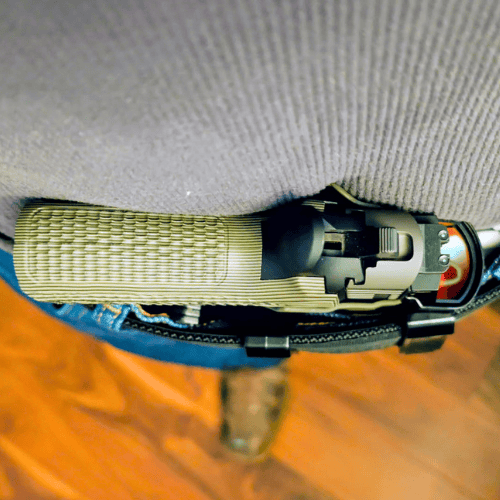
Carrying a firearm daily means carrying responsibility. Your gun is only as effective as your mindset, and that’s where everyday carry mindset tips become game-changing.
At Cloudster Pillow, we know that most CCW carriers focus heavily on gear and range time. But the mental side of carrying is what separates prepared carriers from those who freeze when it matters.
Mental Awareness That Actually Matters
Establish Your Environmental Baseline
Your environment tells you everything if you know what to look for. Most CCW carriers understand they need to be aware, but awareness without direction becomes paranoia. The difference between effective situational awareness and constant anxiety comes down to establishing a baseline for each location you enter. When you walk into a coffee shop, library, or grocery store, your brain should automatically register what normal looks like for that space-the noise level, typical customer flow, staff positions, and regular patterns. This baseline becomes your reference point. When something deviates from that baseline, your mind flags it immediately.
Use Visual Scanning Techniques
Studies on visual processing show that your brain processes significant information visually, which means your eyes should scan systematically rather than randomly. Look at entrances and exits first, identify where cover exists versus mere concealment, watch people’s hands and body language, and position yourself with a view of the entrance while keeping your back to a wall when possible. This isn’t paranoia; it’s the same scanning pattern law enforcement uses during patrol.
Recognize Threats Through the Cooper Color Code
Your brain recognizes threats faster when you train it to spot early warning signs. The Cooper Color Code framework developed by Jeff Cooper breaks down alertness levels into four colors of escalating degrees of preparation: White means unaware, Yellow means relaxed alertness, Orange means you’ve identified a potential threat, and Red means immediate action. Most CCW carriers should operate in Yellow as their default state-aware but not anxious. When you notice someone’s behavior shifts unexpectedly, their hands move toward a pocket, or their gaze focuses intensely on you or your belongings, you move to Orange and create distance.
Train Your Decision-Making Under Pressure
Decision-making under pressure improves dramatically with mental rehearsal. Before you carry, visualize common scenarios: someone becomes aggressive in a parking lot, a stranger approaches too quickly, or a situation escalates rapidly.
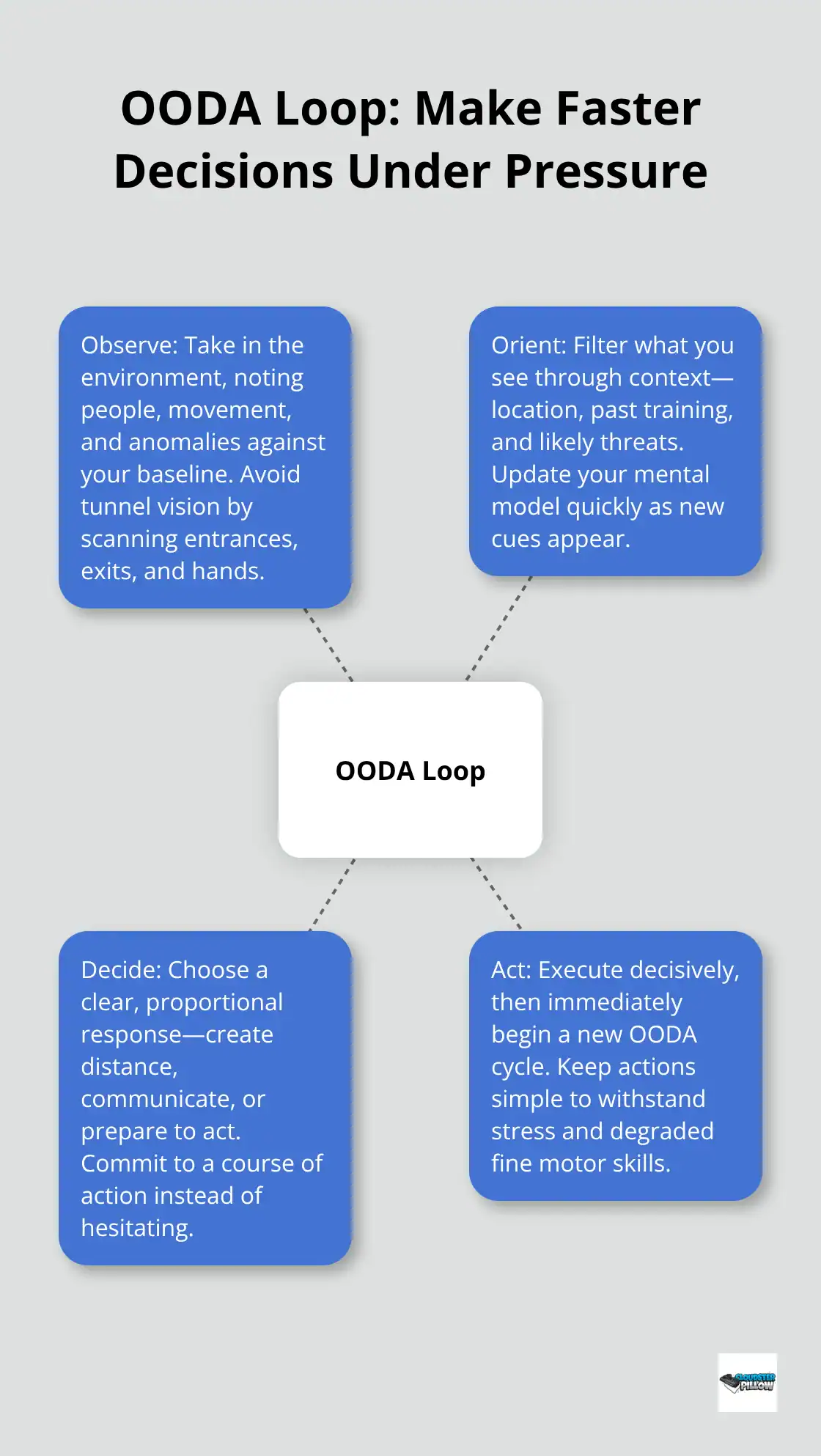
Spend two minutes each week mentally walking through these scenarios and your response-where you’d move, how you’d communicate, when you’d create distance or call 911. This mental practice activates the same neural pathways as physical training. John Boyd’s OODA Loop (Observe-Orient-Decide-Act) gives you a repeatable decision-making cycle that operates through an iterative process once trained. Your goal isn’t to become hypervigilant but to make threat recognition automatic so your conscious mind stays calm and your responses remain controlled.
Connect Comfort to Mental Discipline
Comfort during this constant awareness matters more than most carriers realize. When your holster or carry method causes discomfort, you adjust your position or clothing frequently, which breaks your focus and increases the likelihood of printing or poor concealment. A proper carry setup maintains the mental discipline that awareness demands. This is why everyday carriers who invest in solutions that enhance comfort and concealment find they can sustain their awareness practice without distraction. The next step in your mindset development involves moving from awareness into consistent training that builds the confidence to act decisively when it matters.
Building Confidence Through Consistent Training
Consistency Beats Intensity Every Single Time
Consistency beats intensity every single time, and most CCW carriers get this backwards. You’ll see people at the range who fire 200 rounds once a month and call themselves trained, then six months pass without another session. That approach leaves massive gaps in your muscle memory and decision-making speed. Instead, shooting 50 rounds every two weeks maintains your neural pathways far better than sporadic high-volume days.
Dry-Fire Practice Fills the Critical Gaps
Dry-fire practice at home fills these gaps even more effectively. Spend 10 minutes three times per week doing dry-fire drills in a safe, dedicated space. Draw from your holster, practice trigger control on a fixed target, and work on your presentation speed.
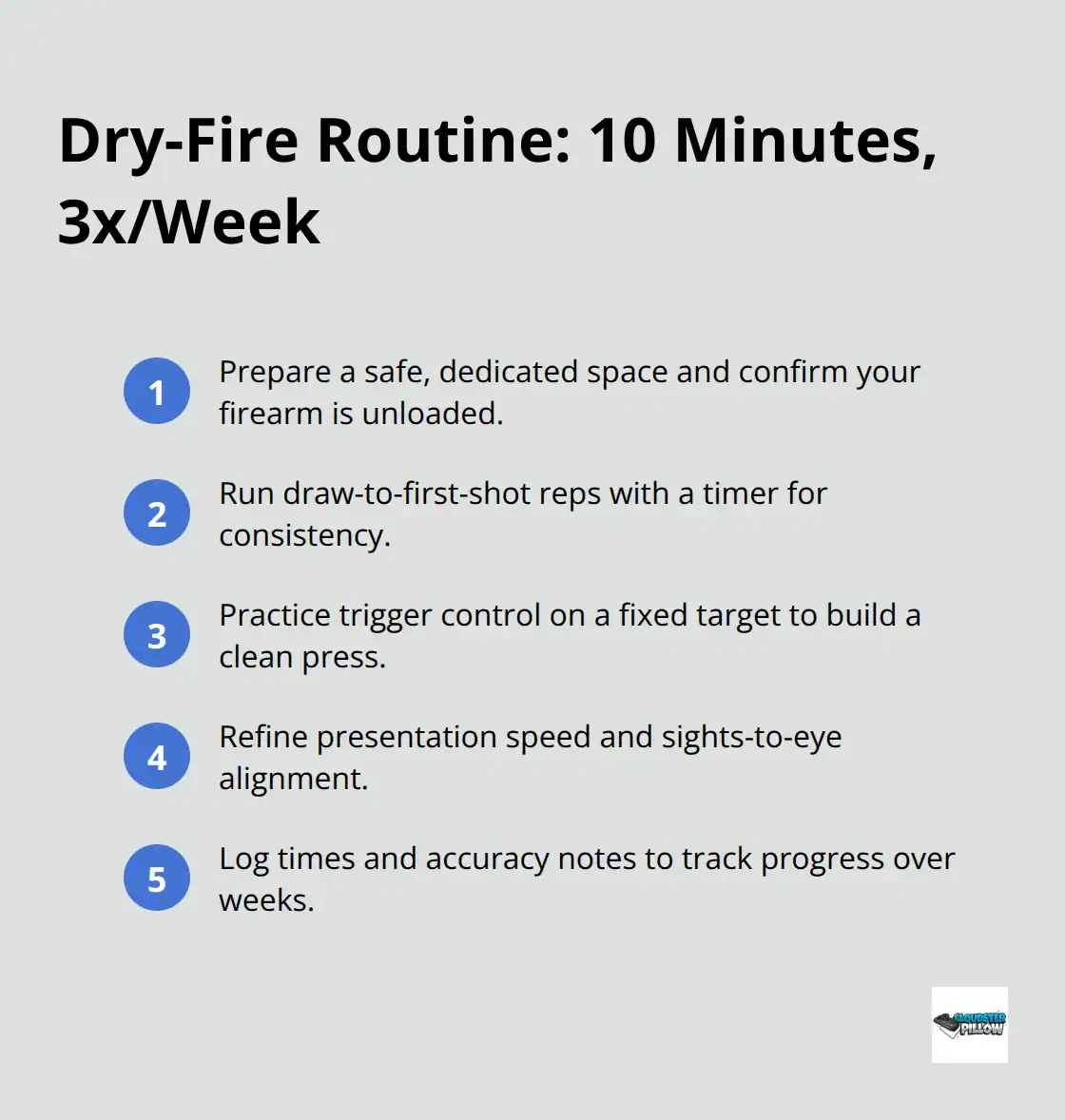
After four weeks of this routine, your draw becomes smoother and your trigger press more consistent. Track your performance metrics: measure your draw speed with a timer, count your hits on target, and note how your accuracy changes across different distances. When you see your draw speed improve from 1.8 seconds to 1.4 seconds, that concrete progress builds actual confidence, not false bravado.
Train Exactly as You Carry
The mistake most carriers make is training in isolation from their real carry setup. If you practice at the range with a different holster, different clothing, or different positioning than your everyday carry, your muscle memory doesn’t transfer to real life. Train exactly as you carry. Wear your normal concealment clothing, use your actual IWB or AIWB holster, and practice from your actual carry position.
This specificity matters enormously-your body learns the exact movements, angles, and timing that apply to your daily life. After eight weeks of consistent training aligned with your real carry method, your draw becomes automatic enough that your conscious mind stays focused on threat assessment and decision-making rather than fumbling with your gear. Comfort during training directly impacts your ability to maintain this consistency. When your carry setup causes discomfort, you adjust your position or clothing frequently, which breaks your focus and degrades your practice quality.
Adapt Your Training Every 30 Days
Adjust your training plan every 30 days based on what your metrics show. If your accuracy drops at 15 yards, dedicate two weeks to distance work. If your draw speed plateaus, focus on presentation mechanics. This adaptive approach keeps training relevant and prevents the stagnation that kills motivation. The carriers who stay committed are the ones who see measurable improvement and feel their readiness actually increase. Once you establish this training rhythm and track your progress, you’re ready to address what happens when stress enters the equation-because real-world scenarios demand more than just technical skill.
Stress Changes Your Performance Under Pressure
Your body’s stress response during a threat is automatic and predictable, which means you can train it specifically. When adrenaline floods your system, your heart rate spikes, fine motor control degrades, and tunnel vision narrows your peripheral awareness. Research from the International Association of Law Enforcement Firearms Instructors shows that officers under stress experience measurable decreases in accuracy and increased reaction times compared to calm range conditions. This isn’t weakness-it’s physiology. The carriers who perform well in real situations aren’t the ones who ignore this reality; they’re the ones who deliberately train under simulated stress to rewire their nervous system’s response.
Incorporate Stress Into Your Training Immediately
Start adding stress to your training right now. Add time pressure to your dry-fire drills: draw and fire three rounds in under three seconds, then rest and repeat. Add physical stress by completing 20 pushups before your draw practice, so your elevated heart rate and breathing mirror what happens during an actual threat.
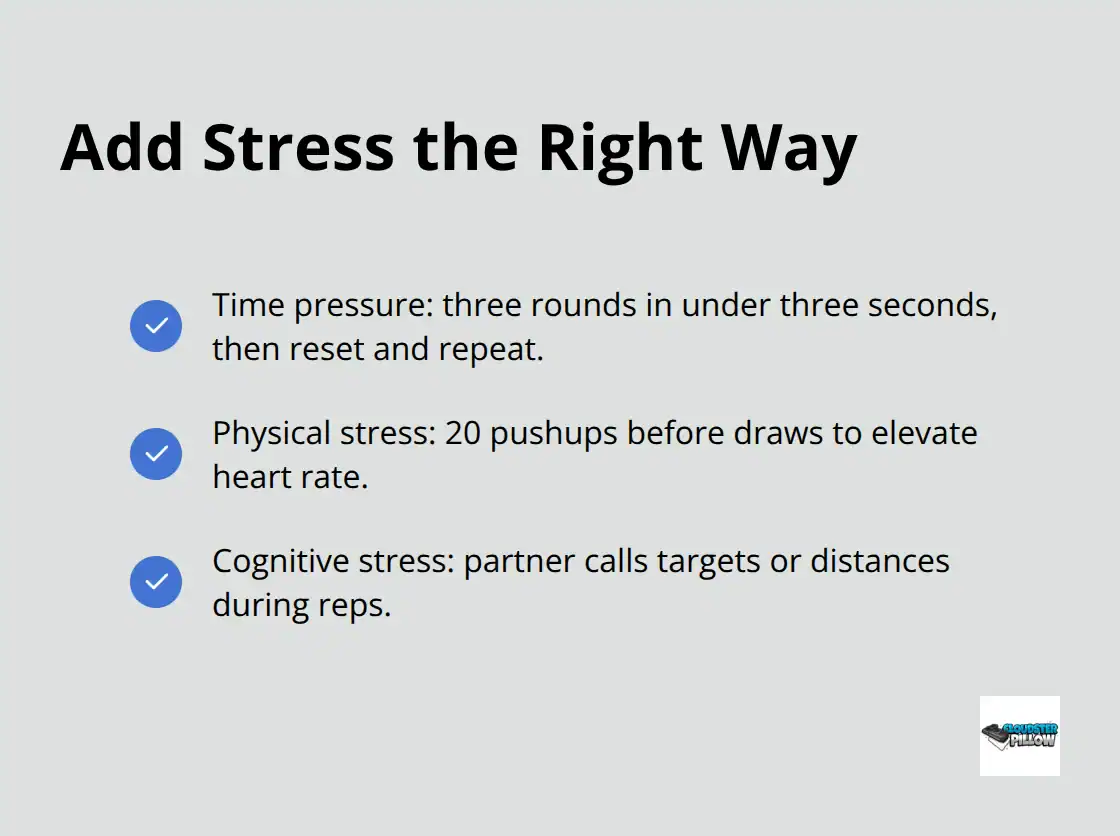
Add cognitive stress by having a training partner call out distances or targets while you perform your draw, forcing your brain to process information while managing your presentation. After four weeks of this type of training, your body learns to maintain basic competence even when adrenaline is present. Your draw speed might slow slightly, but it remains functional. Your accuracy drops less than it would have without stress inoculation training.
Make Real Decisions Under Pressure With Scenario Training
Scenario-based training forces your mind to make real decisions under pressure, which is where most carriers fail. Range drills teach you how to shoot, but they don’t teach you when to shoot or how to handle the chaos that precedes the decision to draw. Spend time at facilities that offer force-on-force training with airsoft or simulated rounds so you experience decision-making in realistic environments. You’ll discover that most threats don’t look like movie scenes-they’re confusing, fast, and require you to assess whether a real threat exists before acting. This type of training also teaches you your actual limitations. You’ll learn whether you can reliably identify targets in a crowded environment, whether you can distinguish a threat from an innocent person, and whether you can make decisions without freezing.
Control Your Breathing When Stress Appears
Breathing control during stress is mechanical and learnable. The 4-4-4 technique works reliably: inhale for four counts, hold for four counts, exhale for four counts. Practice this during training sessions so it becomes automatic, not something you try to remember during an actual event. Box breathing directly calms your parasympathetic nervous system and lowers your heart rate within seconds. Use this technique during dry-fire practice when you notice your hands shaking or your breathing becoming rapid. After 30 days of consistent practice, your body will default to this breathing pattern automatically when stress appears, without conscious effort.
Final Thoughts
Your everyday carry mindset tips matter far more than your gear collection. The mental framework you build through environmental awareness, consistent training, and stress inoculation directly determines how you perform when it actually counts. A carrier who trains their mind to recognize threats early, practices decision-making under pressure, and maintains composure through breathing control will outperform someone with expensive equipment and sporadic range visits every single time.
The connection between mental training and physical readiness is inseparable. When you establish a baseline for your environment, your body learns to flag deviations automatically. When you practice your draw consistently in your actual carry setup, your muscle memory transfers directly to real life. When you add stress to your training, your nervous system adapts so adrenaline doesn’t paralyze you. Comfort during this commitment matters more than carriers typically acknowledge-when your holster causes discomfort, you adjust your position constantly, which breaks your focus and degrades your awareness practice.
This is why many carriers turn to solutions that enhance both comfort and concealment without replacing their entire setup. At Cloudster Pillow, we designed our holster wedge specifically for everyday carriers who refuse to compromise between comfort and readiness. Our wedge improves all-day concealment for AIWB and IWB holsters, so you can maintain the mental discipline that awareness demands, and we invite you to explore how comfort and concealment work together to support your carry practice.
