
Gun Belt
Kore Belt Guide 2026: Setup, Sizing & Which One to Get
I’m in an odd spot to write this: I’m an authorized Kore dealer at Cloudster Pillow, and I’m also the guy wearing a Kore belt right now, with a P365 or a Glock 19 in the waistband, like most days. So this is both the sales page and the owner’s manual — everything people actually ask me about the Kore belt line: how the ratchet works, how to set one up, and which one to get.
The short answer: a Kore belt is a cut-to-size gun belt built on the X-Series ratchet track — a reinforced 1.5″ strap with over 40 quarter-inch adjustment positions instead of belt holes, interchangeable buckles, and a load rating of up to 6 lbs of holster and gear.
What Is a Kore Belt?
Kore Essentials builds ratcheting belts around one idea: a track sewn along the inside of the strap instead of punched holes, so the buckle locks anywhere along 40+ quarter-inch positions. A Kore belt in the gun-belt line adds a reinforced Power-Core™ center that keeps the strap rigid across its width — the property that stops a holster from rolling the belt outward and printing.
The line we stock, at Kore’s own MSRP:
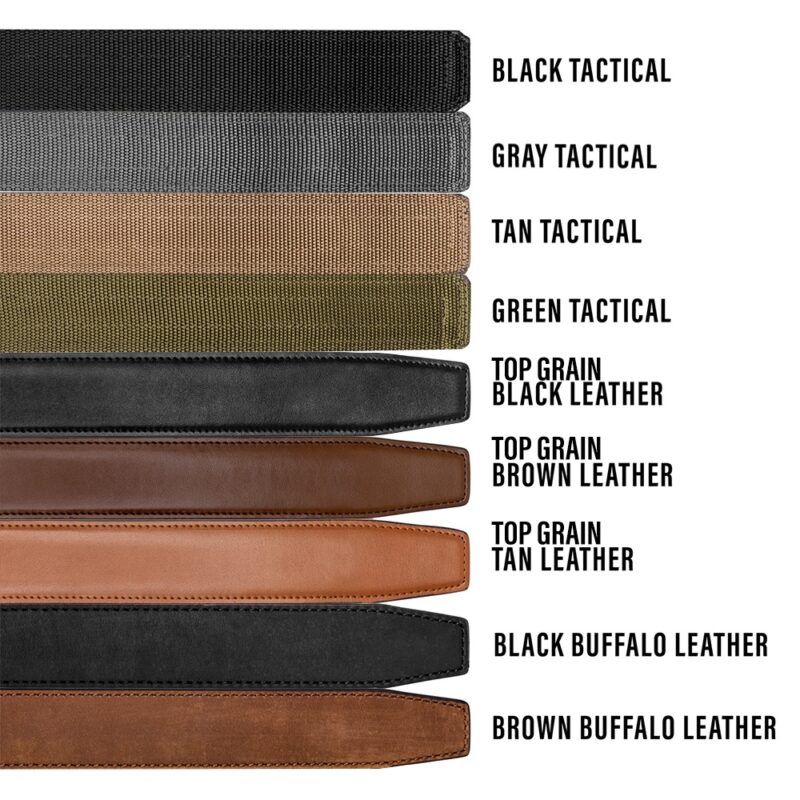
- Tactical nylon ($69.95) — USA-made webbing, the everyday workhorse.
- Buffalo leather ($69.95) — brown, black, tan, coffee; the office pick.
- ArmorTek leather ($59.95) — cowhide look, engineered for twice the durability.
- Basketweave ($59.95) — the classic duty emboss on ArmorTek leather.
- Carbon fiber ($59.95) — one strap covers 24″–54″.
The full lineup lives on our Kore gun belts page, and Kore’s own site is at koreessentials.com if you want the manufacturer’s spec sheets.
How Does the Kore Ratchet Buckle Work?
The inside of the strap carries a sewn-in track. The buckle’s pawl clicks into that track every quarter inch, and a release lever under the buckle face lets the strap run free when you want it off. Practical upshots I notice daily: you tighten the belt to the rig you’re actually wearing — not to the nearest hole an inch away — and you can back off one click after a big lunch or a long drive without undoing anything.
Buckles are interchangeable across the line: any X-Series buckle fits any X-Series strap, so one buffalo strap and one nylon strap can share a buckle, or you can dress the same strap up and down. Most buckle styles are the same price; the X4 stainless steel buckle runs $10 more. For how ratchet systems compare to a traditional holed belt, see ratcheting vs. traditional gun belts.
Finish-wise the X-Series runs the practical spread: gunmetal (X1, X2, X3, X6), black (X5, X6, X7, X10, X11, X12), nickel (X8, X9), brass (X8), and the stainless steel X4. I keep a gunmetal on my nylon strap and a black on the leather — but that’s taste, not function; the track mechanism is identical across all of them.
What Comes With a Kore Belt?
Each belt ships as a complete kit: the X-Series buckle you pick, the strap itself, a tip keeper on most straps, and the hex wrench and set screws that lock the buckle onto the cut end. There’s nothing else to buy — the box contents are the whole setup, which is why the install below takes minutes.
How Do You Set Up a Kore Belt?
Every Kore belt ships cut-to-size — one strap you trim to your exact waist. Four steps:
- Measure where you’ll actually wear it. Put on the pants and holster you carry with and measure that — an IWB rig adds real inches over your pants size.
- Trim the strap to length following the sizing instructions included in the box — and read them first: Kore can’t take a cut belt back for return or exchange.
- Attach the buckle. Clamp it onto the cut end and lock it down with the included set screws and hex wrench.
- Fit the tip keeper (included with most straps) so the tail stays flat against the belt.
That’s the whole job — a few minutes with the hardware in the box.
Which Kore Belt Should You Get?
| Belt | Price (MSRP) | Sizes | Look | Best for |
|---|---|---|---|---|
| Tactical nylon | $69.95 | Cut-to-size 24″–44″ | Low-profile tactical | Daily EDC, range days |
| Buffalo leather | $69.95 | 24″–44″ (XL select styles) | Dress / business casual | Office carry |
| ArmorTek leather | $59.95 | 24″–44″ + XL | Dress, tougher finish | Hard daily wear |
| Basketweave | $59.95 | 24″–44″ | Classic duty | Uniform / traditional |
| Carbon fiber | $59.95 | 24″–54″ one strap | Modern textured | Widest size range |
If you’re weighing these against the broader field of carry belts, my best concealed carry belt guide ranks the types side by side.
Does a Kore Belt Work for Concealed Carry?
It’s what the gun-belt line is for. The 1.5″ width matches virtually every IWB and OWB holster clip, the Power-Core™ reinforcement carries a loaded pistol without belt roll, and Kore rates the belts for up to 6 lbs of gear — a full-size pistol, spare mag, and light with room to spare. My own G19 and P365 have lived on a Kore belt through range days and fourteen-hour days alike. The belt handles the hours you’re upright; for sitting and sleeping with a holster on, pair it with the Cloudster Pillow holster wedge — belt plus wedge is the whole-day system. New to the platform question entirely? Start with the EDC gun belt guide.
Kore Belt Sizing
Standard straps fit 24″–44″ waists; select styles come in XL for 44″–54″, and the carbon fiber strap covers 24″–54″ on its own. Because every strap is cut-to-size, “between sizes” isn’t a thing — you trim to your number. The one mistake to avoid: sizing from your pants label instead of a tape measure over your carry setup. The full Kore belt sizing guide covers measuring, the size chart, and the cut itself.
Kore Belt FAQ
Are Kore belts worth it?
If you carry a firearm, yes — a Kore belt costs $59.95–$69.95 and does the one thing cheaper belts can’t: hold a loaded holster rigid at an exact tension all day. If you don’t carry, a fashion ratchet belt does the wardrobe job for less.
Do Kore buckles fit any Kore strap?
Yes. Every X-Series buckle fits every X-Series strap — swap one buckle between a nylon strap for the weekend and a buffalo leather strap for the office. Buckle styles are priced the same except the X4 stainless, which runs $10 more.
How do you cut a Kore belt to size?
Measure your waist over the clothes and holster you carry with, then trim the strap to that length per the included sizing instructions and clamp the buckle on with the included set screws and hex wrench. It’s a few minutes of work, and the ratchet track means the fit stays quarter-inch exact afterward.
Are Kore belts made in the USA?
The tactical nylon belts are built around USA-made nylon webbing and ship from Kore’s US operation; buckle hardware is sourced separately, so no full-US-origin claim on every component. The buffalo leather and specialty belts are part of Kore’s standard line — we don’t make a US-origin claim on those.

Pingback: Best CCW Belt for Your Body Type & Outfit (2026)
Pingback: Best Concealed Carry Belt 2026: What I Wear Every Day
Pingback: Kore Belt Sizing: Cut-to-Size Guide (Measure Once, Cut Once)
Pingback: Concealed Carry For Beginners: A Beginner’s Guide to Responsible Gun Ownership