
Home Defense
What’s the Best Gun for Home Defense? How to Choose It and Set It Up
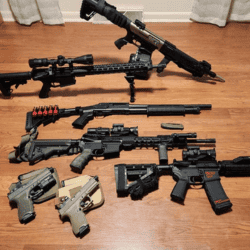
Short answer: The best gun for home defense is one you can run reliably under stress, in the dark, half-awake. For most people that’s a 9mm handgun with a weapon-mounted light. It’s easy to store, easy to reach, and you can operate it with one hand while you call 911 or open a door. A shotgun and a carbine (an AR-15 or a pistol-caliber carbine) are the other two proven choices, and both are easier to shoot well than a handgun if you have the room and the training. Whatever you pick, how you store it, light it and practice with it matters as much as the gun itself.
Handgun vs Shotgun vs Rifle for Home Defense
| Handgun | Shotgun | Carbine (AR-15 or PCC) | |
|---|---|---|---|
| Storage and access | Easiest. Fits a bedside safe or nightstand. | Needs a long safe or rack | Needs a long safe or rack |
| One free hand | Yes, for a phone, door or family member | No, it’s a two-handed gun | No, it’s a two-handed gun |
| Ease of hitting | Hardest of the three to shoot well | Easier with a stock, but the most recoil | Easiest to shoot accurately, light recoil |
| Capacity | Typically 10–17 rounds | Usually 4–8 shells | Commonly 20–30 rounds |
| Maneuvering indoors | Best in halls and doorways | Longest, hardest around corners | Shorter than most shotguns |
| Best for | Most people, especially if you already carry one | People who train with it and have room to store it | People who train with it; often the easiest to shoot |
Capacities vary by model and are limited by law in some states. Check what’s legal where you live.
What Actually Makes a Good Home Defense Gun
- Proven reliability. Pick a widely used model with a long track record, then prove your own gun runs by putting a few hundred rounds of your chosen defensive ammunition through it.
- A weapon-mounted light. Home defense happens in the dark, and you have to identify what you’re pointing at before you do anything else. A light on the gun keeps both hands free for the gun. When we asked our own customers this month what they carry, about half of the people who answered said their pistol already wears a light.
- A gun that fits you. If you can’t manage the recoil or reach the controls, you won’t shoot it well under stress. Try before you buy if you can.
- Training. Practice drawing or retrieving the gun, turning on the light and moving through your own house. A home defense plan you’ve walked through once is worth more than a better gun.
- The right ammunition. Every common defensive round can pass through interior walls. Use quality defensive ammunition, know what’s behind the rooms you’d be defending, and plan your position around family members’ bedrooms.
The Four Rules Still Apply at Home
- Treat every gun as if it’s loaded.
- Never point the muzzle at anything you aren’t willing to destroy.
- Keep your finger off the trigger until you’re on target and ready to shoot.
- Be sure of your target and what’s beyond it.
The fourth rule is the reason a light matters so much inside a house.
If You Already Carry, Your Carry Gun Can Be Your Home Defense Gun
For a lot of people the simplest answer is the pistol they already carry every day. You already know its controls, you already practice with it, and there’s only one gun to maintain. A compact 9mm like the Glock 19 is a common choice for exactly this reason. See our Glock 17 vs 19 comparison if you’re choosing between a full-size and a compact, and our Glock 19 holster guide for carrying it.
If you carry that same gun during the day, make the carry setup comfortable enough that you actually wear it. That’s what we make: the Cloudster Pillow holster wedge, which tucks the grip in so it stops printing and cushions the holster edge so it stops digging in.
How to Store and Stage a Home Defense Gun
A home defense gun has two jobs that pull against each other: fast for you to reach, and impossible for anyone else to reach. How you balance that depends on who lives in your house.
- Kids or visitors in the home: a quick-access bedside safe (biometric, keypad or RFID) is the standard answer. Many states have child-access-prevention laws that set storage requirements, so check your state’s law.
- Keep the trigger covered. If the gun is staged at the bedside, leave it in its holster so nothing can touch the trigger while you’re half-asleep.
- Give it one consistent spot. In the dark, your hand needs to find the gun, the light and your phone without searching. That’s why we build our reinforced carbon fiber EDC tray: one place on the nightstand for your holstered pistol, keys, wallet and phone. We’re also developing a version that holds the gun securely with the trigger guard covered; see the gun-holder tray page for updates.
- Stage the light and phone together. Your first moves in the dark are light, phone, gun. Keep them within one arm’s reach.
After a Self-Defense Incident at Home
Even a clearly justified self-defense shooting in your own home can bring an investigation and legal bills. Many gun owners carry self-defense legal protection for that reason. Our concealed carry insurance comparison covers what the main plans cost and what they actually pay for.
Quick Answers
Is a shotgun better than a handgun for home defense?
Not automatically. A shotgun is easier to hit with at close range if you’ve trained with it, but it’s long, has heavy recoil and needs two hands. A handgun is easier to store and reach, and it leaves a hand free. For most people, the handgun they already practice with is the more practical choice.
What’s the easiest home defense gun for a beginner?
Many instructors point beginners to a carbine (like a pistol-caliber carbine) because it’s the easiest to shoot accurately with light recoil. If storage space or one-handed use matters more, a full-size or compact 9mm handgun with a light is the usual pick. Take a class with whichever you choose.
Do I need a light on my home defense gun?
It’s strongly recommended. You must identify your target before you shoot, and a light on the gun lets you do that while keeping both hands on it.
Where should I keep a home defense gun?
In a quick-access safe if anyone else could reach it, or holstered in one consistent spot next to your light and phone if it’s just you. Always check your state’s storage laws.
Written by the Cloudster Pillow team. We make holster wedges and reinforced carbon fiber EDC trays. We don’t sell firearms, and nobody paid to be mentioned here. This is general information, not legal advice. Take a class, and follow the laws where you live.
