
Police Duty Belts: 2″ Patrol and 2.25″ Duty, Rated 30 lb
Kore police duty belts in 2.25″ duty and 2″ patrol widths — rated to 30 lb, micro-adjustable in quarter-inch steps, inner belt included (padded or non-padded, same price). Match the width to the holster, pouches and keepers you already own or that your department issues; the buying guide below covers width, material, keepers, comfort and how to size and cut the belt.
Kore police duty belts in 2.25″ duty and 2″ patrol widths, rated to 30 lb and micro-adjustable in quarter-inch steps, inner belt included. Pick your width, then your finish.
Duty Belts
Duty Belts
Duty Belts
Duty Belts
Duty Belts
Duty Belts
Kore rates its 2.25″ duty belt at 30 lb against up to 6 lb for its 1.5″ leather belts, and Kore says the Power-Core center adds stiffness and support.
Load rating by belt width (as published by Kore)
1.25″ slim EDC — 8 lb
1.5″ leather — up to 6 lb
1.5″ tactical / USA — 10 lb
1.75″ garrison — 10 lb
1.75″ MOLLE battle belt — 20 lb
2″ patrol duty — 30 lb
2.25″ duty — 30 lb
Why micro-adjustment matters more under a duty load
A hole-punched belt only moves from hole to hole. Kore's ratchet track adjusts in quarter-inch increments with over 20 sizing positions, and Kore says it adjusts without removing the belt.
Padded or non-padded inner belt: you choose
Every duty belt kit includes a reinforced inner belt, and you choose non-padded or padded when you order, at the same price. Kore says the only difference between the two is 2 mm of padding. The 2.25″ XL (48″–60″) comes with the padded inner belt only.
Nylon, Leather or Basketweave: Which Duty Belt Material?
Most duty belts are 2.25 inches wide and are made of ballistic nylon or leather. Nylon duty gear is generally less expensive, lighter and easier to maintain than leather gear of comparable quality, while leather is generally regarded as having a more traditional and professional appearance. Here, Kore’s nylon and ArmorTek duty belts cost the same.
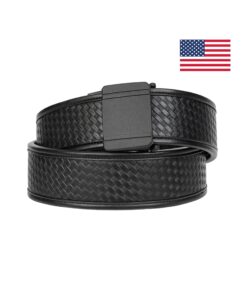
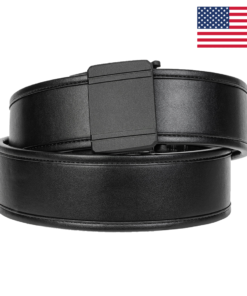
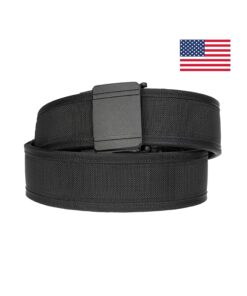
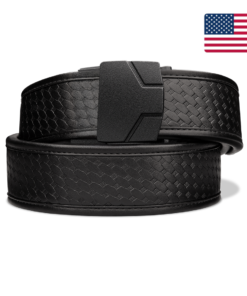
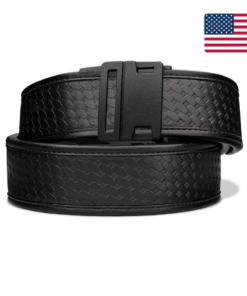
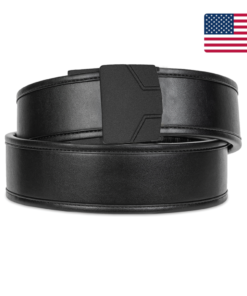
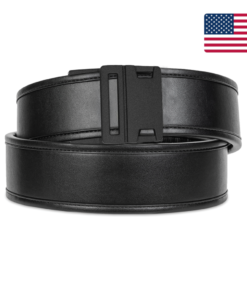
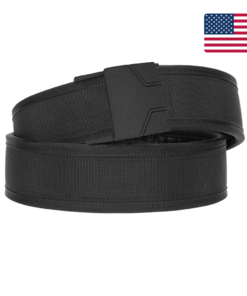
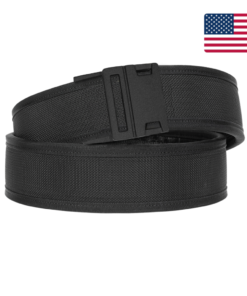
Kore offers its duty belts in plain black Armortek, basketweave Armortek and nylon. Armortek is a man-made material that Kore says is engineered to outperform and outlast leather, with the look and feel of cowhide leather and weather and scratch resistance. The Kore Leather Duty Belt 2.25″ sold here has an Armortek outer belt, not animal hide. The Kore Basketweave Duty Belt 2.25″ has a basketweave-pattern outer belt in Armortek. The Kore Nylon Duty Belt 2.25″ has a nylon webbing outer belt. All three are 2.25″ wide, rated to 30 lb and use Kore's ratchet track, which adjusts in quarter-inch increments.
Which to choose:
- Nylon if your agency has moved to nylon gear.
- Plain (leather look) if you want the traditional appearance associated with leather.
- Basketweave if your department specifies basketweave for the belt, holster and pouches.
Check your department's uniform policy before you buy; it may specify the material.
2″ Patrol or 2.25″ Duty: Which Width Do You Need?
Most duty belts are 2.25 inches wide. Belt keepers can be made for a specific belt width; Kore, for example, sells separate keepers for its 2.25″ duty belts and its 2″ patrol belts.
Two-inch duty belts also exist. Kore's 2″ patrol duty belt carries the same 30 lb rating as the 2.25″ belt and uses a 7 mm thick outer belt and a 1.5″ inner belt.
The rule is simple: match the belt width to the holster, pouches and keepers you already own or that your department issues. If your gear is sized for 2.25″, buy the Kore Basketweave, Leather or Nylon Duty Belt 2.25″. If your gear is sized for 2″, buy the Kore Patrol Duty Belt 2″ in basketweave, leather or nylon. Both widths have Kore's quarter-inch ratchet track, a reinforced inner belt and Kore’s one-year manufacturer’s warranty.
Inner Belt, Keepers and Where the Gear Goes
A duty rig is two belts. The inner belt goes through your pant loops, and the outer belt attaches to it with hook-and-loop. Every Kore 2.25″ duty belt kit here includes the 1.5″ inner belt, the outer belt, your buckle, a tip keeper, an inner belt clip, sizing tape and the hex wrench and set screws.
Kore's inner belt comes in a reinforced version and a padded reinforced version. Both are reinforced with Kore's Power-Core center; Kore says the only difference between them is 2 mm of padding. Both cost the same here.
Belt keepers are small straps that connect the duty belt to your trouser belt. They wrap around both belts and keep the duty belt in place when you draw something from it or struggle with a suspect. Buy keepers in your belt width; a 2.25″ belt takes 2.25″ keepers.
Your department's standards and your assignment decide the final layout.
Staying Comfortable on a Long Shift
American police officers often carry more than 20 lb of equipment on the belt. Kore's duty belts are rated to 30 lb.
The rest of the answer is where the weight sits. Belt suspenders move part of the belt's weight onto the shoulders and reduce the load on the lower back. A report sponsored by the National Institute of Justice, dated January 1, 2009, field-tested an under-the-shirt suspender system that transfers some of the duty-belt weight to the officer's shoulders. The majority of the testers found that the suspenders significantly improved the comfort of wearing their duty belts and relieved the waist, hip and back pain they regularly experienced. The researchers added that a medical study would likely be needed to say for certain whether suspenders prevent long-term problems.
Three things you can do with the belt itself:
- Choose the padded reinforced inner belt if you want padding. Kore says the only difference is 2 mm of padding, and it costs the same as the non-padded belt here.
- Use the ratchet track, which adjusts in quarter-inch increments with over 20 sizing positions.
- Use keepers to keep the duty belt in place.
How to Size and Cut a Kore Duty Belt
Kore’s sizing page for its duty and patrol belts starts with these two steps, quoted exactly. Kore adds: “IMPORTANT: The sizing tape is a cutting guide only. Do not wrap the sizing tape around your waist.”
- Size Outer Belt: “Lay the included sizing tape alongside the outer belt. Find your pant size on the sizing tape and cut the outer belt at that mark.” “Example: If your pant size is 36", cut the outer belt at the 36" mark.”
- Size Inner Velcro Belt: “Lay the sizing tape alongside the inner belt. Find your pant size, subtract 1", and cut at that mark.” “Example: If your pant size is 36", cut the inner belt at the 35" mark.”
Belts custom-cut to size are final sale: once a belt has been trimmed to fit, it cannot be returned or exchanged. Kore’s full steps, including attaching the buckle and the try-on check, are in our Kore belt sizing guide.
Duty belt FAQ
How wide should a duty belt be?
Two to 2.25 inches for a full duty load. Kore makes its duty belts in 2″ and 2.25″ widths and rates both for loads up to 30 lb.
Can I use a regular leather belt as a duty belt?
Check the belt's load rating against what you carry. American police officers often carry more than 20 lb of equipment; Kore rates its 2″ and 2.25″ duty belts for loads up to 30 lb, listing a full-size firearm, stun gun, magazine pouches, radio, flashlight, handcuffs, mace, baton and more.
Leather or basketweave?
Check your department's uniform policy first — it may specify one or the other. Both run the same 2.25″ platform, the same 30 lb rating and the same ratchet track.
Can duty belts be returned?
Uncut belts, even if tried on, have free 30-day returns. Belts custom-cut to size are final sale: once a belt has been trimmed to fit, it cannot be returned or exchanged, so measure before you trim. Kore gives its belts a one-year manufacturer’s warranty; warranty claims go to Kore directly.
Why does my duty belt still hurt if it fits?
If a single point digs in rather than the whole belt wearing on you, see our guide to the leather duty belt and the holster wedge.
Kore’s sizing instructions for its duty and patrol belts start from your pant size — the Kore belt sizing guide walks through it. For where each piece of gear goes on the belt, see our duty belt setup guide. For concealed carry rather than duty, see our concealed carry belts.
What goes on a police duty belt?
A duty belt is worn by police, prison and security officers to carry equipment in pouches attached to the belt. Commonly carried items include handcuffs, a radio, baton, pepper spray, firearm and ammunition, Taser, flashlight, batteries, gloves, pens, keys, a multi-tool and a window punch. Your setup should comply with your department's standards.
Is nylon or leather better for a duty belt?
Kore's "leather" and basketweave duty belts use Armortek, a man-made material with the look and feel of leather, and its nylon duty belts have a nylon outer belt.
What is a basketweave duty belt?
On this page, basketweave is a surface pattern on the Armortek outer belt of the Kore Basketweave Duty Belt 2.25″ and the Kore Patrol Duty Belt 2″ Basketweave. If your department’s uniform policy specifies a finish, check it before you order. Both widths are rated to 30 lb and use Kore's ratchet track.
How wide is a standard duty belt?
Most duty belts are 2.25 inches wide. Two-inch duty belts also exist. Match the width to your holster, pouches and keepers; keepers, for example, are made for a specific belt width.
What is the difference between the padded and non-padded inner belt?
Both are reinforced with Kore's Power-Core center. Kore says the only difference between them is 2 mm of padding. They cost the same here.
Do I need belt keepers?
Keepers wrap around the duty belt and the trouser belt to keep the duty belt in place, including when you take something from the belt or struggle with a suspect. Buy them in your belt width.
How do I stop back and hip pain from a duty belt?
Officers often carry more than 20 lb on the belt. Suspenders shift part of that weight to the shoulders; in a field test sponsored by the National Institute of Justice, most testers said suspenders relieved their waist, hip and back pain. Kore says the only difference between its padded and non-padded inner belts is 2 mm of padding, and both cost the same here.
Does my department decide which duty belt I can wear?
Your department's uniform policy may specify the belt material. Check your uniform policy before you buy.
2″ patrol duty belts
Kore builds the patrol belt at 2″ with the same 30 lb rating as the 2.25″. Both widths adjust in quarter-inch steps with over 20 positions, include a reinforced inner belt and carry Kore’s one-year manufacturer’s warranty. The 2″ comes in one size, 24″–48″, with P1 or P2 buckles; the 2.25″ comes in 24″–48″ and XL 48″–60″, with D1, D2 or D3 buckles. Smooth ArmorTek, basketweave and nylon are all stocked in 2″.