
Uncategorized
Carry Permit Requirements 2026: What Every Gun Owner Should Know

Carry permit laws shifted dramatically across the country in 2026, and staying on top of these changes matters more than ever for gun owners.
Whether you’re new to concealed carry or renewing your permit, understanding your state’s specific requirements-from training hours to fees to reciprocity rules-keeps you legal and confident. Here at Cloudster Pillow, we know that responsible carry starts with knowing the rules in your state and beyond.
This guide breaks down everything you need to know about permit requirements this year.
Understanding Your Permit Options in 2026
Constitutional Carry vs. Permit Requirements
As of 2026, your permit landscape depends entirely on where you live and how you want to carry. Twenty-nine states now allow permitless or constitutional carry, meaning eligible citizens can carry without government approval. The remaining states require permits, but they fall into two distinct categories that dramatically affect your application process. Shall-issue states must approve your permit if you meet basic criteria like age, residency, and a clean background check. May-issue states, including California, New York, and a handful of others, give authorities discretion to deny permits even when you meet requirements. This distinction matters because a shall-issue permit takes weeks to months, while may-issue permits can take six months or longer, and approval isn’t guaranteed regardless of your qualifications. Understanding which category your state falls into shapes your entire timeline and strategy for legally carrying.
Concealed vs. Open Carry Rules
The difference between concealed and open carry creates another critical layer. Some states allow both under permitless carry, while others restrict you to concealed only, even without a permit requirement. Texas permits both open and concealed carry without a permit, but Florida requires a permit for concealed carry while prohibiting open carry entirely. North Carolina requires a permit for concealed carry but allows open carry without one.
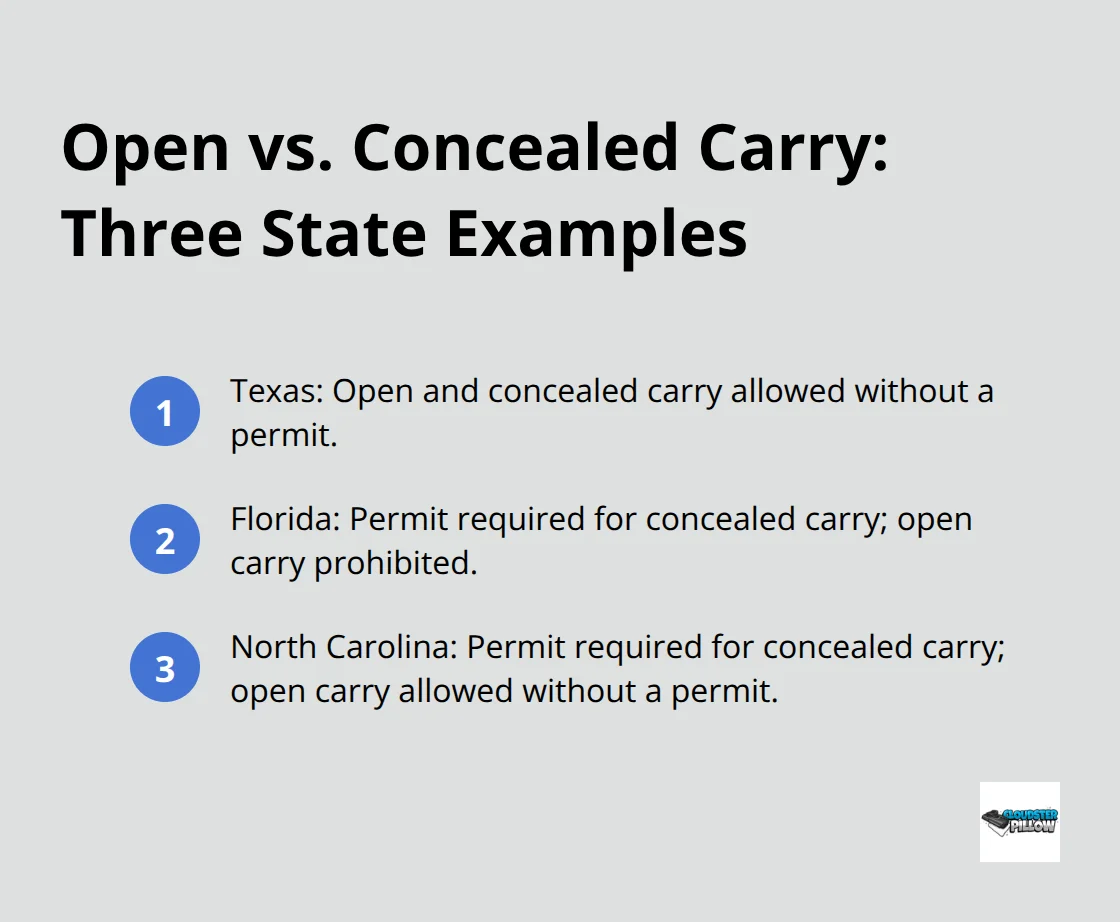
These distinctions aren’t academic-they affect what you can legally wear, how you position your holster, and whether you need to invest in a permit at all.
Interstate Reciprocity and Travel Considerations
If you plan to travel across state lines, interstate reciprocity for concealed carry permits only recognize permits, not permitless carry rights. This means carrying legally in one state doesn’t automatically make you legal in another, forcing many carriers to obtain permits specifically for interstate reciprocity. The practical solution involves checking your home state’s exact statute language and verifying reciprocity with any states you frequent before you carry, because assumptions about what’s legal in neighboring states often prove wrong. Your next step requires understanding exactly what documentation and training your specific state demands to move forward with an application.
What’s Actually Changed in Permit Laws for 2026
New Permitless Carry States and Reciprocity Implications
Alabama, Louisiana, and South Carolina joined the permitless carry movement after their laws took effect in mid-2024. If you live in one of these states, you no longer need government approval to carry concealed, but this doesn’t mean your application process disappeared entirely. Many carriers in these newly permitless states still obtain permits anyway because reciprocity agreements only recognize permits, not constitutional carry rights. When you cross state lines, your permitless carry status means nothing in states that require permits. A permit from your home state opens doors across multiple jurisdictions through reciprocity agreements, making it the practical choice for anyone who travels regularly or works across state boundaries.
Crime Data and Training Reality
The FBI Crime Data Explorer shows that 12 of the 20 states that adopted permitless carry before 2023 saw violent crime declines, while 8 did not, indicating that permit status alone doesn’t determine public safety outcomes. What matters more is your actual preparation and training, regardless of whether your state requires a permit. Your commitment to responsible carry depends far more on your actions than on your state’s legal framework.
Understanding Your State’s Specific Requirements
Fingerprinting remains standard in most jurisdictions as part of background checks, though some states now accept digital fingerprint submissions through authorized vendors rather than requiring in-person visits to sheriff offices. Training requirements vary dramatically: some states mandate 8 hours of instruction, others require live-fire demonstrations, while permitless states impose no training requirements at all. Processing times range from 7 days in shall-issue states to 6 months or longer in may-issue jurisdictions like California and New York.
Documentation and Application Checklist
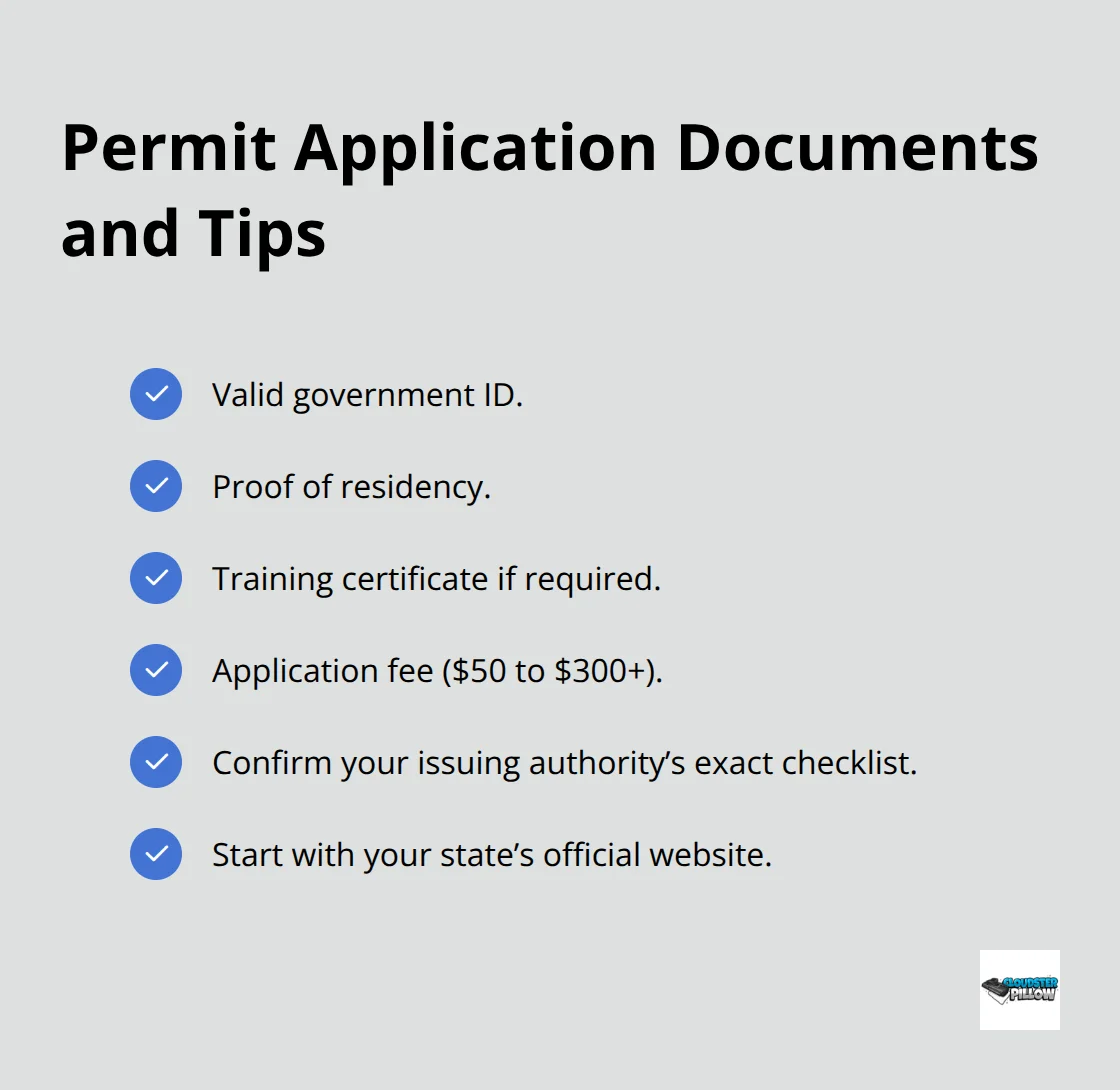
Start with your state’s official website to verify residency requirements, age restrictions, and whether you need character references, because assuming your neighbor’s process matches yours often leads to rejected applications and wasted fees. Documentation typically includes a valid government ID, proof of residency, training certificates if required, and the application fee, which ranges from $50 in some states to over $300 in others. The critical step happens before you submit anything: contact your issuing authority directly to confirm their exact checklist, because missing a single document can delay approval by weeks or restart your entire application timeline.
Next Steps for Your Permit Application
Once you understand your state’s requirements and gather your documentation, the actual application process begins. Your next move involves identifying which training courses your state accepts and scheduling your instruction before you submit your application, since many states require proof of training at the time of submission. Proper gear setup matters too-investing in quality equipment like the Cloudster Pillow holster wedge ensures your concealed carry remains comfortable and secure throughout your daily routine, supporting the responsible carry habits that define experienced CCW holders.
Keeping Your Permit Current Without Wasting Time or Money
Expiration Dates and Renewal Timelines
Permit renewal catches most carriers off guard because states handle expiration dates inconsistently. Some states issue permits valid for five years, others for three, and a handful for just two years, making a calendar reminder essential the moment you receive your license. Texas licenses are valid for four years at first and five years after renewal, and the standard fee is $40 for an original license and $40 for a renewal (Texas DPS). New York concealed carry licenses must be recertified every three years under Penal Law 400.00(10); check with your county licensing officer for fees and the process, and see our New York pistol permit guide. Set a phone reminder six months before expiration so you can start the renewal process early and avoid carrying with an expired permit, which creates legal liability regardless of whether your state technically allows you to carry during the grace period.
State-Specific Renewal Windows
States impose different renewal windows that catch unprepared carriers off guard. Around 90 days before your license expires, you should receive a renewal letter with instructions, so checking your state’s specific window prevents premature submissions that get rejected and restart your timeline. Many carriers miss this detail and reapply unnecessarily, paying full fees instead of reduced renewal rates. Contact your issuing authority to confirm your state’s renewal process, because submitting too soon wastes your application fee and delays your actual renewal start date.
Training Requirements for Renewal
Training requirements directly affect your renewal timeline, because some states require refresher instruction before you can renew. Among the official sources we checked on November 4, 2026, Maryland requires an 8-hour course to renew, and Michigan asks for a signed statement of at least three hours of review and one hour of range time in the six months before renewal. Utah charges $20.75 to renew a resident permit online and does not make you retake the course if your permit is unexpired or expired less than one year (Utah Code 53-5a-303(8)(d)).
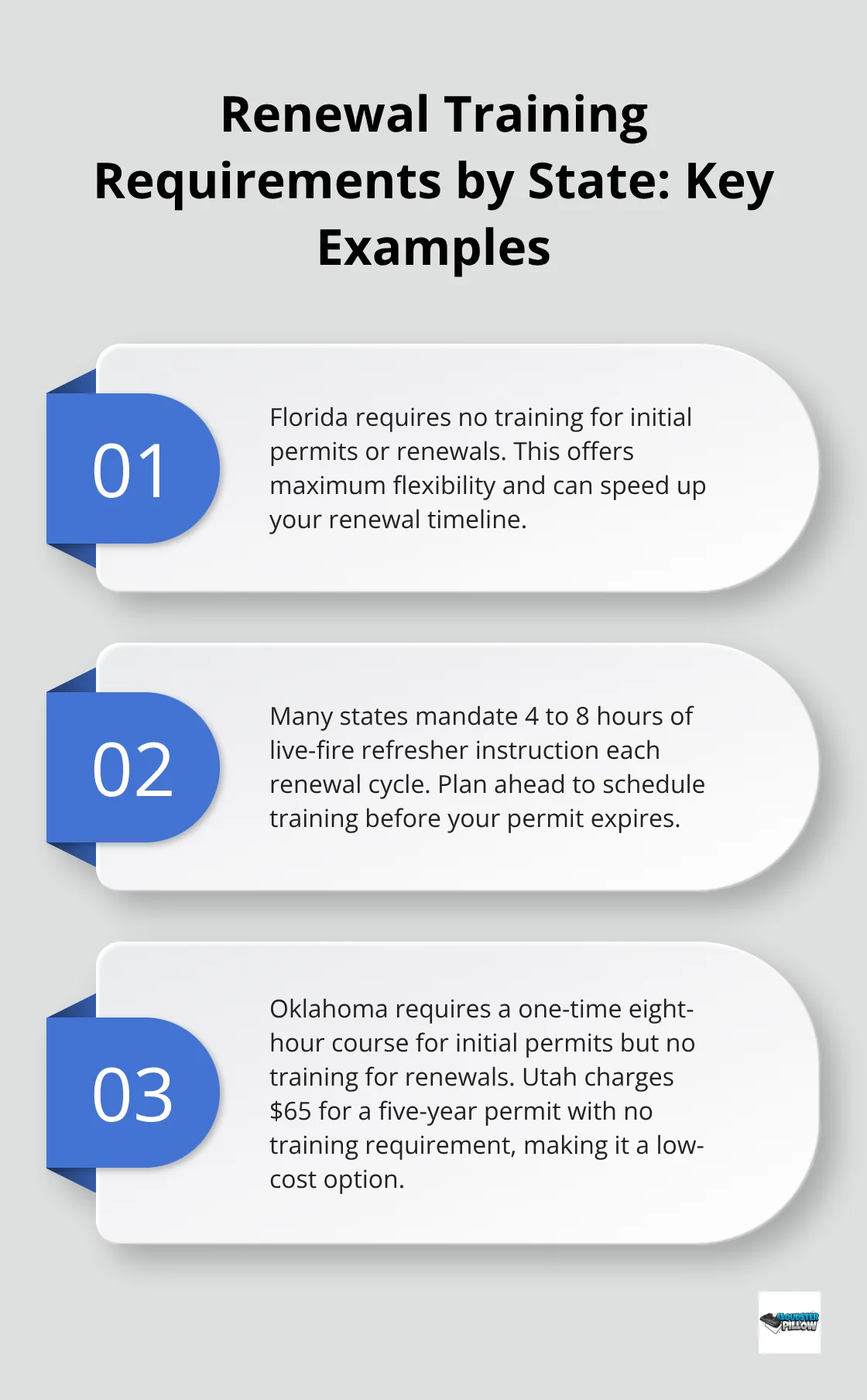
The NRA-ILA tracks state-by-state training mandates, and checking their database prevents you from showing up to renew only to learn your state now requires proof of recent instruction.
Renewal Costs and Processing Methods
Costs vary dramatically across jurisdictions: Alabama charges $20 for a five-year permit while California costs over $300 in some counties plus training course fees that can exceed $200. Processing fees range from $50 to $300, but renewal fees often cost less than initial applications, so tracking your state’s specific renewal rate matters when budgeting. The key distinction involves understanding whether your state allows online renewals, mail-in submissions, or requires an in-person visit, because some states like Texas process online renewals in days while others like California demand lengthy in-person appointments at county offices. Starting your renewal process early and confirming training requirements before your permit expires keeps you legal without interruption and eliminates the stress of last-minute applications.
Staying Organized Throughout Your Permit Lifecycle
Maintain a simple spreadsheet or calendar entry that tracks your permit expiration date, renewal fee amount, required training hours, and your state’s renewal window. This approach prevents missed deadlines and ensures you never carry with an expired permit. Your state’s official website provides the most current renewal information, and contacting your issuing authority directly answers any questions about your specific situation. Responsible carry depends on staying current with your permit status, and organized renewal planning eliminates unnecessary stress and legal exposure. When you’re carrying daily, comfort matters just as much as compliance-the Cloudster Pillow holster wedge keeps your concealed carry comfortable throughout your permit lifecycle.
Getting Your Permit Sooner and Renewing It
- Finish the slow steps first. Book any required class and fingerprinting early, and gather your documents before you apply.
- Send a complete application. Missing documents or signatures are a common reason for delays.
- Renew early. Note your expiration date and check your state’s renewal window and requirements well before it, since some states treat a lapsed permit like a new application.
Once you carry, a stiff belt matters as much as the permit; we carry Kore ratcheting gun belts.
A Gun License to Buy or Own vs. a Permit to Carry
In some states, a license to buy a handgun and a permit to carry one are separate credentials. Maryland, for example, requires a Handgun Qualification License to “purchase, rent or receive a handgun”, and a separate Wear and Carry Permit to carry, wear or transport one.
At the federal level, a licensed dealer must contact the National Instant Criminal Background Check System before transferring a firearm to a buyer who is not a licensee. The dealer may proceed once the system provides a unique identification number, or once three business days pass without the system notifying the dealer that the transfer would be unlawful. Federal law also bars a dealer from selling a handgun to anyone under 21, or a rifle or shotgun to anyone under 18. Our concealed carry laws page covers court rulings on that age rule.
Maryland’s Handgun Qualification License takes a 4-hour safety course, costs $50.00 for the initial application, and is valid for 10 years. The HQL does not let you carry. Maryland’s Wear and Carry Permit is a separate credential with its own 16-hour course and $125.00 fee, and the State Police say “A HQL is only required when purchasing a handgun that isn’t a curio or relic”. New York’s pistol license comes in types: one lets a householder “have and possess in his dwelling”, and another lets the holder “have and carry concealed”.
If your state lists a purchase license and a carry permit as separate items, you may need both. Check which one your state’s page describes before you apply.
How to Get a Concealed Carry Permit: The Steps Most States Share
The exact forms differ. The steps below are drawn from the seven state sources we opened.
- Confirm you meet the age rule. Utah, Maryland, Virginia, Minnesota, Pennsylvania (Chester County) and New York each set 21 as the standard minimum age for a full permit. Utah offers a provisional permit from age 18 to 20. Florida’s statute says 21, but the Fourth District Court of Appeal ruled on June 17, 2026 that the under-21 bar is unconstitutional, and FDACS now issues licenses to applicants 18 and older who meet the other requirements.
- Take the required training before you apply. Utah requires a firearms familiarity course certified by BCI. Maryland requires a 16-hour firearms safety course. New York requires a minimum of 16 hours of in-person live curriculum plus a minimum of 2 hours of live-fire range training. Minnesota requires training from a certified instructor within one year of the application. Virginia accepts nine kinds of proof of competence, including a hunter education course, a class from a certified instructor, or law-enforcement or military firearms training. Florida requires proof of competence through one of seven methods (see our Florida concealed carry guide). Chester County, Pennsylvania lists no training requirement on its application page. Our Pennsylvania License to Carry guide covers the state process.
- Apply to the right office. That is the county sheriff in Minnesota and in Chester County, Pennsylvania, the circuit court clerk where you live in Virginia, the State Police in Maryland, BCI in Utah, FDACS in Florida, and the licensing officer in New York.
- Submit the application and pay the fee. New York also requires an in-person meeting with the licensing officer, at least four character references and a list of your social media accounts from the past three years. The documentation checklist earlier on this page covers the common items.
- Wait the statutory period. The table above lists how long each state gives itself to decide.
Once the permit is in hand, the Cloudster Pillow holster wedge is a USA-made memory foam pad that angles the grip into the body for better concealment and comfort during appendix or IWB carry. It comes in four sizes, priced from $20.00, with free 30-day returns and a lifetime warranty.
How Long a Permit Takes, How Long It Lasts and What It Costs
Figures below are from each state’s official page or statute, with the date shown on that source. Fees and deadlines change often, so confirm on the state page before you apply.
| State | Decision deadline | Valid for | Fee (new permit) | Source and date |
|---|---|---|---|---|
| Utah | 60 days | 5 years | $55.00 resident, $90.00 out-of-state | BCI, fee effective October 1, 2026 |
| Florida | 90 days, extendable by 45 | 7 years | up to $55 | Fla. Stat. 790.06, amended 2025 |
| Virginia | 45 days | 5 years | up to $50.00 total | VSP form SP-248, revised 11-24-25 |
| Minnesota | 30 days | 5 years | up to $100 | Minn. Stat. 624.714, amended through 2025 |
| Pennsylvania (Chester County) | 45 days | 5 years | $20.00 | Chester County Sheriff, opened November 3, 2026 |
| Maryland | 90 days | 2 years initial, then 3-year renewals | $125.00 | MSP, page notes a September 2025 update |
| New York | up to 6 months | recertified every 3 years for carry licenses | not verified | Penal Law 400.00, page revision 2026-10-23 |
How Long Approval Takes: Official Examples (checked November 3, 2026)
The published numbers vary widely. These examples come from the issuing authorities themselves.
- Michigan. “The County Clerk shall issue the concealed pistol license or notice of statutory disqualification within 45 days after the date the applicant has classifiable fingerprints taken”. New applicants pay a $100 application fee plus a $15 Live Scan fingerprinting fee.
- Utah. “It takes 60 days to process a concealed firearm permit application”. The application needs a photocopy of your state-issued driver license, a recent passport-quality color photograph, a completed fingerprint card, and proof you completed a firearms familiarity course certified by BCI. The permit is valid for five years. Our Utah concealed firearm permit guide covers fees, non-resident rules and renewal.
- Maryland. The Licensing Division “will review your application, conduct a background investigation, and render a final disposition notification within 90 days”. Applications go through the online Licensing Portal, and LiveScan fingerprints are submitted through approved vendors.
- Mesa County, Colorado. “It may take up to 90 days to complete your application”. Fingerprinting is scheduled through the online process, and the page states that online classes, home study and hunter safety courses are not accepted as training proof. Our Colorado concealed carry guide covers the statewide rules.
Fingerprinting is part of the application in every example above. Because Michigan counts its 45 days from the date your classifiable fingerprints are taken, get fingerprinted as early as the office allows. Our Michigan CPL guide covers the full application and renewal steps.
Do You Need a Permit in a Permitless-Carry State?
Our constitutional carry page counts 29 states that allow carry without a permit as of October 2026, and lists them. In those states you may still want the permit, for three reasons found in the Utah and Florida sources.
First, reciprocity. Utah BCI notes that 36 other states honor Utah’s permit, which matters when you travel. Second, carve-outs. Utah still requires its concealed firearm permit to carry in a public school. Third, eligibility is not automatic. Florida’s statute authorizes carry without a license only for a person who “otherwise satisfies the criteria for receiving and maintaining such a license”, and the Jacksonville Sheriff’s Office reminded residents to carry valid identification when carrying concealed.
Permit Requirements in More States
Oregon and Maryland
The sources below are the state statutes and the state police pages. In Oregon, county sheriffs add their own charges, as Linn County does, so confirm with your county sheriff before you apply.
Oregon concealed handgun license (ORS 166.291, current through early 2026)
Oregon’s statute requires an applicant to be “at least 21 years of age”, “a resident of the county”, and a United States citizen or a documented legal resident noncitizen. Non-residents have one narrow path: “The county sheriff may waive the residency requirement in subsection (1)(c) of this section for a resident of a contiguous state who has a compelling business interest or other legitimate demonstrated need”.
Oregon accepts several ways to show competence with a handgun. The statute’s list includes: – a hunter education or hunter safety course approved by the State Department of Fish and Wildlife or a similar agency of another state; – a National Rifle Association firearms safety or training course; – a firearms safety course open to the public offered by law enforcement, a community college, or another organization using NRA- or law-enforcement-certified instructors; – a law enforcement course for security guards, investigators or reserve officers; – evidence of equivalent experience through organized shooting competition or military service; – a current or former Oregon license to carry a firearm.
For the courses, handgun safety must have been a component. Linn County adds a warning that many online courses “DO NOT qualify as proof of competency” unless taught by a current NRA-certified instructor or an instructor certified by a law enforcement agency. It lists the Oregon State Sheriffs’ Association online course at oregonchl.org as accepted.
The statutory fee is “$100 to the sheriff” for a new license, “$15 to the Department of State Police” for the fingerprint check, and “$75 to the sheriff” for a renewal. Counties may add charges. Linn County, for example, lists: – $119.00 for a new application ($100.00 plus a $15.00 fingerprinting fee plus a $4.00 online convenience fee); – $79.00 for a renewal ($75.00 plus the $4.00 online convenience fee).
Linn County’s pricing went into effect September 25, 2021, following Senate Bill 554. The license is “valid for a period of four years from the date on which it is issued”. Fees and rules change, so check the statute and your county sheriff’s page for the current version before relying on any number here.
Oregon does not generally honor other states’ permits. The Oregon Secretary of State license directory states: “Generally there is no reciprocity with other states concealed handgun licenses” (page last updated August 12, 2022).
Maryland Wear and Carry Permit
Maryland requires a Wear and Carry Permit from the Maryland State Police. Applicants must be at least 21 (or an active member of the armed forces, National Guard or uniformed services) and complete a 16-hour course; the initial fee is $125.00 (Maryland State Police, read November 4, 2026). Our Maryland Wear and Carry Permit guide covers the full process, fees and renewal.
The Wear and Carry Permit is not the same as Maryland’s Handgun Qualification License. “You must have a HQL before you purchase, rent or receive a handgun”. For the HQL: – it requires a 4-hour firearms safety training course; – it costs $50.00 for a first application and $20.00 to renew; – it is “valid for 10 years from the date of issuance”; – the applicant is notified of the decision “within 30 days”.
A person who holds a valid Wear and Carry Permit may apply for the HQL as permit-exempt.
Virginia
Virginia residents 21 and older apply to the circuit court clerk where they live and must show competence with a handgun in person. Total fees may not exceed $50.00, the court must issue the permit within 45 days unless the applicant is disqualified, and the permit lasts five years (Virginia State Police and Va. Code § 18.2-308.02, read November 4, 2026).
Our full Virginia concealed carry permit guide covers the nine ways to show competence, the de facto permit, renewal by mail and nonresident permits.
South Carolina
South Carolina no longer requires a permit to carry. H. 3594, signed by the Governor on March 7, 2024, allows anyone 18 or older who is not prohibited from possessing a firearm to carry openly or concealed without a permit or training. SLED’s concealed weapon permit (CWP) program continues for people who want one. SLED lists its benefits as including reciprocity with other states and easier firearm purchases from dealers.
SLED may not charge a fee of any kind for a new permit. Renewal costs $50, waived for disabled veterans and retired law enforcement officers. Applicants provide proof of training, which must include firing at least 25 rounds in the presence of the instructor, plus a complete set of fingerprints. SLED must issue the permit unless it denies the application in writing within 90 days of receiving it. The 2024 law set the permit age at 18. It also directs SLED to provide a free statewide CWP training course, offered in every county at least twice a month; SLED says this is subject to the legislature funding it. Applications and renewals can be started online through the SLED portal at applicants.sled.sc.gov, with fingerprint appointments booked through IdentoGo. A renewed permit is valid for five years. These rules are as of the statute’s 2024 amendment, effective March 7, 2024.
Washington
Washington calls its permit a concealed pistol license (CPL). You apply to your city police or county sheriff, not the Department of Licensing. Under RCW 9.41.070 the agency has 30 days (60 for applicants without a Washington license or ID, or new residents), the state fee is $36 plus FBI charges, the license lasts five years, and you can renew within 90 days before or after expiration (read November 4, 2026).
Our full Washington concealed pistol license guide covers the full application, fees, renewal and the training rule that starts May 1, 2027.
Renewal Windows Compared (verified November 2026)
Fees change often. Each row names its official source and the date shown on it.
| State (source) | Term | Earliest renewal | Latest renewal | Fee | Training to renew |
|---|---|---|---|---|---|
| Florida (FDACS, no date on page) | 7 years | Notice sent about 95 days before expiry | 180 days after expiry, with a $15 late fee; after that, new application | $45 resident; tax collectors may add up to $12 | None listed |
| Texas (DPS FAQ, dated 2020-09-29, read 2026-11-03) | 4 years initial, 5 years renewal | 6 months before expiry | Not stated on the DPS page | $40 | Not stated on the DPS page |
| Michigan (MCL 28.425l, amended effective 2017-10-11, and Grand Traverse County) | To your birthday 4 to 5 years out | 6 months before expiry | 1 year after expiry | $115 | 3 hours review plus 1 hour range time, self-certified |
| Colorado, Mesa County (rules as of July 1, 2025) | Not stated on the page | 120 days before expiry | 6 months after expiry | $13 | Refresher course of at least 2 hours, 50 rounds at 70%, written test at 80% |
| Utah (BCI, fees effective October 1, 2026) | 5 years | 90 days before expiry | 1 year after expiry | $20.75 resident, $50.75 non-resident online | Background check only; no course listed |
| New York outside NYC and Nassau, Suffolk, Westchester (State Police; FAQ dated 2022-08-27) | Recertify every 3 years | Not stated on the page; online only | Not stated on the page | No State Police fee | Not required to recertify |
Two patterns stand out. Florida, Michigan and Utah let you renew well after expiry, while New York State Police recertification has no grace period stated on its page. Michigan and Mesa County, Colorado require refresher training to renew, while Florida and Utah do not list any. Whether you may carry on an expired permit while a renewal is pending is a state question; among the sources read for this table, only Michigan’s addresses it, and it allows carry on the renewal receipt plus the expired license. The Florida pages read for this section do not address carrying on an expired license, so ask FDACS directly.
The state details above come from each state’s official statutes and agency pages; those sources were read again on November 4, 2026. Laws and fees change; check the official source before you apply.
Concealed Carry Permit: Questions People Ask
How do I get a concealed carry permit?
Confirm you meet your state’s age rule, take any required training, then submit the application and fee to the issuing office. That office is the county sheriff in Minnesota and in Chester County, Pennsylvania, the circuit court clerk in Virginia, the State Police in Maryland, BCI in Utah, FDACS in Florida and the licensing officer in New York. The step-by-step section above walks through each stage.
What are the age and training requirements?
Twenty-one is the standard minimum age in Utah, Maryland, Virginia, Minnesota, Pennsylvania (Chester County) and New York. Training ranges from Virginia’s nine accepted proofs of competence to Maryland’s 16-hour course and New York’s 16 hours of in-person live curriculum plus 2 hours of live fire. Florida now issues to applicants 18 and older after a June 17, 2026 appellate ruling.
How much does a concealed carry permit cost?
Official fees we checked range from $20.00 in Chester County, Pennsylvania to $125.00 in Maryland. Utah charges $55.00 for residents effective October 1, 2026, Florida up to $55, Virginia up to $50.00 and Minnesota up to $100.
How long does a permit take, and how long is it valid?
Statutory decision deadlines run from 30 days in Minnesota to six months in New York, with 45 days in Virginia and Chester County, 60 days in Utah and 90 days in Florida and Maryland. Florida licenses last 7 years, Utah, Virginia, Minnesota and Chester County, Pennsylvania five years, and Maryland two years initially. New York carry licenses are recertified every three years.
Do I need a permit in a permitless-carry state?
Not to carry at home if you meet the state’s eligibility rules; our constitutional carry page counts 29 such states as of October 2026. A permit still matters for travel, since Utah’s permit is recognized by 36 other states. Some places inside permitless states, such as Utah public schools, still require the permit.
Do I need a gun license to buy or own a gun?
Federal law requires a dealer to run a NICS background check before transferring a firearm, and bars dealer handgun sales to anyone under 21. Whether you also need a state license to buy depends on the state: Maryland requires a Handgun Qualification License before you purchase, rent or receive a handgun, and New York issues a license to possess a pistol in the home. A carry permit is a separate credential in both states.
Does my permit work in other states?
Our concealed carry laws page explains that no federal law makes every state honor every other state’s carry permit. Utah BCI lists 36 states that recognize its permit. Check the destination state before every trip; our reciprocity guide explains how.
Do I have to carry the permit with me?
In Minnesota, yes: the statute requires the permit card and a government photo ID in immediate possession whenever you carry. In Florida, where no license is needed, the Jacksonville Sheriff’s Office still advises carrying valid identification. Other states set their own rules; the reciprocity guide has a section on carrying your permit and ID.
How do I get an Oregon concealed handgun license?
Apply to the sheriff of the county where you live. You must be at least 21, a resident of the county, and a citizen or documented legal resident. You also show competence with a handgun through one of the courses or forms of experience listed in the statute.
Can non-residents get an Oregon CHL?
Only in a narrow case. The sheriff “may waive the residency requirement” for “a resident of a contiguous state who has a compelling business interest or other legitimate demonstrated need”. Oregon generally does not honor other states’ licenses.
How much does an Oregon CHL cost?
The statute sets $100 to the sheriff plus $15 to the Department of State Police for a new license, and $75 for a renewal. Counties may add charges; Linn County lists $119.00 new and $79.00 renewal, including a $4.00 online convenience fee. The license is valid for four years.
What is the difference between Maryland’s HQL and a Wear and Carry Permit?
The Handgun Qualification License is required before you “purchase, rent or receive a handgun”. The Wear and Carry Permit is the separate license that lets you carry. The HQL needs a 4-hour course and lasts 10 years. The Wear and Carry Permit needs a 16-hour course, and a first permit is valid “until the last day of your birth month, 2 years after issuance”.
How many training hours does a Maryland Wear and Carry Permit require, and what does it cost?
A first permit requires a 16-hour firearms safety training course and a renewal requires 8 hours. The fee is $125.00 for a first permit and $75.00 for a renewal. The State Police decide within 90 days.
How long is a Maryland Wear and Carry Permit valid?
A first permit is valid “until the last day of your birth month, 2 years after issuance”. Renewals are issued “for an additional 3 years”.
Is fingerprinting required?
In every official example we checked, yes. Michigan uses Live Scan, Maryland uses LiveScan through approved vendors, Utah requires a completed fingerprint card, and Mesa County, Colorado schedules fingerprinting through its online application.
How early can I renew my concealed carry permit?
Michigan: not more than six months before expiration. Utah: not more than 90 days before. Mesa County, Colorado: not until 120 days before.
Do I need to retake training to renew?
It varies. Maryland requires an 8-hour course to renew. Michigan accepts a signed statement of three hours of review and one hour of range time in the six months before renewal. New York recertification asks for identifying information and an inventory of licensed handguns, with no fee.
What happens if my permit has already expired?
In the examples we checked, there is a limited window after expiration, and after that you apply as a new applicant: – Michigan allows renewal up to one year after expiration. A license expired more than one year requires a new application, and Wayne County requires the training course again. – Utah allows renewal up to one year after expiration. – Mesa County, Colorado accepts late renewals up to six months after expiration with a refresher course.
Do I still need a permit in South Carolina?
No. Since H. 3594 was signed on March 7, 2024, anyone 18 or older who is not prohibited from possessing a firearm may carry openly or concealed without a permit or training. SLED still issues the CWP and lists its benefits as including reciprocity with other states and easier purchases from dealers.
What training does a South Carolina CWP require?
Proof of a handgun training course that includes firing at least 25 rounds in the presence of the instructor. The 2024 law also directs SLED to offer a free course at least twice a month in every county; SLED says this depends on legislative funding.
Can I renew my permit online?
Florida (cwrex.fdacs.gov), Texas (RSD Connect), Utah (secure.utah.gov) and Michigan (State Police online system) all offer online renewal. New York State Police recertification is online only.
Are “100% online” concealed carry permit websites legitimate?
The site reviewed by Lead Stories cannot issue a permit: it states on its own pages that it does not issue permits and that applicants must apply separately. It sells a course and application help for a New Hampshire non-resident license; New Hampshire’s Department of Safety encourages applying directly to the New Hampshire State Police, and the application includes a $100 payment for a five-year permit.
Are online CCW courses accepted?
Texas accepts its four to six hour classroom course in person or online, but the written exam is with a certified instructor and range instruction is a separate class. New York requires a 16-hour classroom and 2-hour live-fire course from authorized instructors under State Police and DCJS standards. Check your own state’s training standard before paying for a course.
Final Thoughts
Permit requirements for 2026 boil down to three core facts: know your state’s specific rules, understand whether you live in a constitutional carry or permit-required state, and stay current with renewal deadlines. The landscape shifted significantly with Alabama, Louisiana, and South Carolina joining permitless carry in mid-2024, but even carriers in these states benefit from obtaining permits for interstate reciprocity. Your carry permit 2026 strategy depends on checking your state’s official website, confirming training requirements, and budgeting for fees that range from $20 to over $300 depending on your jurisdiction.
The most common mistake gun owners make involves assuming their neighbor’s process matches theirs. State requirements differ dramatically on fingerprinting methods, training hours, processing times, and renewal windows-so contact your issuing authority directly before submitting anything, because missing a single document restarts your entire timeline and wastes your application fee. Staying updated matters because permit laws change regularly, and your state’s official licensing website provides the most current information.
Responsible carry extends beyond legal compliance to daily comfort and confidence. When you carry consistently, your gear setup directly impacts whether you’ll actually carry every day, and the Cloudster Pillow holster wedge enhances all-day concealment for both AIWB and IWB holsters. Quality gear supports your commitment to responsible carry throughout 2026 and beyond.
