Holsters and Gear Recommendations
AR-15 Pistol Holster Guide: How AR Holsters Work
Quick answer: An AR-15 pistol holster is a mount that holds an AR-style pistol or rifle against your belt or MOLLE gear so it stops swinging, usually by locking a pin or the receiver into a receiver plate. The ones reviewed here work with a sling rather than replacing it, move weight off your shoulder, and need a stiff belt or vest.
What Is an AR-15 Holster?
It isn’t a pistol holster scaled up. Most are a two-part retention system. Everyday Holster describes its version as “a two-piece system”: a pin “that screws onto your rifle’s standard Picatinny rail” and a receiver “that attaches to your MOLLE webbing, plate carrier, chest rig, or belt.” Stratus’s system, reviewed by GunMag Warehouse, uses a quick-detach pin on a replacement receiver end plate, and its holster “works on your belt or MOLLE gear.”
Older designs wrap the rifle instead. GunsAmerica’s review of one such holster found it “open on the bottom to allow for mags to poke through,” with “A reinforced strap” holding the gun.
Why Use One
- Weight off the shoulder. GunMag Warehouse: “The most obvious one is the ability to distribute the weight of the rifle to your vest or belt, even with a sling on.”
- No swinging. GunsAmerica: “A sling allows a gun to bounce around,” while with the holster “the gun stays where you put it.”
- Hands free. Everyday Holster says it keeps the rifle from “swinging, sagging, and getting in your way when your hands are busy.”
Use It With a Sling, Not Instead of One
Everyday Holster is blunt about this: “This is a retention anchor, not a hands-free carrier — and it’s built to be run alongside a two-point sling, not instead of one.” Its reason: an AR “is long and top-heavy,” and on a single mount with no sling “it becomes a pendulum — the rifle tips, swings, and puts tearing force on your vest webbing.” GunMag Warehouse found the same balance: “When both the sling and holster are placed correctly, the sling will help hold the weight of the rifle while the holster keeps the gun from moving around.”
Retention and the Draw
- Retention levels: Stratus “offers two levels of retention”; with Level 2, “you must push in on a release before the rifle will come back off the holster.”
- The draw: GunsAmerica found drawing “isn’t as easy as pulling up from a single-point, but it isn’t that much slower,” and advises you “grab the gun with two hands instead of one.”
- Safety: GunsAmerica: “The gun should be safe when you put it in the holster.”
The Belt or Rig Underneath
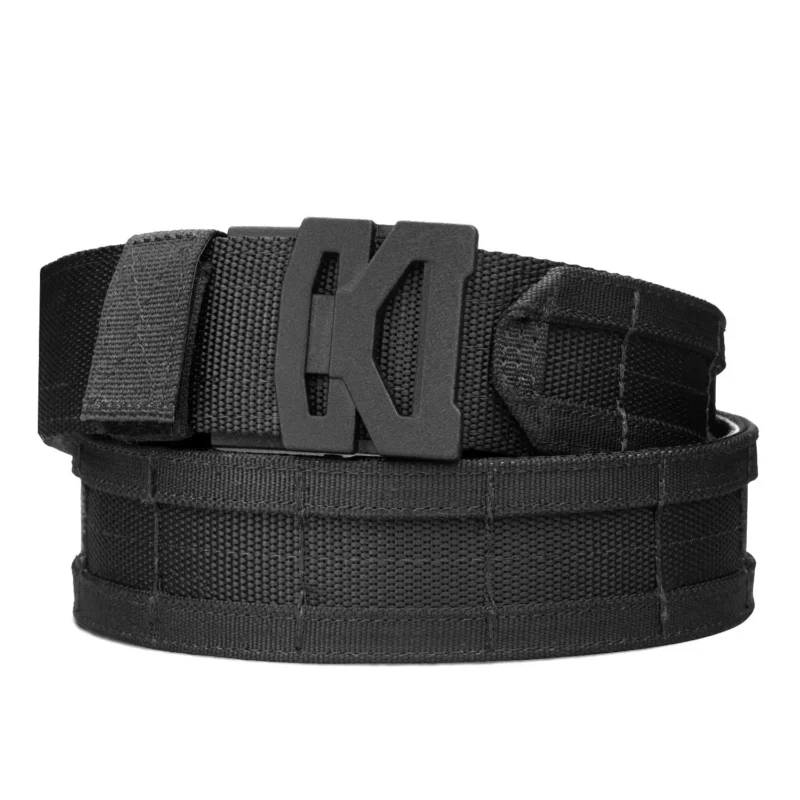
The point is to move the rifle’s weight to your belt or vest, so the belt has to be up to it. The Kore Battle Belt we carry is a two-belt kit with a 1.75″ outer belt that has “two rows of MOLLE” and “Kore’s reinforced Power-Core™ center for added stiffness, strength, and support.” Kore rates it “Up to 20 lbs.” for “Full-Size Firearms, Magazine Pouches, Dump Pouches, Trauma Kits & Other Gear,” and its track adjusts “without removing or undoing the buckle.”
Check your mount’s instructions for how it attaches, since some are made for MOLLE and some for a belt. Our guides to battle belt setup and MOLLE holsters cover the rest of the rig.
AR-15 Pistol Holster: Questions People Ask
Do I still need a sling?
The sources here say yes. Everyday Holster calls its mount “a retention anchor, not a hands-free carrier.”
Does it fit my AR?
It depends on the system: some clamp to a Picatinny rail, others need a replacement receiver end plate.
Belt or MOLLE?
Some mount either way. Everyday Holster lists “MOLLE panels, plate carriers, chest rigs, and duty belts.”
Is an AR holster slower to draw from?
A little. GunsAmerica found it “a bit slower, but a lot more secure.”
Written by the Cloudster Pillow team. We make the Cloudster Pillow and the Cloudster magnetic mag carriers, and carry Kore belts. We don’t sell holsters or firearms, and no maker paid to be mentioned here. This is general information, not legal advice or a substitute for professional training; check the firearm and carry laws where you live.