Holsters and Gear Recommendations
What Do Police Carry? Duty Belt Gear and Sidearms Explained
Quick answer: Most patrol officers carry a handgun, spare magazines, handcuffs, a radio and less-lethal tools on a duty belt. Police1 says the belt “holds items such as a firearm, handcuffs, radio, TASER, pepper spray, baton, and spare magazines,” and that “Duty belt gear may vary by agency policy and assignment.”
What’s on a Police Duty Belt
Police1’s guide lists “The standard issue or most common police duty gear.” The items and the purpose Police1 gives each:
| Item | Purpose (Police1) |
|---|---|
| Firearm | “Primary weapon for deadly force situations” |
| Handcuffs | “Secure arrested individuals” |
| Handheld radio | “Communication with dispatch and other officers” |
| TASER / CEW | “Less-lethal force option” |
| OC (pepper) spray | “Non-lethal control option for aggressive subjects” |
| Expandable baton | “Striking or control tool” |
| Spare magazines | “Ammunition reload for a firearm” |
| Gloves | “Safety during searches or medical aid” |
| Flashlight | “Illumination during low-light operations” |
| Tourniquet | “Immediate trauma care for self or others” |
| Multi-tool or knife | “Utility tasks or emergency cutting” |
Police1 adds that a body camera is “Not on belt, but connected to gear setup,” and that “A fully equipped police duty belt typically weighs between 15 and 25 pounds, depending on the gear required by the department.” Where each item goes is covered in our duty belt setup guide.
What Handguns Do Police Carry?
It depends on the department. Athlon Outdoors surveyed the sidearms of large U.S. departments and cautions that its list “is based on “best available information,” which may or may not have come from departmental sources.” Three examples from it:
- Los Angeles (LAPD): “As of January 2022, the FN 509 MRD LE became the official duty gun of the LAPD.”
- Washington, D.C. (MPD): “Since 1989, D.C. Metro officers run either standard-issue Glock 17s or Glock 19s in 9mm for patrol.”
- Chicago (CPD): since 2015, officers “can only carry a striker-fired semiautomatic pistol chambered in 9mm Luger,” with a .380 exception for some officers.
Athlon also notes that “many departments are following the tide and switching their duty weapons back to ones chambered in 9mm.” For the civilian side, see our best Glock for concealed carry guide.
The Belt Itself
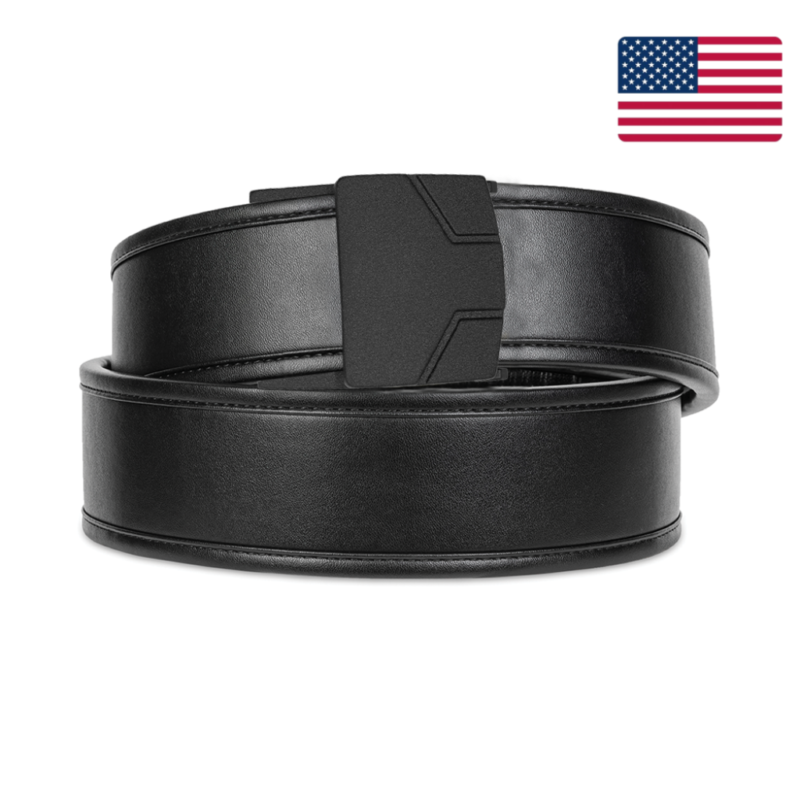
Police1 says duty belts are “Typically made of leather or high-strength nylon.” The Kore duty belts we carry use a two-belt system, an outer duty belt over a hook-and-loop inner belt:
- Kore Patrol Duty Belt 2″: Kore says its “hidden track lets you instantly tighten or loosen your belt in small 1/4″ increments” without undoing the belt or buckle.
- Kore Duty Belt 2.25″: Kore lists a “dual belt track system” that “allows 1/4″ micro-adjustments without removing the belt,” and says “Both the outer and inner belt feature our reinforced Power-Core™ center.”
Agencies set their own equipment rules, so check your policy before buying. For keepers and layout, see our duty belt setup guide; for a MOLLE belt, our battle belt setup guide and MOLLE mag pouch guide.
What Police Carry: Questions People Ask
What do police carry on their belts?
Police1 lists a firearm, handcuffs, a radio, a TASER, pepper spray, a baton and spare magazines, plus gloves, a flashlight, a tourniquet and a knife or multi-tool.
What gun do most police carry?
It varies by department. Athlon’s survey of large departments lists Glock, FN, Smith & Wesson and SIG Sauer models, with many in 9mm.
How much does a police duty belt weigh?
Police1: “typically weighs between 15 and 25 pounds, depending on the gear required by the department.”
Do all police carry the same gear?
No. Police1: “Duty belt gear may vary by agency policy and assignment.”
Written by the Cloudster Pillow team. We make the Cloudster Pillow and the Cloudster magnetic mag carriers, and carry Kore belts and pouches. We don’t sell firearms or law-enforcement equipment, and this page is general information, not training or agency guidance.