Licensing and Cost-Saving Tips
Las Vegas CCW: How to Get a Nevada Concealed Firearm Permit (2026)
Quick answer: Nevada requires a concealed firearm permit (CCW) to carry a concealed pistol or revolver. In Las Vegas and the rest of Clark County, the permit comes from the Las Vegas Metropolitan Police Department (LVMPD) Records and Fingerprint Bureau. You must be at least 21 (18 under a military exception), finish an eight-hour Nevada-certified course with live-fire qualification, and be fingerprinted. LVMPD’s fee for a new CCW is $100.00 (effective October 1, 2026), it has up to 120 days to decide, and the permit is valid for five years. Out-of-state residents can apply too, but LVMPD only accepts training completed in Clark County. Facts below are from LVMPD’s concealed firearm permit pages, the Washoe County Sheriff’s Office and Nevada Revised Statutes chapter 202, checked November 4, 2026.
Nevada requires a permit to carry concealed
NRS 202.350 says a person shall not “Carry concealed upon his or her person any” pistol, revolver or other firearm, except as allowed by the permit law in NRS 202.3653 to 202.369. Carrying a concealed firearm without a permit is a category C felony.
Who issues the permit in Las Vegas and Nevada
LVMPD: “Nevada residents must apply through the sheriff’s office in their county of residence. LVMPD accepts applications from Clark County residents and eligible out-of-state residents.” Its application page adds that an out-of-state resident can apply if they “completed firearms training in Clark County.” In Reno and the rest of Washoe County, the Washoe County Sheriff’s Office takes applications online and then schedules an in-person appointment.
Who qualifies
- Age: “You must be at least 21 years old, or at least 18 years old if you qualify under the military exception.” The military exception covers certain current or former members of the U.S. Armed Forces, reserve components or National Guard, with supporting documents.
- Firearm eligibility: you must be legally permitted to possess a firearm under state and federal law.
- Training: an approved Nevada course (next section).
LVMPD lists disqualifying conditions, including:
- an outstanding warrant;
- admission to a mental health facility within the preceding five years;
- a misdemeanor involving the use or threatened use of force or violence within the preceding three years;
- any felony conviction;
- a domestic violence or stalking conviction, or a qualifying order of protection;
- being on parole or probation;
- a false statement on a CCW application.
The full rules are in NRS 202.3657.
Training: eight hours to apply, four to renew
LVMPD’s training rules:
- New applications: “Complete an eight-hour Nevada-certified firearms training course, including live-fire qualification.”
- Renewals: “Complete a four-hour Nevada-certified firearms training course, including live-fire qualification.”
- Training must be with a Nevada-certified CCW firearms instructor in Clark County. “Out-of-state firearms training certificates are not accepted.”
- “Training certificates are valid for up to one year after completion.”
You bring the signed Nevada Sheriffs and Chiefs Firearms Safety Course Certificate of Completion and Firearms Proficiency Certificate, found on page 7 of the CCW Application Packet.
How to apply with LVMPD
- Complete the training and get both signed certificates.
- Gather your documents: a valid state-issued ID (such as a REAL ID or driver’s license) showing your current address, plus any citizenship, residency or military documents that apply. U.S. citizens born outside the United States bring one more document, such as a U.S. passport or Certificate of Naturalization.
- Apply online and upload your documents, or apply in person at the Records and Fingerprint Bureau, LVMPD Headquarters, Building C. Walk-ins are accepted. Do not sign the application before your visit.
- If you applied online, pay through the secure link within 30 days, then schedule your fingerprint appointment.
- Bring original documents to the appointment. “Photocopies are not accepted for in-person verification.” LVMPD takes your fingerprints and photograph. Fingerprints are needed for every new and renewal application, and existing fingerprints cannot be reused.
Fees and processing time
LVMPD fees, “effective October 1, 2026,” are nonrefundable and include the required fingerprinting and FBI background check:
- New CCW application: $100.00
- CCW renewal: $65.00
- Late CCW renewal: $80.00
- Name change: $25.00
- Duplicate permit: $15.00
- Address change with replacement card: $15.00
LVMPD: “Under Nevada law (NRS 202.366), LVMPD has up to 120 days (approximately four months) after a complete application is submitted to approve or deny a CCW permit.”
Renewal and address changes
- “Nevada concealed firearm permits are valid for five years from the date of issuance.”
- LVMPD says you may begin renewal at any time, but no credit is given for unused time, and it recommends starting 120 days before the permit expires. The Washoe County Sheriff’s Office also asks renewal applicants to submit everything 120 days before expiration.
- Renewal needs the four-hour course and new fingerprints.
- You must notify the issuing sheriff in writing within 30 days of a permanent address change (NRS 202.367). LVMPD says failing to do so may bring a $25 civil penalty.
Where a permit does not let you carry
Under NRS 202.3673, a permittee may generally carry in public buildings, but not:
- in a public building on the property of a public airport;
- in a public building on the property of a public school, a child care facility or the Nevada System of Higher Education, unless you have written permission under NRS 202.265;
- in a public building that has a metal detector at each public entrance or a sign at each public entrance saying no firearms are allowed, unless an exception applies (for example, written permission from the person in control of the building).
A violation is a misdemeanor.
Other states’ permits in Nevada
Under NRS 202.3688, someone holding a permit from a state on the list the Department prepares each year under NRS 202.3689 may carry concealed in Nevada under Nevada’s rules. That stops if they become a Nevada resident and haven’t gotten a permit from their county sheriff within 60 days. For how states treat each other’s permits, see our concealed carry reciprocity guide.
Carrying comfortably once your permit arrives
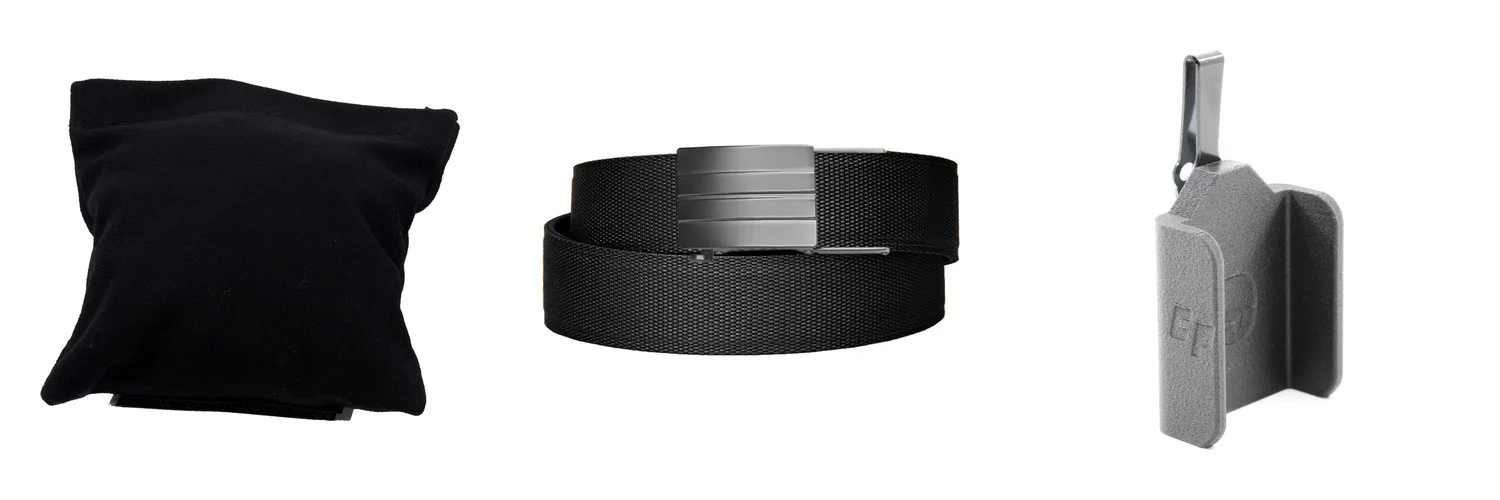
The Cloudster Pillow holster wedge mounts to the back of any IWB or AIWB holster with hook-and-loop, angles the grip into your body for better concealment and comfort, and has shredded cooling gel memory foam fill you can add or remove to set its thickness. Our Kore 1.5″ ratchet gun belts keep the holster steady. For how other states handle permits and renewals, see our carry permit requirements guide.
Las Vegas CCW: Questions People Ask
How much is a CCW in Las Vegas?
LVMPD charges $100.00 for a new CCW application and $65.00 for a renewal (fees effective October 1, 2026). Both include fingerprinting and the FBI background check.
How long does a Las Vegas CCW take?
Nevada law gives LVMPD up to 120 days after a complete application to approve or deny the permit.
Can I get a Nevada CCW if I don’t live in Nevada?
Yes. LVMPD accepts applications from out-of-state residents who completed their firearms training in Clark County.
How many hours is the Nevada CCW class?
Eight hours for a new permit and four hours for a renewal, each with live-fire qualification, from a Nevada-certified instructor.
How long is a Nevada CCW permit good for?
Five years from the date of issuance.
Sources, all read November 4, 2026: Las Vegas Metropolitan Police Department, Concealed Carry Firearm Permits (CCW) page and Apply for a Concealed Weapons Permit page; Washoe County Sheriff’s Office, Concealed Weapons Permits (CCW) page; Nevada Revised Statutes 202.350, 202.3673 and 202.3688 (leg.state.nv.us). Laws and fees change, so confirm with your county sheriff before you apply. This is general information, not legal advice.