Carry Techniques and Optimization, Holsters and Gear Recommendations
Car Holster Guide: Mounts, Safety, Laws and a Better Option
Quick answer: A car holster holds a handgun in a fixed spot in your vehicle, usually under the steering column, on the side of the center console or strapped to the seat. A good one fully covers the trigger guard, holds the gun firmly over bumps and is mounted clear of airbags and pedals. But a mounted gun means more handling every time you get in and out, it can be seen through the windows, and it’s easy to steal if you leave it behind. For most people, carrying on your body with a holster set up for sitting is the better daily choice, with a locked, bolted-down vehicle safe for times you can’t take the gun inside.
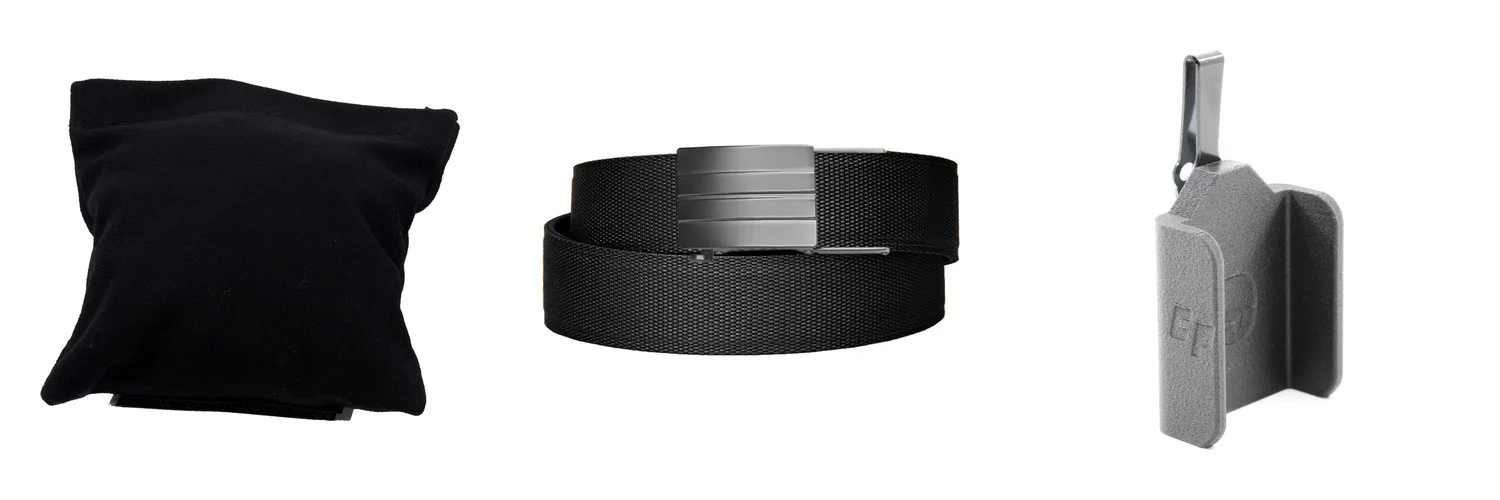
To make appendix carry comfortable while driving, raise the ride height, add a soft wedge at the bottom of the holster, and use a belt you can loosen a notch when seated. See the Cloudster Pillow holster wedge: four sizes, Velcro mount, USA made →
Types of Car Holsters and Vehicle Mounts
| Type | Good | Watch out for |
|---|---|---|
| Rigid mounted holster (screw-in or RAM-ball, under the column or on the console) | Same spot every time; molded to your gun; covers the trigger | Must clear airbags and pedals; often needs drilling; there’s no crash-test standard for car holsters |
| Strap or seat-mount holster | No drilling; moves between vehicles | Universal-fit pouches often hold the gun loosely and can sag |
| Magnetic mount | Cheap and fast to install | Bare magnets leave the trigger exposed and may not hold in a crash; no theft protection |
| Cupholder holster | No install; easy to remove | Gun is usually in plain view, which matters legally and at traffic stops |
| Console vault or vehicle safe | Locked, bolted down, out of sight; best when you must leave the gun | Slower to reach; not a carry method while driving |
Steering column, console, seat or magnetic: which spot works best?
There is no single best spot, because each position has its own drawback. A console holster keeps the gun concealed and easy to reach from the driver’s seat, but it takes up console space, a console shared with a passenger can make the gun harder to reach, and in cars the limited space can make a larger gun hard to store. A steering column holster mounts directly beneath the steering wheel and gives one of the fastest access points, but in a car the compact space can put it in the way of the pedals or other driving controls, and it may be more visible to passengers or anyone looking into the car. A seat holster attaches to the side of the driver or passenger seat and keeps the gun well hidden, but it can take up space in smaller cars or interfere with seat adjustments, and it may cause discomfort if not positioned correctly, especially on long drives. A magnetic holster needs a suitable metal surface, and weaker magnets may not hold the gun securely, especially in a truck with more vibration. Whatever the position, the rules in “If You Use a Car Holster” still apply: full trigger coverage, clear of the airbag and pedals, and never left in the vehicle.
The Problems Nobody Selling Car Holsters Mentions
More handling. With a car holster you move the gun from your body to the mount and back every trip. As ConcealedCarry.com puts it, “the more times you handle the gun, the greater the potential for a negligent discharge” (ConcealedCarry.com).
Crashes. PHLster ran informal tests on a scrap car and found magnets and hook-and-loop mounts slid during rough driving, and an airbag deployment threw a mounted gun across the cabin (PHLster’s blog). PHLster sells on-body holsters, but its point stands: no standard rates car holsters for crash retention. Our velcro holster guide covers hook-and-loop holsters for bags.
Leaving the car. If you have to get out fast, the gun is still in the car.
Theft. Everytown’s analysis of FBI data from 337 cities found the rate of guns stolen from cars roughly tripled from 2013 to 2022, to 63.1 per 100,000 people. By 2022, cars were the source of more than half of reported gun thefts (Everytown, May 2024). The ATF warns that locking your doors “does not provide secure firearm storage,” and that gloveboxes and consoles can be pried open (ATF).
If You Use a Car Holster
- Choose one that fully covers the trigger guard in rigid material. Skip bare magnets.
- Mount it clear of airbag zones, your knees and the pedals.
- Check that the gun stays put over bumps, potholes and hard braking, using an unloaded gun.
- Never leave the gun in the holster when you leave the vehicle. Take it with you or lock it in a safe bolted to the car.
- Know whether a visible gun is legal where you drive (see below).
Why the airbag and pedal rule matters
A Hyundai owner’s manual page titled “Airbag Location” says never to place any objects, such as a dashboard cover, mobile phone holder, cup holder, perfume or stickers, over or near the airbag modules on the steering wheel, instrument panel, windshield glass and the front passenger’s panel above the glove box, because such objects may cause harm in a collision severe enough to deploy the airbags. That warning names the steering wheel and the instrument panel, so check the airbag locations in your own owner’s manual before you mount anything near them. The same warning also covers the front passenger’s panel above the glove box. In cars, the compact space can put a column holster in the way of the pedals or other driving controls, so it needs careful placement.
Truck holsters: same rules, more room
Trucks have more spacious interiors than compact cars, so they can fit larger handguns and offer more placement choices and adjustable mounting options. Column, console and seat holsters can all be used in trucks, and forum members described both column and console setups. One member clipped a holster to the wall of the center console compartment of a Toyota Tundra and called it a “perfect fit”. Another planned a mount under the column because, in that member’s words, “I think it’ll be more accessible under the column than trying to wrestle it out of a seat belt entanglement”, and said they planned to carry the gun on their body when leaving the truck.
The drawbacks do not change with cabin size. One member who was considering a magnetic holder low on the dash of a Tundra wrote, “If someone came to my window and looked hard they would be able to see it”. The same member, who wanted a truck mount, wrote that it was “not comfortable to wear IWB on a long drive”. Another member’s choice was to “always have it on me no matter what” and said they had trained to reach the gun “safely and as quickly as possible”.
The Usually Better Option: Carry on Your Body While Seated
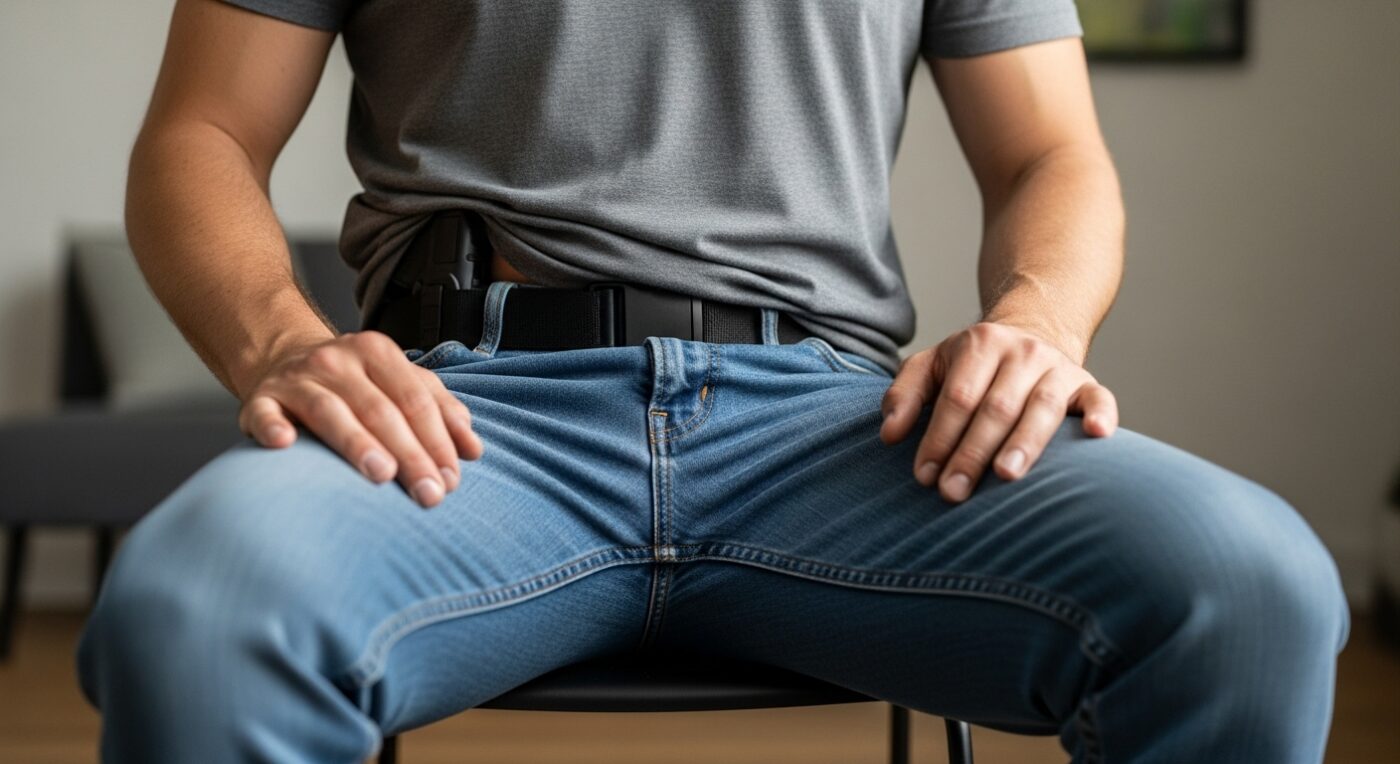
Even Alien Gear, which sells car holsters, calls on-body carry “the gold standard whenever it is practical” (Alien Gear). The usual complaint is comfort: an appendix holster can dig into your thigh or stomach when you sit, and the seatbelt can get in the way of a strong-side draw.
Most of that is fixable:
- Set the ride height so the muzzle doesn’t press into the crease of your hip when you sit.
- Add a soft wedge at the bottom of the holster. It cushions the holster against your body and keeps the grip tucked in. See the Cloudster Pillow →
- Wear a ratchet gun belt. You can let it out a notch when you sit and tighten it when you stand, without hunting for a belt hole. Shop concealed carry belts →
- Practice a seated draw with an unloaded gun, seatbelt on, in your own car.
More tips in our guide to concealed carry while sitting.
Vehicle Carry Laws Vary by State
Rules on loaded guns, visible guns and permits in vehicles differ a lot from state to state. A few examples:
- Texas: it’s an offense to have a handgun in plain view in a vehicle you control unless, among other conditions, it’s in a holster (Texas Penal Code §46.02(a-1)).
- Illinois: without a concealed carry license, a gun in a vehicle generally has to be unloaded and cased or not immediately accessible. License holders may carry loaded and concealed in the vehicle (summary of 720 ILCS 5/24-1 and 430 ILCS 66).
- Michigan: CPL holders who are stopped by police must immediately disclose that they’re carrying, on the body or in the vehicle (Michigan State Police).
- Crossing state lines: the federal safe-passage law (18 U.S.C. §926A) only protects you if the gun is unloaded and not readily accessible from the passenger compartment. A loaded gun in a mounted holster isn’t covered.
Check our reciprocity guide and carry laws overview, then confirm with your state’s official sources before you drive.
Can people see a mounted gun through the window?
One forum member who was considering a magnetic holder low on the dash wrote that someone who came to the window and looked hard would be able to see it. Whether a visible gun matters legally depends on the state; see the state examples above. An empty holster on view is also a signal: one member asked, “if a crook looks into my truck and sees an empty holster, what do you think he’d think?”. The rules above already say never to leave the gun in the vehicle, and the on-body section shows how to carry comfortably while seated.
Does a car holster count as a secure container?
It depends on the state, and the definitions are specific. In Florida, section 790.001(15) of the 2026 Florida Statutes defines “securely encased” as “in a glove compartment, whether or not locked; snapped in a holster; in a gun case, whether or not locked; in a zippered gun case; or in a closed box or container which requires a lid or cover to be opened for access”. Section 790.25(4)(a) allows a person 18 or older who is in lawful possession of a handgun to possess it inside a private conveyance “if the handgun or weapon is securely encased or otherwise not readily accessible for immediate use”. “Readily accessible for immediate use” means a weapon “carried on the person or within such close proximity and in such a manner that it can be retrieved and used as easily and quickly as if carried on the person”. So in Florida a snapped holster can qualify, as of the 2026 Florida Statutes.
California is the opposite case. The California Attorney General’s office says a handgun may be transported by motor vehicle “provided it is unloaded and locked in the vehicle’s trunk or in a locked container”, and it defines a locked container as “a secure container that is fully enclosed and locked by a padlock, key lock, combination lock, or similar locking device. This includes the trunk of a motor vehicle, but does not include the utility or glove compartment” (checked on the Attorney General’s page November 4, 2026; the page shows no date). An open holster on the console is not a locked container under that definition. Laws vary by state, so check your state’s official statute or attorney general page before you rely on any of them.
Driving across state lines in a truck or SUV with no trunk
The federal safe-passage law, 18 U.S.C. §926A, lets a person transport a firearm from any place where they may lawfully possess and carry it to any other place where they may lawfully possess and carry it, if during the trip the firearm is unloaded and neither it nor any ammunition is “readily accessible or is directly accessible from the passenger compartment”, as of the 2023 edition of the United States Code. The statute adds that “in the case of a vehicle without a compartment separate from the driver’s compartment the firearm or ammunition shall be contained in a locked container other than the glove compartment or console”. So if your truck or SUV has no compartment separate from the driver’s compartment, a glove box or console does not meet the federal requirement. A loaded gun in a mounted holster is outside this protection, as the note above already says. Every state sets its own standards, so research the laws and permit reciprocity of every state on your route before you go.
Quick Answers
Is a car holster a good idea?
It can be for long daily drives, if it covers the trigger and you never leave the gun in the car. For most people, on-body carry set up for sitting is safer and simpler. Cross draw is one on-body option built for sitting; see our cross draw holster guide.
Are magnetic gun mounts safe?
Bare magnets leave the trigger exposed and may not hold the gun in a crash. If you use one, pick a model with a trigger guard.
Where should a car holster go?
Where you can reach it without leaning, clear of airbag zones, your knees and the pedals. Under the steering column or on the side of the console are the usual spots.
Can I keep my gun in the glovebox?
Rules vary by state, and gloveboxes are easy to break into, passengers can open them, and reaching for your registration during a stop puts your hand near the gun.
Is it legal to have a gun mounted in my car?
It depends on your state, especially if the gun is loaded or in plain view. Check your state’s laws before you mount one.
How do I make appendix carry comfortable while driving?
Raise the ride height, add a soft wedge at the bottom of the holster, and use a belt you can loosen a notch when seated.
Does an empty truck holster attract break-ins?
Forum members raised exactly this concern, with one asking what a thief would think on seeing an empty holster through the window. The theft section above cites Everytown figures showing that by 2022 cars were the source of more than half of reported gun thefts. Carrying on the body, as covered above, means the gun does not stay in the vehicle.
Should I carry on my body or use a truck mount on long drives?
One member who wanted a truck mount said an IWB holster was not comfortable on a long drive, while another kept the gun on their body at all times and trained to reach it safely and quickly. The seated-carry fixes above, including a soft wedge at the bottom of the holster and a ratchet belt you can let out a notch, address the comfort problem without leaving the gun in the truck. On-body carry also means the gun goes with you when you step out.
Written by the Cloudster Pillow team. We make holster wedges and the Magnetic Pocket Mag Carrier, and carry Kore gun belts. We don’t sell car holsters, holsters or firearms, and no maker paid to be mentioned here. This is general information, not legal advice or a substitute for professional training; check the carry laws where you live and drive.