Licensing and Cost-Saving Tips
Florida Concealed Carry: Permitless Carry and the Concealed Weapon License (2026)
Quick answer: Florida allows concealed carry without a license for anyone who meets the criteria for a license, under section 790.01 of the 2026 Florida Statutes. Section 790.01 lists the license criteria that apply to carrying without a license as section 790.06(2)(a)-(f) and (i)-(n), (3) and (10). That list leaves out section 790.06(2)(h), the firearm-competence (training) requirement for a license. The Florida Department of Agriculture and Consumer Services (FDACS) still issues a Concealed Weapon License, and since a June 17, 2026 appeals court ruling it issues licenses to applicants 18 or older. The license costs $97 for a new Florida resident ($55 plus a $42 fingerprint fee) and is valid for seven years. Every fact below comes from Florida’s own statutes, FDACS pages and, for open carry, the Volusia County Sheriff’s statement, checked November 4, 2026.
Can you carry concealed in Florida without a license?
Yes, if you qualify. Section 790.01 says a person is authorized to carry a concealed weapon or concealed firearm if he or she is licensed under section 790.06, or is not licensed but “otherwise satisfies the criteria for receiving and maintaining such a license.” Someone who does not meet the criteria and carries a concealed firearm commits a third-degree felony; carrying a concealed weapon or electric weapon or device is a first-degree misdemeanor. Section 790.01(5) lists exceptions, including a self-defense chemical spray or a nonlethal stun gun carried concealed for lawful self-defense.
If you carry without a license, section 790.013 requires you to carry valid identification at all times while in actual possession of a concealed firearm, and to display it on demand by a law enforcement officer. A violation is a noncriminal violation with a $25 fine.
Who can get a Florida Concealed Weapon License
Section 790.06(2) lists the requirements. In summary, you must:
- be a U.S. resident and a citizen or permanent resident alien;
- meet the age requirement: the statute says 21, but FDACS says that after the Fourth District Court of Appeal’s June 17, 2026 ruling in Eubanks v. Florida (4D2025-1698), it “will issue concealed weapon licenses to applicants who are 18 years or older and meet all other eligibility requirements”;
- not have a physical infirmity that prevents safe handling of a firearm;
- not have a felony conviction that bars firearm possession, a controlled-substance conviction within the 3 years before you apply, or a commitment for the abuse of a controlled substance, among the statute’s other disqualifiers;
- demonstrate competence with a firearm (see the next section).
Training that counts
Section 790.06(2)(h) accepts any one of these as proof of competence with a firearm:
- a hunter education or hunter safety course approved by the Fish and Wildlife Conservation Commission or a similar agency of another state;
- any National Rifle Association firearms safety or training course;
- a firearms safety or training course open to the public, taught by instructors certified by the NRA, the Criminal Justice Standards and Training Commission or FDACS;
- a law enforcement or security firearms course;
- equivalent experience through organized shooting competition or U.S. military service;
- a current or past Florida concealed weapon license that was not revoked for cause;
- a course taught by a state-certified or NRA-certified firearms instructor.
For an NRA course, a public course, or a course taught by a state-certified or NRA-certified instructor, the instructor must keep records that you safely handled and discharged a firearm in the instructor’s physical presence, including live fire.
How to apply
FDACS (checked November 4, 2026) lets you apply online, in person or by mail. In person, you can apply “at an FDACS regional office or an authorized Florida tax collector’s office in your area.” Bring:
- a picture ID (a driver license or state-issued identification card);
- a copy of a training document or other certificate that shows you are proficient with a firearm;
- your payment. FDACS regional offices cannot accept cash.
Staff take your photograph and scan your fingerprints, and you swear that you have been given a copy of Chapter 790, Florida Statutes, and know its provisions. FDACS says applications from active military members and veterans are expedited.
Fees
The FDACS fee schedule (section 790.06, read November 4, 2026):
- Florida resident, new license: $55 license fee plus $42 fingerprint processing, $97 in total. Renewal: $45.
- Out-of-state resident, new license: $97 in total. Renewal: $87, which includes the $42 fingerprint processing fee.
- Revised or duplicate license: $15.
- Tax collector offices may add convenience fees: $22 for a new application and $12 for a renewal.
How long it takes, and how long it lasts
- Processing: FDACS says that “by law” it “has 90 days from the date on which we receive a complete application to either issue a license or deny the application.” If the criminal history check finds a record of a crime that may disqualify you but has no final disposition, or lacks enough information to decide, section 790.06(6)(c)3 allows the 90-day limit to be extended for up to an additional 45 days after the information is received.
- Term: a Florida concealed weapon or firearm license “is valid for a period of seven years.”
- Renewal: FDACS mails a renewal form about 95 days before the expiration date. If you miss it, you may renew up to 180 days after expiration, with a $15 late fee.
Why get a license if Florida is permitless?
- Travel: FDACS describes reciprocity as a “mutual recognition agreement between two states to recognize a concealed weapon license issued by the other state.” FDACS publishes the list of states that honor a Florida license and says it is your responsibility to know and comply with the law of any state you visit. See our reciprocity guide for how to check.
- Buying a gun: under section 790.0655, the three-day purchase waiting period does not apply to the holder of a concealed weapons license.
Where a license still doesn’t let you carry
Section 790.06(12)(a) lists places a license does not cover, including police, sheriff and highway patrol stations; jails and prisons; courthouses and courtrooms; polling places; meetings of a county, school district, city or the Legislature; school, college and professional athletic events not related to firearms; elementary and secondary school facilities; and the part of a bar that is primarily devoted to serving alcohol. Read the full list in the statute before you carry somewhere new. Section 790.013 makes people who carry without a license subject to the same place restrictions in section 790.06(12) as license holders.
Open carry in Florida
In a statement dated September 11, 2025, the Volusia County Sheriff said the First District Court of Appeal had ruled the day before, in McDaniels v. State, that the state’s Open Carry Ban (section 790.053) is unconstitutional. The Sheriff told deputies to stop enforcing the ban, while noting that the places listed in section 790.06(12)(a) remain off limits, and that owners of private property or businesses may still prohibit open carry on their property. This rests on a court ruling, not a rewritten statute, so check for changes.
Carrying comfortably in Florida heat
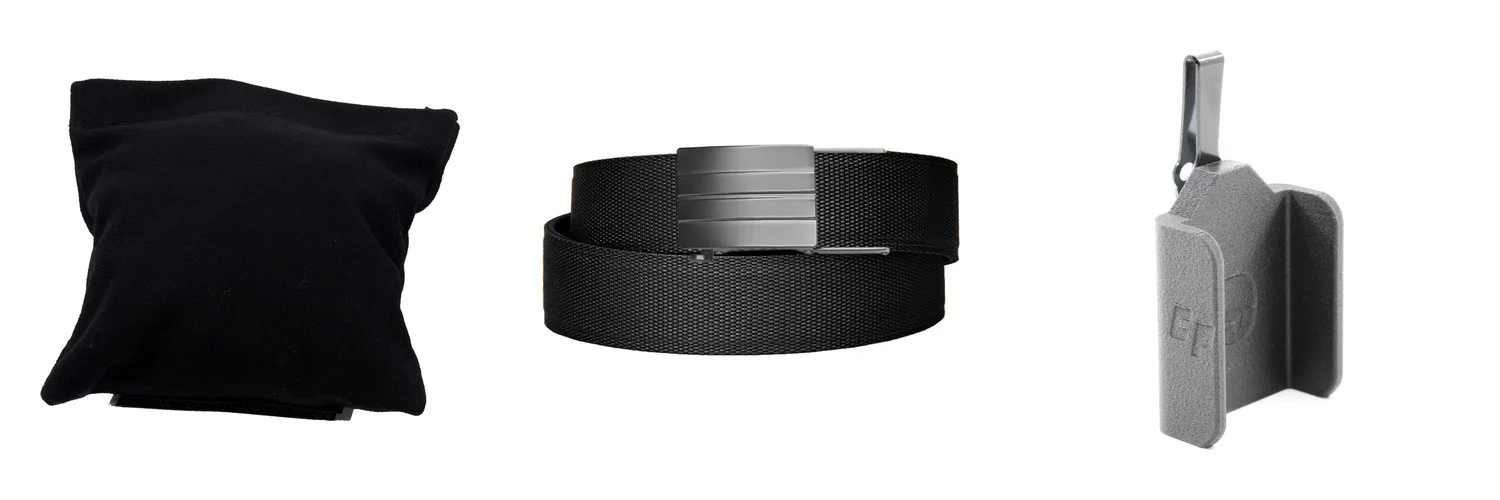
Florida summers are long, so the holster you can wear all day matters. The Cloudster Pillow holster wedge mounts to the back of any IWB or AIWB holster with hook-and-loop and has shredded cooling gel memory foam fill you can add or remove to set its thickness. For shorts and summer clothing, see our concealed carry in shorts guide, and for a belt that holds the holster steady, our Kore 1.5″ ratchet gun belts.
Florida Concealed Carry: Questions People Ask
Do you need a permit to carry concealed in Florida?
No, if you meet the criteria for a license. Section 790.01 authorizes concealed carry for anyone licensed or anyone who “otherwise satisfies the criteria for receiving and maintaining such a license.” You must carry valid ID and show it to an officer on demand.
How much is a concealed carry permit in Florida?
For a Florida resident, $97 for a new license ($55 plus the $42 fingerprint processing fee) and $45 to renew, per the FDACS fee schedule. Tax collector offices may add a convenience fee.
How old do you have to be to get a Florida concealed carry license?
FDACS says that after the June 17, 2026 Eubanks v. Florida ruling it issues licenses to applicants 18 or older who meet all other requirements, although the statute still says 21.
How long does a Florida concealed weapon license take?
By law, FDACS has 90 days from receiving a complete application to issue or deny the license. Section 790.06(6)(c)3 allows up to 45 more days when the criminal history check finds a possibly disqualifying record with no final disposition or not enough information.
How long is a Florida concealed carry license good for?
Seven years. FDACS mails a renewal form about 95 days before it expires.
Can nonresidents get a Florida concealed weapon license?
Yes. The FDACS fee schedule lists a fee for out-of-state residents ($97 new, $87 renewal).
Sources, all read and re-checked November 4, 2026: Florida Statutes 790.01, 790.013, 790.06, 790.0655 and 790.053 (2026 edition, leg.state.fl.us); FDACS Concealed Weapon License, Applying, Renew and Reciprocity pages and its fee schedule; Volusia County Sheriff’s statement on open carry. Laws change, so confirm with FDACS before you apply or travel. This is general information, not legal advice.