Licensing and Cost-Saving Tips
Colorado Concealed Carry: How to Get a Concealed Handgun Permit (2026)
Quick answer: Colorado requires a Concealed Handgun Permit (CHP) to carry a concealed handgun outside your home, business or property, or your private vehicle. County sheriffs issue the permit to legal Colorado residents 21 and older. Since July 1, 2025, the usual way to show handgun competence is an in-person concealed handgun training class of at least 8 hours, with a live-fire exercise and a written exam, taken within one year before you apply. The sheriff’s permit fee can be up to $100, plus the state’s $52.50 background check fees, and the sheriff has 90 days to decide. The permit is valid for five years. Facts below are from the Colorado Bureau of Investigation (CBI) CHP and reciprocity pages, the Colorado Revised Statutes and the El Paso County Sheriff’s Office, checked November 4, 2026.
When you need a permit in Colorado
Under C.R.S. 18-12-105, a person commits a class 1 misdemeanor by knowingly and unlawfully carrying a firearm concealed on or about the person. The statute’s exceptions include a person “in his or her own dwelling or place of business or on property owned or under his or her control,” and a person in a private automobile or other private means of conveyance who carries a weapon for lawful protection while traveling. C.R.S. 18-12-204(3) adds that a handgun carried for a legal use, including self-defense, in a private automobile “shall not be considered concealed.” Anywhere else, concealed carry needs a permit.
Who issues the permit
CBI explains that sheriffs are “the issuing authorities in the State of Colorado.” CBI runs the fingerprint and name-based background checks “on behalf of Colorado Sheriffs” and sends the results back to the county sheriff’s office. You apply in person to the sheriff of the county where you live, or of a county where you keep a secondary residence or own or lease real property used in a business (C.R.S. 18-12-205), and you sign the application in person before the sheriff.
Who qualifies
C.R.S. 18-12-203 lists the criteria. A sheriff issues a permit to an applicant who, among other things:
- is a legal resident of Colorado (members of the armed forces stationed in Colorado on permanent duty station orders, and their immediate family living in Colorado, count as residents);
- is twenty-one years of age or older;
- is not ineligible to possess a firearm under C.R.S. 18-12-108 or federal law;
- since July 1, 2025, has not been convicted within the past five years of certain misdemeanors listed in the statute;
- does not chronically and habitually use alcoholic beverages to the extent that normal faculties are impaired, and is not an unlawful user of or addicted to a controlled substance;
- is not subject to a protection order or an extreme risk protection order;
- demonstrates competence with a handgun (next section).
A sheriff may also deny a permit if there is a reasonable belief that the applicant would be a danger to self or others.
Training: the 8-hour class
House Bill 24-1174, approved by the Governor on June 4, 2024, changed the training rules. Beginning July 1, 2025, a training class counts only if it meets the new minimum standards and you complete it within one year before you apply. Under C.R.S. 18-12-202.5, the class:
- must be held in person, and “no part of the class may be conducted via the internet”;
- must provide “a minimum of eight hours of instruction,” including a live-fire shooting exercise and a written concealed handgun competency exam;
- covers safe handling of firearms and ammunition, safe storage and child safety, shooting fundamentals, federal and state firearm laws, the use of deadly force for self-defense, safely interacting with law enforcement responding to an emergency, and avoiding a criminal attack and managing a violent confrontation;
- requires a minimum seventy percent accuracy score in the live-fire exercise;
- is taught by an instructor verified by a county sheriff.
The El Paso County Sheriff’s Office notes that a verified instructor may be from any Colorado county, as long as the instructor is listed on a county sheriff’s public website. Other ways to show competence include current military service, organized shooting competitions, current peace officer certification, being a certified instructor, an honorable discharge within three years (or within ten years with pistol qualifications listed), or retirement from a Colorado law enforcement agency with pistol qualifications within ten years.
Fees
There are two parts:
- The sheriff’s permit fee. C.R.S. 18-12-205 caps it at “one hundred dollars.” Renewals are capped at fifty dollars, plus a fifteen dollar late fee if you renew after expiration.
- The state background check fees, paid to CBI through the sheriff: $52.50 for a new application ($17.50 CCIC fingerprint check, $13.00 InstaCheck, $22.00 FBI fingerprint check), $13.00 for a renewal and $30.50 for a temporary emergency permit. CBI says these fees “must be submitted to the issuing sheriff’s department in the form of a cashier’s check or money order made payable to CBI,” and that sheriffs may charge an administrative fee on top.
Counties show the combined amount. For example, the El Paso County Sheriff’s Office charges a total processing fee of $135.00 for a new permit. Neither the permit fee nor the fingerprint fee is refunded if the application is denied.
How to apply
- Complete a concealed handgun training class with a verified instructor (or gather another proof of competence).
- Fill out the statewide standardized application form from your county sheriff. Many counties take the application online first, then book an appointment.
- Appear in person, sign the application under oath before the sheriff, and have your fingerprints and photo taken. El Paso County says that appointment takes approximately 15-20 minutes.
- Pay the sheriff’s fee and the CBI fees.
Under C.R.S. 18-12-206, the sheriff must approve or deny the application “Within ninety days after the date of receipt” of the required items. A denied applicant is told the grounds in writing and can ask for a second review and judicial review.
How long the permit lasts and how to renew
- “A permit is valid for a period of five years after the date of issuance” (C.R.S. 18-12-204).
- You can renew within one hundred twenty days before expiration, with the sheriff of your county of residence (or of a county where you have a secondary residence or business property).
- Since July 1, 2025, a renewal also needs proof of handgun competence. One option is a full concealed handgun training class or a refresher class of at least two hours, taken within six months before you renew (C.R.S. 18-12-211; HB24-1174).
- If you miss the expiration date, you can still renew with the late fee. “No permit shall be renewed six months or more after its expiration date,” and after that you apply again as a new applicant.
Carrying with a Colorado permit
Carry the permit and photo ID. C.R.S. 18-12-204 requires you to carry the permit, together with valid photo identification, whenever you are in actual possession of a concealed handgun, and to produce both on demand by a law enforcement officer. Failure to do so is a petty offense, and the charge is dismissed if you later show the court a valid permit and photo ID issued before the charge.
Where a permit does not let you carry. C.R.S. 18-12-214 and related sections exclude:
- places where federal law prohibits firearms;
- public elementary, middle, junior high and high school property, except a handgun kept in your vehicle (stored as the law requires if you leave the vehicle unattended);
- licensed child care centers and public or private colleges, universities and seminaries;
- government buildings covered by C.R.S. 18-12-105.3: buildings with the general assembly’s chambers or offices, local government governing-body chambers and offices unless the local government permits carry, and courthouses, including their adjacent parking areas;
- polling locations, drop boxes and central count facilities;
- public buildings with security personnel and electronic weapons screening at each entrance;
- buildings or areas where a local government or higher education governing board bans concealed carry by ordinance or rule and posts signs at the public entrances.
Other states’ permits in Colorado
CBI says Colorado recognizes another state’s permit only if that state honors a Colorado permit, the holder is 21 or older, and the holder is a resident of the issuing state with a matching driver’s license or state ID. “The State of Colorado does not recognize the validity of a concealed carry permit issued by any state, to a nonresident of that state.” That also means “A Colorado resident may only carry concealed in the state using a Colorado Concealed Handgun Permit (CHP).” For which states honor a Colorado permit, see our concealed carry reciprocity guide and CBI’s reciprocity page.
Carrying comfortably once your permit arrives
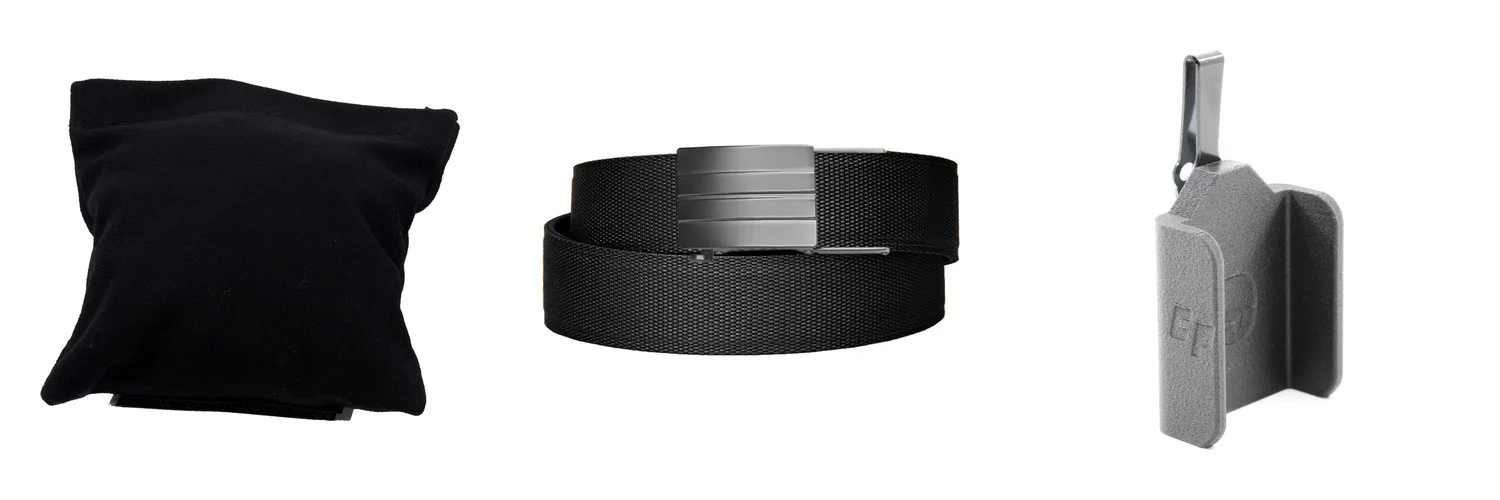
The Cloudster Pillow holster wedge mounts to the back of any IWB or AIWB holster with hook-and-loop, angles the grip into your body for better concealment and comfort, and has shredded cooling gel memory foam fill you can add or remove to set its thickness. Our Kore 1.5″ ratchet gun belts keep the holster steady. For how other states handle permits and renewals, see our carry permit requirements guide.
Colorado Concealed Carry: Questions People Ask
Does Colorado allow permitless concealed carry?
No. Carrying a concealed firearm without a permit is a class 1 misdemeanor, except in your own home, business or property, or in a private vehicle while traveling for lawful protection.
How much is a Colorado concealed carry permit?
The sheriff’s fee can be up to $100, plus CBI’s $52.50 background check fees. Counties publish the total; El Paso County’s is $135.00.
How many hours of training does Colorado require?
At least 8 hours, in person, including a live-fire exercise and a written exam, from a sheriff-verified instructor, within one year before you apply. Renewals can use a refresher class of at least 2 hours taken within six months.
How long does it take to get a Colorado CHP?
The sheriff must approve or deny the application within ninety days after receiving the required items.
Can non-residents get a Colorado permit?
No. The sheriff issues permits to legal Colorado residents, and Colorado honors another state’s permit only when the holder lives in the state that issued it.
Sources, all read November 4, 2026: Colorado Bureau of Investigation, Concealed Handgun Permit (CHP) page and CHP Reciprocity page; Colorado Revised Statutes 18-12-105, 18-12-105.3 and 18-12-202.5 to 18-12-214 (Office of Legislative Legal Services 2024 printout, including the House Bill 24-1174 provisions effective July 1, 2025); Colorado General Assembly, HB24-1174 bill page; El Paso County Sheriff’s Office, Concealed Handgun Permit page. Laws change, so confirm with your county sheriff before you apply. This is general information, not legal advice.