Holsters and Gear Recommendations
Israeli Carry: What It Means and Why Instructors Debate It
Quick answer: Israeli carry means carrying a semi-automatic pistol with a loaded magazine but no round in the chamber, so you rack the slide as you draw. It’s Condition 3 in Jeff Cooper’s terms. The name comes from the Israel Defense Forces, but the practice is older. The instructors quoted here argue it’s slower and needs both hands.
What Is Israeli Carry?
CCW Safe defines it: ““Israeli Carry” is a term commonly used when concealed carriers holster-carry their semi-automatic handguns with a loaded magazine and empty chamber.” Creedmoor Training Academy puts it more briefly: “the practice carrying a pistol without a round in the chamber.”
In the condition system Ammoman attributes to Colonel Jeff Cooper:
- Condition 1: “You have inserted the magazine, there is a round in the chamber, and you have engaged all appropriate safeties.”
- Condition 3: “The magazine is inserted but there is no round in the chamber. We call this “Israeli Carry.””
Where the Name Comes From
The sources agree the Israelis didn’t invent it. Creedmoor: “The Israelis didn’t invent the practice but it got the name from Israeli armed forces policy.” CCW Safe points to W.E. Fairbairn and E.A. Sykes, authors of “Shooting to Live,” as “early proponents of carrying a semi-automatic pistol with a full magazine inserted into the pistol and empty chamber.”
Ammoman quotes a 1940 U.S. Army manual on the 1911A1: “In campaign, when early use of the pistol is not foreseen, it should be carried with a fully loaded magazine in the socket, chamber empty, hammer down.”
On why Israel kept it, Creedmoor writes that when the state was founded, ““drop safe” firearms were not as common as today and the fledgling state had a mixed bag of armaments scrounged from all over the world.” CCW Safe suggests the IDF “may have standardized their handgun training at one time given the variety of handguns in their possession whose methods of operation might vary significantly.”
The Case Made for It
CCW Safe summarizes the argument: “Advocates have stated that carrying a handgun in such a condition is safer because it lessens the chances that the carrier will experience an unintended discharge.” Creedmoor lists the advantages people give, each with its own reply:
- “Safer if you leave a loaded pistol laying around (but we don’t do that, right?)”
- “Safer in the case of a gun grab (but we conceal or use retention holsters, right?)”
The Case Against It
Every source quoted here argues against it for concealed carry. Their main points:
- It takes two hands. Creedmoor’s first disadvantage: “Requires two hands (or advanced techniques that new shooter are unlikely to know).” Ammoman credits writer Tamara Keel with the line “You own a handgun, not a hands gun.”
- It’s slower. Creedmoor: ““Israeli Carry” is much slower. The Israelis train hard to mitigate this disadvantage but it will never be as fast as a chambered draw.”
- Attacks happen up close. Creedmoor: “Frequently the victim is forced to draw while wresting or fending off an attacker or after being knocked or thrown to the ground.”
- The support hand may be busy. CCW Safe asks “what if my support hand is not free?” Gun Digest’s author, a firearms instructor, notes that racking off “your boot, belt or holster” is “a task that is easier said than done.”
On drop safety, CCW Safe says that a pistol in Israeli carry won’t fire if dropped, but “the same is true for most modern-day, good -quality semi-automatic pistols.” Gun Digest says the concept “originated in a time before the widespread adoption of modern, drop-safe semi-automatic pistols.”
Ammoman’s conclusion: “every single defensive pistol on the market today is designed to be carried with a round in the chamber.” Gun Digest adds that “whether you choose to carry with a round in the chamber is up to you.”
Holster and Belt, Whichever Way You Carry
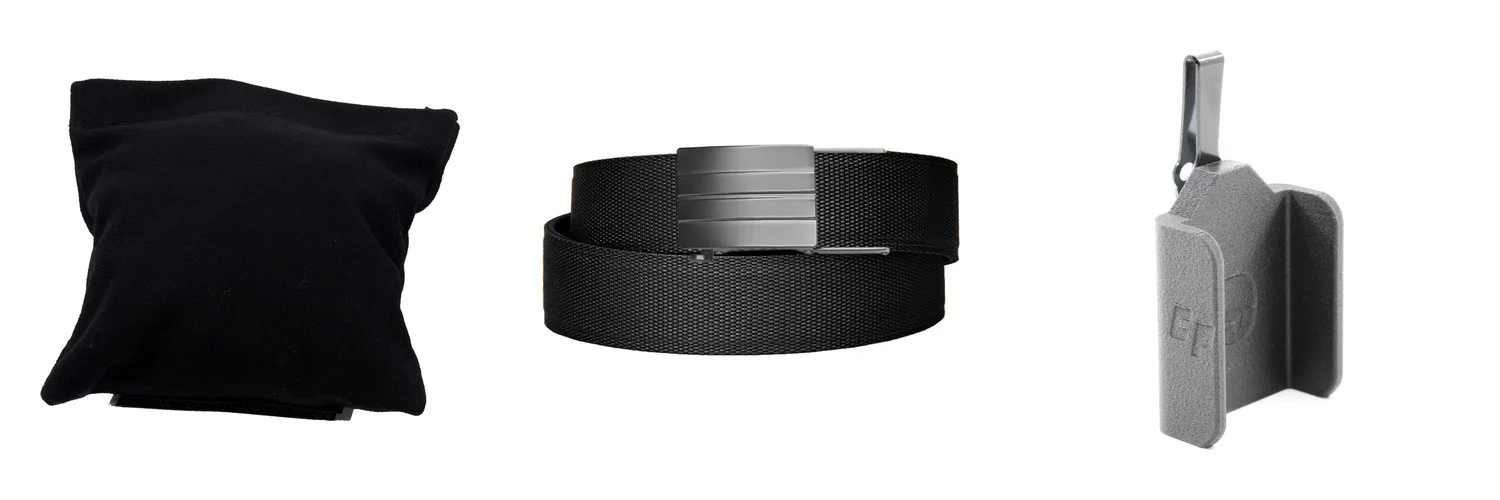
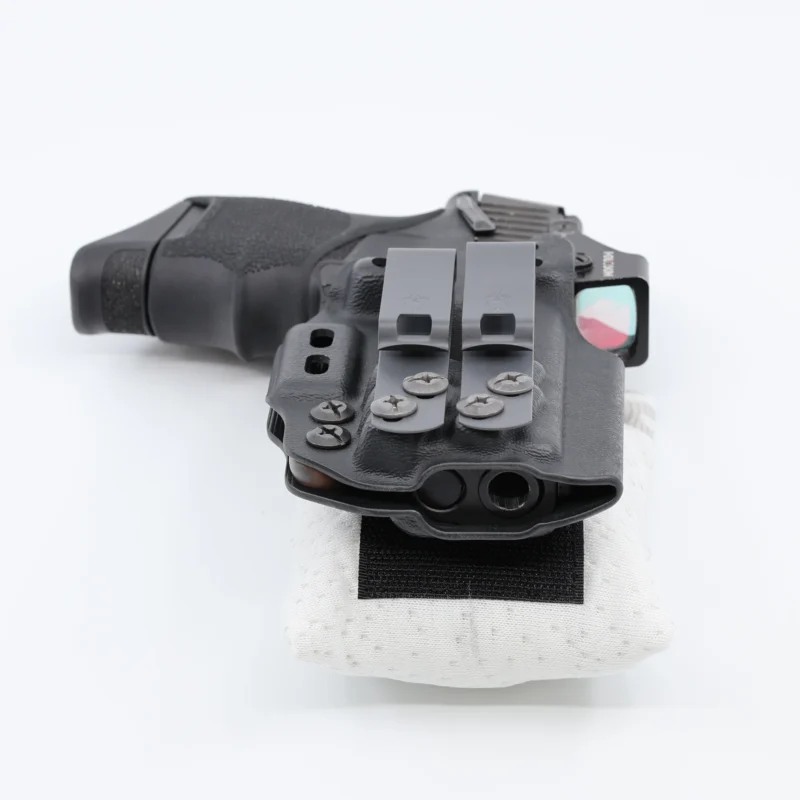
Either way, the pistol rides in a holster. Our guide to holster retention levels explains how holsters hold the gun. For comfort inside the waistband, the Cloudster Pillow holster wedge mounts to any IWB or AIWB holster with hook-and-loop, angles the grip into your body, and has memory-foam fill you can add or remove to set its thickness. The Kore gun belts we carry are 1.5″ wide.
Israeli Carry: Questions People Ask
What condition is Israeli carry?
Condition 3: a loaded magazine in the gun and an empty chamber.
Did the Israelis invent it?
No. The sources trace it to Fairbairn and Sykes and to WWII-era military practice; the name comes from IDF policy.
Is Israeli carry safer?
Its advocates say so. The instructors quoted here disagree, pointing out that most modern pistols are drop-safe and that the method is slower and needs two hands.
Does the IDF still use it?
Creedmoor writes that “While other military and police forces have largely abandoned the practice, it has remained in Israel.”
Written by the Cloudster Pillow team. We make the Cloudster Pillow and the Cloudster magnetic mag carriers, and carry Kore belts. We don’t sell holsters or firearms. This page summarizes published views from the sources named; it is general information, not legal advice or a substitute for professional training.