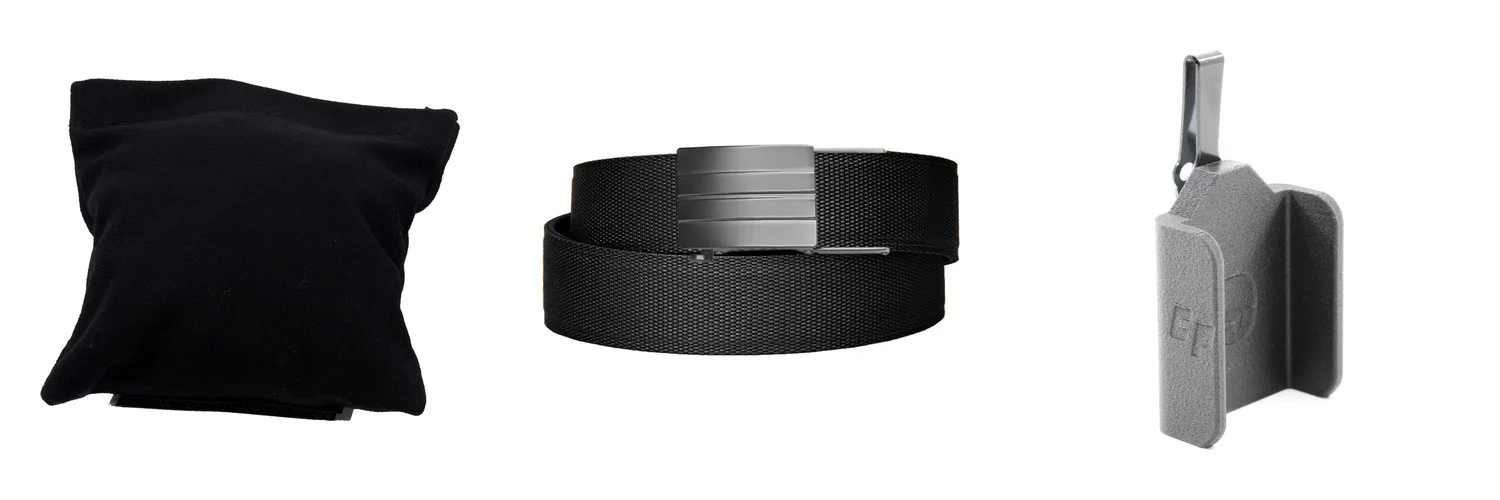
Holsters and Gear Recommendations
IWB Revolver Holster: J-Frame Picks and Comfort Fixes
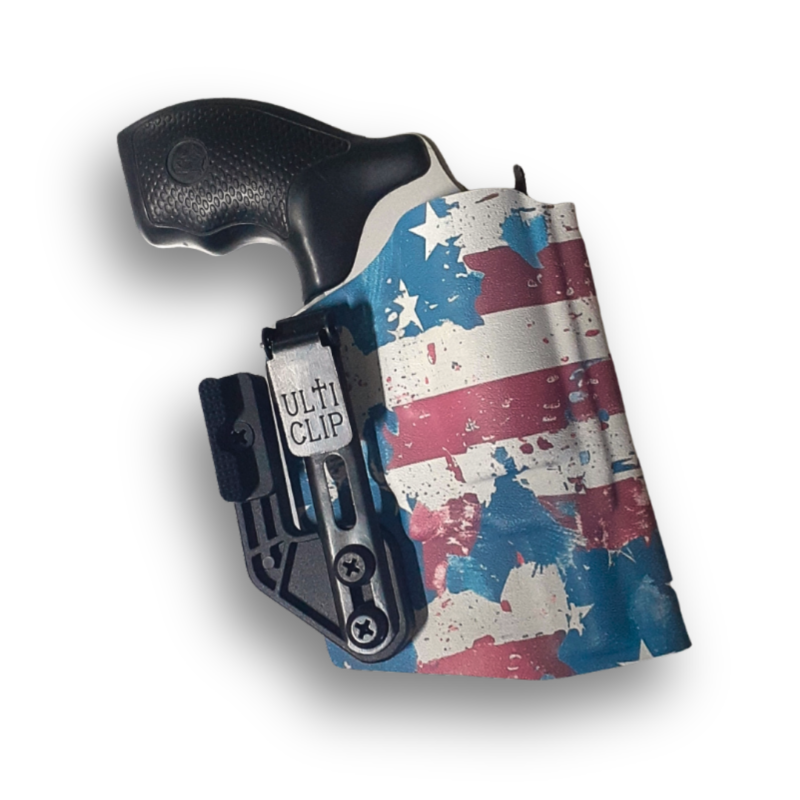
Quick answer: The best IWB revolver holster is one molded for your exact revolver model. Look for adjustable ride height and cant, a fully covered trigger guard, and a claw or wing to tuck the grip in. For a small J-frame like the Smith & Wesson 642, two well-documented choices are the Vedder LightTuck (all-Kydex, adjustable retention) and the CrossBreed SuperTuck (a Kydex pocket on a leather backing). Both are made for the 642 by name. Before blaming the gun for discomfort or printing, check the holster’s fit, its position and your belt. A soft wedge like the Cloudster Pillow handles the rest; for a small J-frame, the Standard or the Deluxe. For the revolvers that carry best, see our concealed carry revolvers guide.
S&W 642 Size at a Glance
| Caliber | .38 S&W Special |
| Capacity | 5 rounds |
| Barrel | 1.88 in |
| Overall length | 6.31 in |
| Height | 4.3 in |
| Width | 1.3 in |
| Weight | 16.3 oz |
| Action / frame | Double action only / aluminum |
Specs for the Model 642 Ultimate Carry from Smith & Wesson’s own product page, checked October 2026. Other 642 versions may differ slightly.
S&W lists a snag-free enclosed hammer, a beveled cylinder front edge “for smoother holstering,” and a grip bottom that is flush cut for concealment. At 16.3 oz it’s light, so pair it with a well-fitted holster and a stiff belt.
What to Look For in an IWB Revolver Holster
- Molded for your exact model. Vedder and CrossBreed both list J-frames model by model. CrossBreed, for example, lists the Airweight 642 separately from the Model 60 with a 3-inch barrel. Check that your model is on the list.
- Adjustable ride height and cant. Small changes in height and angle can change how it feels, especially when you sit.
- A claw or wing. It presses against your belt to draw the grip closer to your body.
- A sweat guard. It cuts down how much of the gun touches your body.
- Kydex or hybrid. An all-Kydex holster like the LightTuck is the thinnest option. A hybrid like the SuperTuck puts a leather backing between the holster and your skin.
- A trigger guard that’s fully covered, every time, for safe carry and reholstering.
Two IWB Revolver Holsters Made for the J-Frame 642
We don’t sell holsters and nobody paid to be listed here. Both are made for the S&W J-Frame 642 by name, and the details below come from each maker’s own product page.
Vedder LightTuck (S&W J-Frame Model 642)
An all-Kydex IWB holster that Vedder says is formed to your exact gun model in .080-inch Kydex. Vedder lists Level 1 retention with adjustable retention and 30° of adjustable forward and reverse cant. It also lists ride height with three levels of adjustment and a full sweat shield, and calls it claw compatible. Vedder also lists LightTuck versions for other J-frames, including the Models 36, 40 and 438.
CrossBreed SuperTuck (S&W J-Frame Airweight 642)
A hybrid: a premium leather backing with a molded Kydex pocket, hand molded for each gun on CrossBreed’s list. That list includes the Airweight 642, 442 and 637 and the Model 36. CrossBreed says its steel SnapLok clips let you adjust cant and ride height, and that the SuperTuck is designed to ride at 3:30 to 5 o’clock for a right-hand draw. Leather options are black cowhide, horsehide and Founder’s Leather. CrossBreed backs it with a two-week try-it-free guarantee and a lifetime warranty.
Next step. For concealed carry with either of these IWB holsters, the Cloudster Pillow holster wedge mounts to any IWB or AIWB holster with hook-and-loop, and you add or remove the shredded cooling gel memory foam fill to set the thickness. See the Cloudster Pillow holster wedge.
Carrying appendix? See our AIWB holster guide for what matters in front-of-the-hip carry.
What Makes a Revolver Holster Different
DeSantis, which has made revolver holsters since the 1970s, sums up the problem: “a cylinder is wider than the slide on an automatic pistol and a snub nose carries nothing like a six-inch barrel.” That’s why a revolver holster is cut for one gun. DeSantis says its revolver holsters “are formed around the specific frame size and barrel length of the gun they are marked for.”
- Match the frame and barrel. A .38 Special J-frame snub and a large-frame .357 need different holsters. Check the maker’s fit list for your exact model and barrel length.
- Pick the carry style. DeSantis lists pocket holsters for J-frames, belt holsters for mid-frames, and chest rigs for large-frame revolvers: “Large-frame and single action revolvers get their own rigs, including chest holsters for hunting and backcountry work.”
- Use a gun belt. DeSantis: “Pair any belt model with a proper gun belt, since a heavy cylinder pulls a soft belt out of shape fast.” The Kore gun belts we carry are 1.5″ wide.
For other ways to carry a revolver, see our guides to concealed carry revolvers, pocket holsters, chest holsters and western holsters.
Moon clips, which hold a full cylinder of revolver rounds together, are covered in our mag vs clip guide.
How to Match a Holster to Your Revolver: Frame Size, Barrel, Hammer and Sights
Falco Holsters says the revolver make and model are essential when ordering, that frame size is an important fact when ordering, and that you should consider whether the hammer is exposed or concealed.
Frame size. Smith & Wesson revolvers are grouped by frame size, and each frame has a different cylinder diameter. Falco describes the J-frame as a small frame that usually has a five-shot .38 Special cylinder or a six-shot .32 cylinder, the K-frame as a medium frame, usually a six-shot .38 or .357, the L-frame as in between, and the N-frame as a .44 caliber revolver. Measured cylinder diameters published by all4shooters show the step between frames: 33.1 mm for the J-frame, 36.8 mm for the K-frame, 39.5 mm for the L-frame and 43.5 mm for the N-frame. Examples by frame: Models 36, 60 and 340 are J-frames; Models 15, 19, 64 and 66 are K-frames; Models 586 and 686 are L-frames; Models 27, 29 and 629 are N-frames.
Barrel length. Falco says two- and three-inch barrels work best for concealed carry, that a four-inch barrel is feasible with a proper holster, and that a revolver worn on the waistband should be limited to a four-inch barrel.
Hammer type. Falco advises considering whether the hammer is exposed or concealed, and gives the example that a thumb-break holster made for a Model 36 with an exposed hammer will not loop over the hidden-hammer Model 442.
Sights. Falco notes that a ramp front sight, such as the one on the Model 66, and an adjustable rear sight demand a built-in sight track, while a fixed-sight Model 10 is simpler. It lists sights alongside make, model and frame size as details to identify before ordering.
Revolver Holster Types: IWB, OWB, Pocket and Chest
Each carry method suits a different size of revolver.
- Inside the waistband (IWB). Alien Gear says IWB holsters offer excellent concealment for compact or snub-nose revolvers. Falco adds that most of the handgun is concealed by your trousers. This is the method the rest of this page covers in detail.
- Outside the waistband (OWB). Alien Gear says OWB holsters work well with full-size revolvers due to better weight distribution. Falco calls the strong-side holster the default for most uses and says that, cinched in tightly to the belt, it may be concealed by a covering garment.
- Pocket. Falco describes pocket holsters as suitable for the smallest handguns. DeSantis builds its pocket holsters for small autos and revolvers such as the Ruger LCR and S&W J-frame, and says they are built to stay put in your front pocket, break up the shape of your firearm, and deliver a smooth draw. Members of the Smith & Wesson Forum discussing pocket carry for snub-nose revolvers name holsters including the DeSantis Nemesis, Galco and Remora, and one member explains that a holster whose bottom shape does not match the pocket’s shape will tip the gun.
- Chest. Alien Gear says chest rigs are an alternative for outdoor enthusiasts carrying large-frame revolvers during hiking or hunting trips. Falco says chest holsters are for outdoors use.
- Shoulder. Falco says shoulder holsters help keep weight off the belt line but are a specialty type that demands much thought before you order.
Whatever belt-mounted method you choose, Falco’s advice is to always use a good quality gun belt, not a dress belt, or you will defeat the purpose of the holster. The Kore ratchet gun belts sold on this site are 1.5 inches wide, use a toothed track that locks into the buckle in quarter-inch steps with over 40 sizing positions, and have a reinforced core built to resist belt roll under the weight of a loaded holster.
Leather vs Kydex vs Hybrid for Revolvers
| Leather | Kydex | Hybrid | |
|---|---|---|---|
| How it holds the gun | Fits on the frame | Grips at the frame, cylinder and muzzle | Kydex shell with a leather or neoprene backing |
| Upkeep | Needs break-in and periodic care (see below) | Requires the least maintenance | Not stated in the sources |
| Look and feel | Traditional appearance; classic aesthetics and comfort | Rigid thermoplastic known for durability and precision fit | Balances rigidity with comfort |
| Sweat | May soften with prolonged use, which can reduce retention reliability in humid conditions | Resists sweat | Not stated in the sources |
Falco sums up the trade: Kydex requires the least maintenance, while leather offers a traditional appearance. Sarco’s view is that leather is expensive, should be broken in and needs to be conditioned, but with proper care will last as long as Kydex and is widely considered more comfortable.
Leather Revolver Holsters: Horsehide vs Cowhide, Break-In and Care
Horsehide or cowhide. Vedder Holsters, which offers both as backing for its hybrid holsters, says horsehide has a coarser grain and an especially strong fiber structure and calls it one of the most durable leathers available. It describes cowhide as having a classic, rugged look with a thicker, more structured appearance, while horsehide has a slightly thinner, lighter structure. Both are water-resistant, so rain and sweat will not damage them, and Vedder calls the two fairly matched in durability. Both break in quickly and conform to your body.
Breaking in a new leather holster. Break-in is optional. Sarco says a leather holster does not need to be broken in, but if you do, it will fit the gun better and be more comfortable to wear. The method Handguns magazine recommends is to place the gun in a Ziploc bag and push it into the holster, which lets the leather fibers stretch just enough for a smooth draw while keeping a solid grip on the gun. Members of the USCCA community forum describe the same approach with a plastic bag or wax paper, leaving the gun holstered overnight and repeating as needed, and one member warns against leather softener because it undermines retention.
Caring for a leather holster. Sources disagree on oils and conditioners, so follow your holster maker’s instructions first. We The People Holsters tells its customers not to apply oils, cleaners, liquids or leather conditioner, because they soften the leather and harm the molding and retention, and allows only neutral shoe polish to restore the finish. Handguns magazine says excessive saddle soap and soft conditioners can soften the material and cause the holster to lose its form, and that only cleaning agents designed for leather holsters should be used. Sarco, by contrast, says leather holsters need conditioning to remain viable long-term, applied sparingly when wear marks and creases appear, once or twice a year for a lightly used holster.
Other care points from these sources:
- Sweat is the enemy. Handguns magazine says perspiration’s mix of salts, oils and water will eventually break down the structure of leather fibers, and recommends keeping a barrier of clothing between you and the holster where possible.
- Dry it naturally. Never use artificial heat such as a blow dryer or a warm air vent; leave the holster in a dry place at moderate temperature and let it dry on its own. Do not leave it in a hot place, particularly in direct sunlight.
- Do not store the gun in it. Sarco says leather can trap moisture, which can corrode exposed steel.
Retention: Friction Fit vs Thumb Break
Alien Gear explains the two kinds of retention: passive retention relies on friction to hold the firearm in place, while active systems use mechanisms such as thumb breaks for added security. A molded Kydex holster holds the revolver at the frame, cylinder and muzzle, and a leather holster holds it by fitting on the frame.
If you choose a thumb break, order it for your exact hammer type; Falco’s example is that a thumb break made for an exposed-hammer Model 36 will not loop over the hidden-hammer Model 442. Whichever system you pick, Falco says to be certain the holster retains the handgun properly, and to check that the belt loops are tight and snug on the gun belt so the holster does not have a loose fit or wobble.
Concealing a 3- or 4-Inch Revolver
Falco says two- and three-inch barrels work best for concealed carry, a four-inch barrel is feasible with a proper holster, and a waistband-carried revolver should be limited to a four-inch barrel.
Falco notes that in many cases a K-frame revolver is no wider than a striker-fired handgun. To keep the cylinder bulge off the belt line, Falco recommends a high ride with an OWB holster and a low ride with an IWB holster. For IWB carry, the wedge described above helps conceal the gun by drawing the grip closer to your body.
Comfort and Concealment Fixes for Revolver Carry
- Belt first. Wear a stiff gun belt. See our concealed carry belt guide.
- Use the claw. If your holster takes one, set it so it presses on the belt.
- Add a wedge. A wedge on the body side of the holster presses on the bottom of the gun and draws the top closer to your body. Our wedge placement guide shows where it goes.
- Check it sitting down. Test the fit in a chair or a car, not just standing in front of a mirror.
The Right Cloudster Pillow for a Revolver
The Cloudster Pillow is a soft holster wedge filled with shredded cooling-gel memory foam. You can add or remove fill to set the thickness. It attaches to the body side of the holster with hook-and-loop, and adhesive loop strips and an alcohol wipe come in the box. It fits any holster, including leather and hybrids. On a leather-backed holster like the SuperTuck, some owners make the mount semi-permanent. They spot-glue the corners and center of the adhesive Velcro, or lightly sand the mount spot with very fine-grit sandpaper first. Both methods alter the holster, so check the holster maker’s warranty before you try either.
It comes in four sizes, Mini, Standard, Deluxe and Monster, from $20 to $45. For a small J-frame like the 642, the Standard or the Deluxe. For a larger revolver, or if you’re not sure, our size finder walks you through it.
Quick Answers
Can I use a semi-auto holster for my revolver?
Don’t count on it. Buy a holster the maker lists for your revolver model, and check that your exact model is on the fit list.
Kydex or hybrid for a J-frame?
All-Kydex is the thinnest option. A hybrid adds a soft backing between the holster and your skin. Either way, pair it with a stiff belt.
Where should I carry a revolver IWB?
It depends on the holster and your build. CrossBreed designs the SuperTuck for 3:30 to 5 o’clock (right hand). Vedder says the LightTuck’s cant adjustment covers 3 to 5 o’clock, appendix and cross draw.
What size Cloudster Pillow for a revolver?
Standard for a small J-frame like the S&W 642. For anything larger, use the size finder.
Will the Cloudster Pillow stick to a leather holster?
Yes, it fits any holster. On leather or hybrids, spot glue on the adhesive Velcro or light sanding of the mount spot makes it semi-permanent. Check your holster’s warranty first.
Are leather revolver holsters a good choice?
They suit readers willing to care for them. Falco says leather offers a traditional appearance while Kydex needs the least maintenance, and Sarco says that with proper care a leather holster lasts as long as Kydex and is widely considered more comfortable. Leather holds the revolver by fitting on the frame, and Falco says the make and model are essential when ordering.
Horsehide or cowhide for a revolver holster?
Vedder Holsters, which offers both as hybrid holster backing, says both are water-resistant, both break in quickly, and the two are fairly matched in durability. Horsehide is slightly thinner and lighter; cowhide is thicker and more structured.
How do I break in a leather revolver holster?
Handguns magazine recommends putting the gun in a Ziploc bag and pushing it into the holster, which stretches the leather fibers just enough for a smooth draw while keeping a solid grip. Forum members leave it overnight and repeat as needed, and one member advises against leather softener because it weakens retention.
Should I oil or condition a leather holster?
Follow your holster maker’s instructions. We The People Holsters says not to apply oils, cleaners or conditioner because they soften the leather and harm molding and retention, and Handguns magazine warns that excess saddle soap or conditioner can make a holster lose its form. Sarco allows sparing conditioning once or twice a year when creases appear.
Does my J-frame holster fit a K-frame?
Order a holster for your exact revolver. Falco says the make and model are essential when ordering and frame size is an important fact, and all4shooters’ measurements show a larger cylinder on each frame: 33.1 mm on a J-frame, 36.8 mm on a K-frame, 39.5 mm on an L-frame and 43.5 mm on an N-frame.
Can I carry a 4-inch revolver concealed?
Falco says two- and three-inch barrels work best, but a four-inch barrel is feasible with a proper holster, and four inches is the limit for waistband carry. Ride high with OWB and low with IWB to keep the cylinder bulge off the belt line.
Is a pocket holster good for a snub-nose revolver?
Pocket holsters suit the smallest handguns, and DeSantis builds its pocket holsters for revolvers such as the S&W J-frame, designed to stay put in the pocket and break up the gun’s shape. Smith & Wesson Forum members say a good pocket holster stays in the pocket when the gun is drawn, and one explains that a holster whose bottom shape does not match the pocket will tip the gun.
Do I need a thumb break on a revolver holster?
Passive retention uses friction; a thumb break is an active system that adds security. If you want one, it must suit your hammer type: Falco’s example is that a thumb break made for an exposed-hammer Model 36 will not loop over the hidden-hammer Model 442.