Holsters and Gear Recommendations
Minimalist Holster Guide: Pros, Cons and What to Check

Quick answer: A minimalist holster is a trimmed-down inside-the-waistband holster that covers the trigger guard and holds the gun at one retention point, with little shell beyond that. It cuts bulk and printing, but gives less stability and body shielding than a full holster. It must still cover the trigger completely, hold the gun firmly and stay put on the belt. For the clips that hold a holster on the belt, see our holster clip guide.
What Is a Minimalist Holster?
Holster maker On Your 6 Designs describes it this way: “A minimalist kydex holster strips away unnecessary bulk and focuses on the part of the firearm that matters most for safe carry – the trigger guard and retention point.” Instead of a full shell over the slide and frame, “this style keeps the footprint tight.”
Shooting Illustrated’s review of one such design, the Mission First Tactical Minimalist Appendix IWB, describes it as “a molded Boltaron half shell that looks totally inadequate and not at all up to the task of holding a gun.” In testing, the reviewer found “The gun locked in with an audible click and stayed locked in despite my shaking it.”
Why People Choose One
On Your 6 Designs gives the main reason: “The biggest reason is comfort. Less holster means less material between you and your waistband, less pressure against the hip, and often less printing under a T-shirt or light cover garment.” It adds that the style “tends to shine in everyday concealed carry, especially appendix or strong-side IWB setups.”
The Trade-Offs
| Minimalist | Full-coverage IWB | |
|---|---|---|
| Bulk | Lowest | More shell and backer |
| Stability | “less overall body contact, which sometimes means less leverage and stability” | “more overall stability, more body shielding” |
| Comfort | “Less material can help one person and create hot spots for another.” | Some “prefer a larger shell because it distributes pressure better across the beltline.” |
| Best for | When “low bulk is the top priority and the user already knows what carry position works best” | More “concealment features built into the design” |
Quotes from On Your 6 Designs. Its bottom line: “Neither option is automatically better. The better option is the one that gets worn consistently, retains the firearm correctly, and supports a safe, repeatable draw.”
What to Check Before You Buy
- Trigger coverage: “That should be complete and non-negotiable.”
- Retention: “positive, repeatable retention that secures the handgun without turning the draw into a fight.”
- Exact fit: it “should be molded for the exact firearm model, not a loose guess based on similar frame sizes.”
- The clip and the belt: “If the clip is weak or the shell is not molded correctly, the whole point of Kydex gets lost.” The holster “should stay where you place it.” For what Kydex is and how it compares, see our Kydex vs leather guide.
- Carry position: some are made for one position only. Shooting Illustrated notes the MFT Minimalist “is designed for appendix carry only.”
The first four quotes are from On Your 6 Designs. On re-holstering, Shooting Illustrated reports that “MFT warns on their website that you should remove the holster before inserting the gun,” so follow the maker’s instructions for your holster.
Trigger Guard Holsters: Clip or Tether
A trigger guard holster is the smallest version of the idea. Craft Holsters defines it as “a specialized type of firearm holster designed to cover the trigger guard of a gun fully, minimizing the risk of accidental discharge.” They come in two main setups:
- Clipped to the belt. Rounded Gear lists “an IWB belt-clip configuration for beltline carry” alongside its smallest “minimalist trigger guard setup.” The guard stays on the belt and the gun draws out of it, like any IWB holster.
- Tethered, so the guard comes off on the draw. Rounded Gear calls this a “static-cord setup when your use case requires the holster to release from the firearm during the draw.” Gunner’s Custom Holsters says its version is “great for pocket carry, as well as securing a firearm inside a purse, backpack, vehicle compartment, bug-out bag, or other compatible storage location,” and “When the firearm is drawn, the lanyard pulls the holster free.” Its kit includes “a durable 10-inch, 550 paracord lanyard that can be attached to a belt loop, bag, or another secure fixed point.” Clipdraw sells similar trigger sheaths with “a durable paracord tether.”
For bag and purse carry, see our purse holster guide. For the clips that hold a holster on the belt, see our holster clip guide.
The Belt Does More of the Work
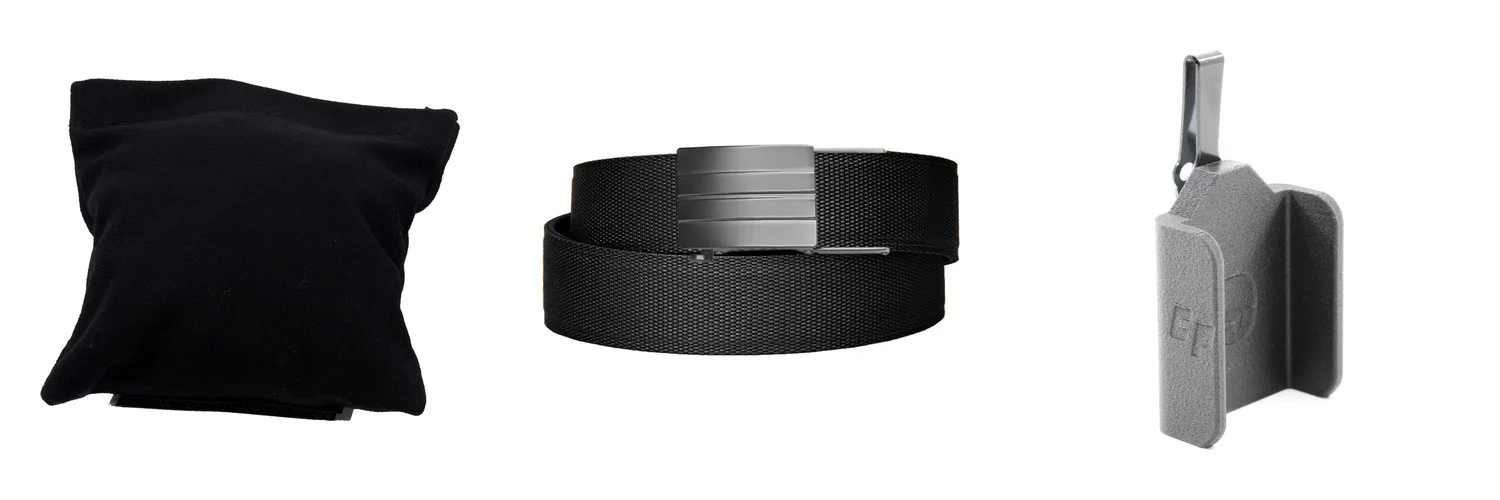
On Your 6 Designs notes that “minimalist designs still need proper construction and a solid attachment method.” Half of that attachment is your belt. The Kore gun belts we carry are 1.5″ wide; the Kore Black Tactical Nylon Gun Belt is rated by Kore for “Up to 10 lbs. • IWB, OWB or Appendix,” with a “Power-Core™ Center for Added Stiffness and Support” and “40+ positions in ¼″ increments.”
If a minimalist holster gives you hot spots and you move to a fuller flat-back holster, the Cloudster Pillow holster wedge mounts to any flat-back IWB or AIWB holster with hook-and-loop, and its memory-foam fill can be added or removed to set the thickness.
More on the basics in our IWB vs OWB comparison and our deep concealment holster guide.
Minimalist Holster: Questions People Ask
Are minimalist holsters safe?
A good one is: it fully covers the trigger, locks the gun in, and stays put on the belt. Shooting Illustrated’s reviewer judged the MFT Minimalist on those same points: it “must cover the trigger and trigger guard, must hold the gun securely, and must allow for one-handed reholstering.”
Do minimalist holsters print less?
Often, because there’s less material. On Your 6 Designs says they mean “often less printing under a T-shirt or light cover garment.”
Can I carry a minimalist holster strong side?
Depends on the model. Some, like the MFT Minimalist reviewed by Shooting Illustrated, are appendix only.
Minimalist or full holster?
Minimalist if low bulk matters most and you know your carry position; a full holster if you want more stability and body shielding.
Written by the Cloudster Pillow team. We make the Cloudster Pillow and the Cloudster magnetic mag carriers, and carry Kore belts. We don’t sell holsters or firearms, and no maker paid to be mentioned here. This is general information, not a substitute for professional training; check the carry laws where you live.