
Holsters and Gear Recommendations
Must-Have Gun Accessories: 9 Essentials for Every Gun Owner
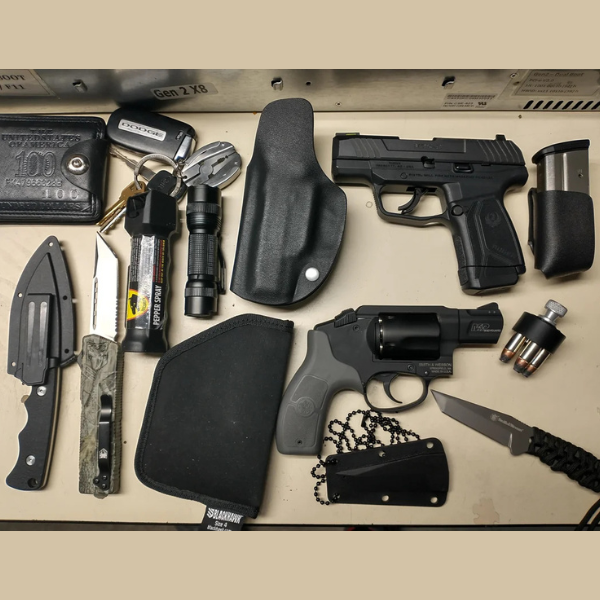
Quick answer
Start with the basics: a way to lock the gun up, a holster that fully covers the trigger guard, a stiff gun belt, eye and ear protection, and a cleaning kit. If you carry, add a weapon light, a way to carry a spare magazine, and regular practice, including dry fire and a bleeding-control class. Comfort add-ons like a holster wedge come last. They help a good setup, but they can’t fix a bad one.
The essentials at a glance
| Accessory | Why it matters | What to look for |
|---|---|---|
| Safe storage | Keeps children and unauthorized adults away from guns and ammo | A lock or safe you will actually use every day |
| Holster | Protects the trigger while you carry | Covers the entire trigger guard with rigid material |
| Gun belt | Gives the holster a stable place to ride | Wide and stiff |
| Eye and ear protection | Shooting noise can damage hearing, and eyes need protection too | ANSI Z87.1 eyewear, plus earplugs and/or earmuffs |
| Cleaning kit | Guns wear and need periodic service | The tools and supplies your gun’s manual calls for |
| Weapon light | Helps you see your target in low light | A holster made for the gun with that light fitted |
| Spare magazine carrier | Keeps a reload on you | Fits your magazine and the clothes you actually wear |
| Comfort add-ons | Optional, once the holster and belt are right | Works with the holster you already own |
| Training | Builds safe handling habits | A dry-fire routine and a bleeding-control course |
1. Safe storage
The National Shooting Sports Foundation’s safety rules say that when firearms aren’t in use, they and their ammunition should be secured in a safe place, separate from each other. The same rules put the job of keeping children and unauthorized adults away from guns squarely on the owner.
You may already own a lock. With some exceptions, federal law says a licensed dealer can’t sell or transfer a handgun unless the buyer is provided with a secure gun storage or safety device for it (18 U.S.C. § 922(z)). If you need one, Project ChildSafe, an NSSF program, runs a “Get a Free Safety Kit” page where you choose your state and city to find a participating law enforcement partner.
2. A holster that covers the trigger guard
Firearms trainer Kathy Jackson of Cornered Cat sets the baseline: with modern firearms, the trigger and the entire trigger guard area must be completely covered. The material covering it also has to be sturdy enough that nothing outside the holster can move the trigger. That applies to every carry method, including pocket carry. Pick the holster for the exact gun you carry, and pick it before you buy anything on this list except storage.
3. A real gun belt
Jackson calls a good belt one that’s “both wide and stiff.” She explains that on a narrow belt, holsters tend to flop around and twist your clothing. Her advice is that when a holster that used to be comfortable starts acting up, the belt is probably the reason. We carry Kore ratcheting gun belts, which Kore makes, if you want a starting point.
4. Eye and ear protection
NSSF’s rule 7 says all shooters should wear protective shooting glasses and some form of hearing protection, because shooting noise can damage hearing. For eyewear, look for glasses that state compliance with ANSI/ISEA Z87.1. That’s the consensus standard OSHA’s eye and face protection rule cites for workplace eye protection.
For ears, NIOSH researchers recommend double protection every time a gun is fired: earplugs under earmuffs. The National Institute on Deafness and Other Communication Disorders warns that hearing loss from a gunshot can be immediate and permanent.
5. A cleaning kit
NSSF describes a gun as a mechanical device that wears out and needs periodic inspection, adjustment and service, and it tells owners to check with the gun’s manufacturer for recommended servicing. Build your kit from what your owner’s manual calls for. Two cleaning habits are also in the NSSF rules. Wear eye protection when you take a gun apart and clean it, so springs and solvents stay out of your eyes. And because cleaning can expose you to lead, keep the area well ventilated and wash your hands thoroughly afterward.
6. A weapon light
NSSF’s rule 4 is “Be Sure of Your Target and What’s Beyond It.” In low light, a weapon light is one way to see what you’re pointing at. One example is the Streamlight TLR-7 X. Streamlight lists it at 725 lumens and 9,500 candela, and it runs on either a CR123A battery or Streamlight’s SL-B9 rechargeable pack. Streamlight also warns against carrying a gun with one of its lights unless it’s in a proper holster that fully covers the trigger guard area. That means a light usually means a new holster made for that gun and light together.
7. A spare magazine carrier
A spare magazine only helps if it’s on you. A belt pouch is one option. If you’d rather keep your beltline clear, our Magnetic Pocket Mag Carrier rides in a pocket and holds the magazine with two N52 magnets. It’s made for 9mm and .40 magazines with steel bodies, since the magnets need steel to grab. It’s $35.
8. Comfort add-ons
If a holster edge digs in, a holster wedge is one fix. The Cloudster Pillow is a soft holster wedge filled with shredded cooling-gel memory foam. You can add or remove fill to set the thickness, and it attaches with hook-and-loop and fits any holster, including leather and hybrids. It comes in four sizes from $20 to $45. It won’t fix a holster that doesn’t fit your gun, so get items 2 and 3 right first.
9. Training
Dry fire lets you practice at home without ammunition, but it needs a strict routine. Jackson’s dry-fire safety ritual starts with getting all the ammunition out of the room and out of sight, and choosing a backstop that would stop a bullet. Her rule is blunt: if you can’t find a reliable backstop, don’t dry fire. She also warns about the classic accident pattern, which is reloading and then taking “just one more” shot.
A bleeding-control class is also worth your time. The American College of Surgeons’ Stop the Bleed program teaches three basic actions for controlling severe bleeding, and its site has a course finder.
FAQ
What should a new gun owner buy first?
Something to store the gun securely, then eye and ear protection for the range. If you plan to carry, add a holster that fully covers the trigger guard and a stiff gun belt. Everything else can wait.
Does a holster wedge replace a good holster?
No. A wedge is a comfort add-on. The holster still has to fully cover the trigger guard and fit your gun.
Do I need a special belt to carry a gun?
You need one that’s wide and stiff enough to hold the holster steady. Kathy Jackson’s rule of thumb: if a holster that used to be comfortable starts acting up, the belt is probably the reason.
Will a magnetic magazine carrier hold a polymer magazine?
Not if the magazine body is fully polymer with no steel in it. The magnets need steel to grab. Our Magnetic Pocket Mag Carrier is made for 9mm and .40 magazines with steel bodies.
Do I need a new holster if I add a weapon light?
Usually, yes. Streamlight says not to carry a gun with one of its lights unless it’s in a proper holster that fully covers the trigger guard area. That means a holster made for the gun with the light fitted.

Pingback: The Complete Gun Safe Buying Guide - Cloudster Pillow
Pingback: Why Quality Shooting Glasses are a Must-Have - Cloudster Pillow
Pingback: Practical Carry Training: Real Skills For Everyday Carriers - Cloudster Pillow