Quick answer: There’s no single best carry pistol. The best one is the gun you can hide all day, shoot well and trust. The models that come up most for everyday carry are 9mm micro-compacts: the Sig P365 family, the Springfield Hellcat, the Smith & Wesson Shield Plus and the Glock 43X. The compact Glock 19 is a frequent pick for people who can hide a bigger gun. For head-to-head specs, see Hellcat vs P365 and Shield Plus vs P365. All eight pistols below are 9mm, and each takes a standard magazine of 10 to 15 rounds. Whatever you choose, carry it in a good holster on a sturdy belt (our 9mm holster guide covers how to pick one).
Carry Pistols Compared
| Pistol | Capacity | Barrel | Length | Height | Width | Weight |
|---|---|---|---|---|---|---|
| Sig P365 | 10-round mags | 3.1 in | 5.8 in | 4.3 in | 1.06 in | 17.8 oz |
| Sig P365X | 12-round mags | 3.1 in | 5.8 in | 4.8 in | 1.1 in | 17.8 oz |
| Sig P365 XL | 12-round mags | 3.7 in | 6.6 in | 4.8 in | 1.1 in | 20.7 oz |
| Glock 43X | 10 (standard mag) | 3.41 in | 6.50 in | 5.04 in | 1.10 in | 16.40 oz (no mag) |
| Springfield Hellcat OSP | 11-round flush, 13-round extended | 3 in | 6 in | 4 in (flush mag) | 1 in (grip) | 17.9 oz (flush mag) |
| S&W M&P9 Shield Plus | 10- and 13-round mags | 3.1 in | not listed | 4.6 in | 1.1 in | 17.9 oz |
| Ruger MAX-9 | 12+1 | 3.20 in | 6 in | 4.42 in | 0.95 in (slide) | 18.4 oz |
| Glock 19 | 15 (standard mag) | 4.02 in | 7.28 in | 5.04 in | 1.34 in | 21.52 oz (no mag) |
Specs are from each manufacturer’s website for one listed model of each pistol, checked October 2026. Makers measure differently (Glock lists weight without a magazine, Springfield with the flush magazine, and some makers list grip or slide width instead of overall width), so compare the numbers loosely and confirm on the maker’s site before you buy.
The Carry Pistols That Come Up Most
We don’t sell guns, and we haven’t lab-tested these. They’re models that appear in major concealed carry guides and head-to-head comparisons, with specs taken from each manufacturer. They’re not ranked.
Sig P365
The P365 holds 10 rounds of 9mm in a pistol 5.8 inches long, 4.3 inches tall and 1.06 inches wide, at 17.8 ounces. Sig also sells versions with a manual safety. If you carry a P365 without a light, the Cloudster Pillow Standard or Deluxe fits it.
Sig P365X
Same 3.1-inch barrel and 5.8-inch length as the P365, but with a taller 4.8-inch grip, 12-round magazines, a flat trigger and an optic-ready slide. Sig lists manual-safety versions and 10-round versions for some states. Our P365 vs P365X comparison covers the differences.
Sig P365 XL
The longer P365: a 3.7-inch barrel, 6.6 inches long, 4.8 inches tall and 20.7 ounces, with 12-round magazines and an optic-ready slide. It’s for carriers who want a longer sight radius and a fuller grip while keeping the slim width.
Glock 43X
Glock’s slimline 9mm: 1.10 inches wide, with a 10-round standard magazine and a 3.41-inch barrel, at 16.40 ounces without a magazine. In April 2026, Glock announced that the G43X will come standard with a new 15-round magazine; its product page still lists 10 rounds as of October 3, 2026, so check what ships in the box. The G43X MOS version has a slide cut for micro red dots. If the 43X fits you, the Standard or the Deluxe Cloudster Pillow fits it. See our Glock 43 vs 43X and Glock 48 vs 43X comparisons.
Springfield Hellcat OSP
11 rounds in the flush magazine and 13 in the extended one, from a pistol 6 inches long and 4 inches tall with a 1-inch grip width. The OSP slide is cut for a micro red dot, and it ships with a tritium front sight. A Hellcat fits the Standard or the Deluxe Cloudster Pillow.
Smith & Wesson M&P9 Shield Plus
The Shield Plus ships with both a flush 10-round and an extended 13-round magazine, has a flat-face trigger and weighs 17.9 ounces. The standard model we checked has no thumb safety and isn’t optic-ready. It fits the Standard or the Deluxe.
Ruger MAX-9
Ruger’s micro 9mm holds 12+1, with a 3.2-inch barrel, a 0.95-inch slide and an optic-ready slide on the model we checked. Note that every MAX-9 spec sheet we opened lists a manual safety, so practice sweeping it off on the draw. Check our size guide for your holster.
Glock 19
The compact choice: 15 rounds standard, a 4.02-inch barrel, 7.28 inches long and 1.34 inches wide. It’s bigger than everything above, but you get more capacity and a full-size grip. Glock currently lists it in V and Gen6 versions. A Glock 19 takes a Deluxe or a Monster Cloudster Pillow. For a shorter Glock, look at the Glock 26, which Glock lists at 4.17 inches tall with a 10-round standard magazine (see our Glock 26 holster guide). Our Glock 26 vs 19 and Glock 19 vs 43X comparisons put the numbers side by side, and our best Glock for concealed carry guide covers more models.
How to Choose a Carry Pistol
- Size vs. capacity vs. shootability. Smaller guns hide more easily. Bigger guns give you more grip to hold and a longer sight radius. Height and length both affect how well a gun hides, so compare the height column, not just the length.
- Grip fit. Hold it with a real shooting grip. Can you reach the trigger and the magazine release without shifting your hand? Is there room for all your fingers?
- Sights and optics. Several guns here come optic-ready from the factory. A red dot adds height and cost and needs a holster with room for it, so decide before you buy the holster.
- Manual safety or not. Some models are offered both ways, and some have a safety on every version. If you choose a safety, train with it until disengaging it is automatic.
- Reliability. Before you carry it, shoot enough of your chosen defensive ammunition to trust that this gun runs it.
- Caliber. Every pistol in this guide is 9mm. If you want something smaller for a pocket, see our best pocket pistol guide, which covers .380 and .32 options.
Carry Methods, Briefly
- Appendix (AIWB): inside the waistband at the front of the body.
- Strong-side IWB: inside the waistband on the hip, around 3 to 5 o’clock for a right-handed carrier.
- OWB: outside the waistband. Easier to wear, but it takes a longer cover garment to hide.
- Pocket: only for very small guns, always in a pocket holster.
Revolver or Semi-Auto for Concealed Carry?
GunsAmerica’s 2026 defensive revolver guide sums up the case for a revolver: “no magazine to forget, no slide to rack under stress, and a trigger press that does the same thing every time”. American Rifleman describes running one as “(1) aim gun at justifiable target, (2) pull trigger, (3) repeat if necessary”. Gun Digest contrasts that with the path each round in a semi-auto must survive: “fire, unlock, extract, eject, re-chamber, lock fire”.
Capacity and reloads are where the semi-auto wins. American Rifleman notes that “capacity beyond five or six rounds is not the case with the snubby revolver”. In this page’s table, the Sig P365 and Glock 43X hold 10 rounds and the Glock 19 holds 15. Gun Digest adds that speedloaders are “bulky and round, not like a slim and sleek magazine for your pistol”. GunsAmerica’s counterpoint is that “five and six rounds still end most civilian fights if you can hit”.
Concealment differs by carry method. American Rifleman writes that the cylinder “makes for a bulky center section, but the overall irregular shape hides pretty well”. On a belt, the same article says “a slim pistol can really fit up tight under the kidney area”. A J-frame cylinder is 1.30 inches wide and a Taurus 856 is 1.41 inches, against 1.06 inches for a Sig P365. For inside-the-waistband revolver carry, a wedge between the bottom of the holster and your body angles the grip back in toward you, which is covered in the revolver guide.
Gun Digest calls the debate “pretty circular” and concludes that you should choose “the gun that works best for your needs and keep it with you”. If you shoot a revolver better, or you cannot rack a slide, a revolver is a sound carry choice. If you want more rounds and faster reloads, pick a pistol from the table above.
.380 or 9mm for Concealed Carry?
Every pistol in the table above is a 9mm, and Outdoor Life’s conclusion is that “the 9mm will be the better option for most people”. Part of the reason is penetration. Defensive ammunition is judged against a standard of “a minimum of 12 inches and a maximum of 18 inches in calibrated ordnance gelatin,” and “the 9mm is a heavier cartridge. It offers a large case, more powder, and heavier bullets — meaning it will generally penetrate deeper”. 9mm pistols also offer “higher capacity magazines”.
The .380’s case is size and recoil. Outdoor Life says .380 pistols “are incredibly convenient to carry” and that “felt recoil will be less in some platforms”. Common .380 carry picks on Alien Gear’s list are the Ruger LCP and LCP II and the Smith & Wesson M&P Bodyguard 380, each 6+1. Outdoor Life’s beginner guide adds that “handguns chambered in 9mm are generally good for beginners, but if you have a hard time managing the recoil, a .22-caliber or .380 Auto can be better options”. If you choose a .380, see our best pocket pistol guide.
If Racking the Slide Is Hard
American Rifleman measured the Smith & Wesson M&P Shield EZ with a scale: “the .380 EZ came in at 9 lbs. of cocking effort while the 9 mm EZ registered 13 lbs., which is in marked contrast to the 23 lbs. required for a standard M&P9 Shield in 9 mm”. The 9mm Shield EZ holds 8 rounds in a single-column magazine, has a 3.67-inch barrel, weighs 23 ounces and is 6.86 inches long. It has a grip safety, and manual thumb safeties are available at no extra charge.
On revolvers, a member of the USCCA community forum warned, “If she can’t easily rack a slide, recoil on an LCR might be a concern”. Another suggested a female instructor “may be able to teach her how to rack using the way women’s strength is best deployed”. Try both options at a rental counter before deciding.
Your First Concealed Carry Handgun: Rent, Train, Then Buy
A USCCA forum member describes choosing a first gun as “touch, feel, rent, shoot, decide. Most local gun store ranges allow you to rent”. A reader comment on The Firearm Blog gives the same advice: spend time “visiting ranges with a large inventory of rental guns” and try as many as you can. Outdoor Life says of the Glock 19, “any gun range that offers rentals will have one, so take one for a spin before you buy”.
Take a class first. One forum member advises, “Take a basic, entry level training class. A lot of the instructors and clubs that teach those will loan you a gun for free”.
Check hand size against the grip. The same Firearm Blog reader comment is blunt: “Small hands? Forget double-stack or DASA pistols with long trigger reaches and heavy pulls”. On caliber, another forum member wrote that “all handguns in the major self defense calibers (.380 ACP, .38 Special, 9mm, .357, .45ACP, 10mm) will do their part to stop a threat, as long as you can do your part”.
Pick a common model. “For a first carry gun you want something ubiquitous… You want there to be tons of magazine choices, optic mounting options,” one member wrote. Models recommended in that thread include the Glock 43 and 43X, Smith & Wesson Shield Plus, Sig P365 and P365X, Springfield Hellcat, Ruger MAX-9 and LC9s, Taurus 856 and Beretta 3032 Tomcat.
Best Concealed Carry Guns for Women
Alien Gear’s guide puts it this way: “the best gun for a woman is the one she can confidently shoot, train with, and carry daily”. It calls test-firing “the most important step,” advising readers to “test-fire multiple guns before buying,” and notes that many ranges rent popular models like the Shield, Glock 43 and Walther CCP. A USCCA forum member put it this way: “The best gun for her will be one she is comfortable shooting and carrying and it’s as personal as clothing”.
Alien Gear’s list names the Glock 43 (6+1), Glock 26 (10+1), Smith & Wesson M&P Shield, Walther CCP (8+1), Sig Sauer P938 (6+1 or 7+1), Taurus G2C (12+1), Ruger LCP and LCP II (.380, 6+1), Smith & Wesson M&P Bodyguard 380 (.380, 6+1) and Springfield XD-S. If slide effort is the concern, see the Shield EZ numbers above.
Carry method matters as much as the gun. For women who carry inside the waistband on a belt, the holster and belt section below applies the same way it does for anyone.
Good Concealed Carry Guns for Summer
The Firearm Blog’s summer list starts from one rule: “The summer months are a fine balance of size and capacity”. Its five picks are the Glock 48/43X, Sig P365 XL/Macro, Dan Wesson DWX Compact, Glock 19 and a Smith & Wesson Airweight J-frame, and it calls the Glock 48 “easy to carry with just a pair of shorts and a light shirt as a cover garment”. In this page’s table, the Glock 43X is the lightest at 16.40 ounces; the Sig P365 is 17.8 ounces and the Hellcat 17.9 ounces.
The Firearm Blog notes that the Gen5 Glock texture “doesn’t irritate or rub your skin”. The J-frame on its list is described as “designed for extremely close engagements, typically 5 yards and closer” and an “incredibly reliable choice when it comes to a concealable carry gun”.
One USCCA forum member does not change guns for summer: “I carry the same, year round. I changed my summer wardrobe years ago to accommodate”. The same member added, “with the changing seasons, it’s a good idea to practice drawing from concealment each time your attire changes”.
Five Questions to Ask Before You Carry Concealed
American Rifleman’s guide lists five questions to ask before you carry concealed.
- Do I understand the legalities of carry in my state? The article’s advice is blunt: “Do not rely on second-hand information or gun range scuttlebutt. Take the proper permit classes, read the law, consult a lawyer and contact the proper state agencies for additional information”. It warns that “violations of carry laws, even unintentionally, can land folks in seriously hot water”. Our concealed carry for beginners guide covers the permit, restricted-location and duty-to-inform questions to check for your state.
- Am I prepared to alter my daily routine? “No matter what method of carry you choose … it will likely be necessary to buy new clothes or accessories to wear around the gun”. The same article says “a critical part of working out the new routine is ensuring that the gun is never left unattended or unsecured at any time during the day”.
- Do I trust my support gear? The holster and belt get their own section below, and American Rifleman’s home test is there.
- What is my defensive Plan A? The article puts avoidance of “known places and people who pose a possible threat,” situational awareness and daily carry tools “that can be used instead of the gun when circumstances allow” ahead of the handgun.
- How much training and practice do I need? “Unlike swimming or learning to ride a bike, shooting skills are perishable. If you don’t practice, they fade away”.
Easy to Shoot or Easy to Hide?
Gun Digest advises against choosing a first carry handgun only for its small size. It says “big guns can be shot more accurately and are more forgiving on recoil,” and “don’t choose a tiny CCW gun just because you think it’ll be easier to hide under a t-shirt”. Its example is boyfriends or husbands recommending “a small snub nose .38 special revolver”: “these little pipsqueaks are cute, but they bark and buck like mad”.
The trade runs the other way with the Glock 19. Gun Talk writes that “the fuller grip, longer sight radius, and balanced weight make the G19 one of the most pleasant compact 9mm pistols to shoot,” but that it “is slightly larger than the micro-compacts on this list, which makes it harder to conceal for smaller-framed shooters”. In the table above, the Glock 19 is 5.04 inches tall and 1.34 inches wide, against 4 inches and 1 inch for the Hellcat OSP.
The middle ground is the group in the table: the Sig P365 family, Glock 43X, Hellcat, Shield Plus and MAX-9 all hold 10 to 13 rounds in a gun 4 to 5.04 inches tall. Gun Talk’s rule for deciding between them is to hold them first: “Never buy a carry gun without holding it first. Grip angle, trigger reach, and texture are personal”. “If your local range rents handguns, try 2-3 options before committing. A $25 rental fee is cheap insurance against a $500 mistake”.
How Many Rounds Should a Carry Gun Hold?
Gun Talk’s answer is “more is generally better. Modern micro-compacts have made 10-15 round capacity standard in concealable packages”. It adds that “a 10-round pistol is more than adequate for the vast majority of defensive scenarios” and that “higher capacity gives you margin for error in worst-case situations”. Every pistol in the table above holds at least 10 rounds in its standard magazine, and the Glock 19 holds 15. Check your state and local magazine laws before choosing an extended magazine.
Is 9mm Enough for Concealed Carry?
Gun Talk says yes. It writes that “modern 9mm defensive ammunition (Federal HST, Speer Gold Dot, Hornady Critical Duty) meets or exceeds FBI penetration and expansion standards” and that “the 9mm offers the best combination of capacity, controllability, and terminal performance of any common defensive handgun caliber”.
The FBI’s reasoning is set out in an FBI Training Division memo dated May 6, 2014, reproduced by Soldier Systems. It notes that law enforcement officers “miss between 70 – 80 percent of the shots fired during a shooting incident,” and concludes that “the 9mm provides struggling shooters the best chance of success while improving the speed and accuracy of the most skilled shooters”. The memo adds that 9mm Luger “offers higher magazine capacities, less recoil, lower cost (both in ammunition and wear on the weapons) and higher functional reliability rates (in FBI weapons)”.
Can You Afford to Practice With It?
Caliber also sets your practice budget. Gun Digest’s advice is to “stop fretting about stopping power and think what it will actually cost you to shoot your handgun. To be sufficiently prepared, you’ll need to practice frequently”. It notes that “.45ACP ammo can be as much as 150% to (in some cases) almost twice the cost of similar types and quantities of 9mm ammo”. Ammunition prices change, so compare current prices before you buy.
American Rifleman gives a starting cadence: “Making your way to the range to fire 50 rounds of practice grade ammunition and a magazine or two of defense grade loads every six to eight weeks is a good place to start if funds are tight”. It also advises new carriers to “invest in quality books and videos until you can get into a good live-fire class”. The training section of our beginners guide lays out a dry-fire and live-fire routine.
Do You Trust Your Support Gear?
American Rifleman’s third question is “Do I trust my support gear?”. Its test is done at home before the first day of carry: “The system should be carefully tested and broken in at home using an unloaded gun”. The article suggests you “wear the rig while working at the computer, watching TV, or cleaning the house.” Because “in a defensive situation you might have to run, jump and crawl,” it also says to “move around your house (as much as your health will allow) in the same way”. “Some products, like leather, will stretch and shift in such a way that they will need to be adjusted”. The pass mark is simple: “If at any point in the testing process the handgun shakes loose or falls out of the carry system … then it’s a good idea to try something else”.
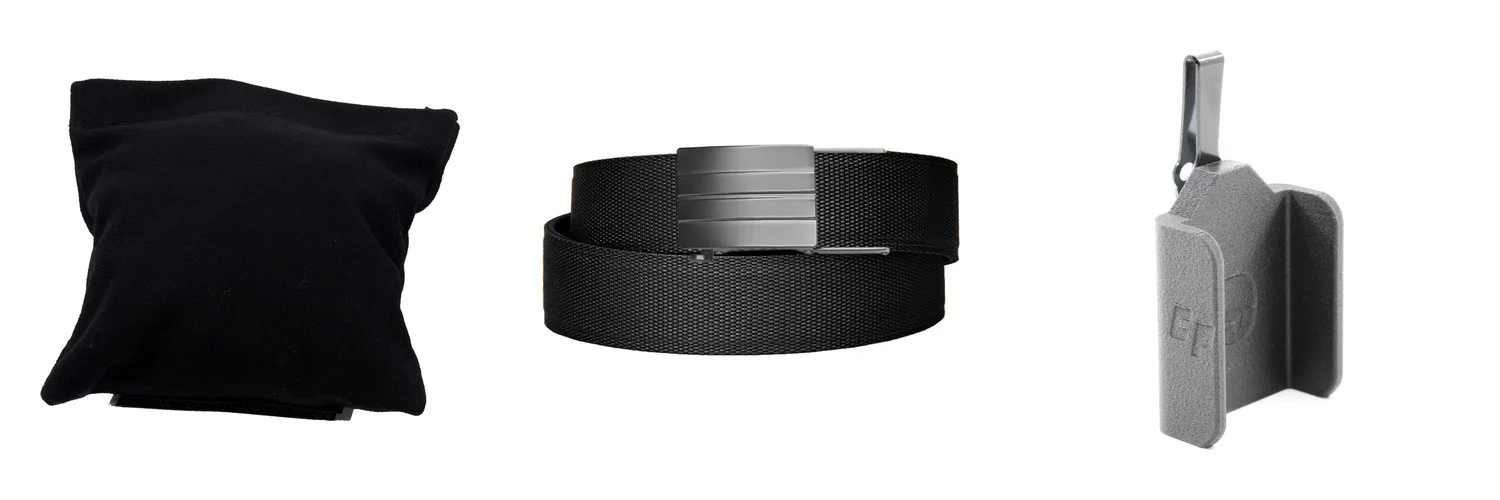
Run the same test for comfort and printing. If an inside-the-waistband holster digs in or the grip sticks out at the back, a Cloudster Pillow holster wedge is built for both. Its hook-and-loop Velcro mounts to any IWB or AIWB holster, and it angles the grip into the body for better concealment and comfort. Its adjustable shredded cooling gel memory foam lets you set the thickness for all-day appendix or strong-side carry without hot spots or pressure points.
Choose the one that matches your holster. It is made in the USA with a lifetime warranty and free 30-day returns.
The Holster and Belt Matter as Much as the Gun
A carry gun is only as good as the way you carry it. Use a holster made for your exact model that fully covers the trigger guard and stays put on the draw. A stiff gun belt keeps the holster from sagging or tipping through the day. The Kore gun belts we carry use a micro-adjust ratchet fit and a reinforced core, built for EDC and CCW. If you add a light or a red dot later, you may need a new holster.
If an inside-the-waistband holster digs in or the grip sticks out, a Cloudster Pillow holster wedge makes IWB carry more comfortable and helps the grip tuck in. Sizes by gun: Standard or Deluxe for a Sig P365 without a light and for micro and subcompact guns like the Glock 43X, Hellcat and Shield Plus; Deluxe or Monster for a Glock 19 and any full-size gun; and Deluxe or Monster for any gun carrying a weapon light. For everything else, the Cloudster Pillow size guide will match you.
Prefer a revolver? Our concealed carry revolvers guide compares the small-frame models and how to carry them.
Quick Answers
What is the best carry pistol?
There isn’t one for everybody. The Sig P365 family, Springfield Hellcat, S&W Shield Plus and Glock 43X are among the most recommended micro-compacts. The Glock 19 is the common compact pick. Choose the one you can conceal and shoot well.
What’s the difference between a micro-compact and a compact?
Mostly size. In this list, the smaller guns run about 4 to 5 inches tall and about 1 inch wide. The compact Glock 19 is 7.28 inches long and 1.34 inches wide, with 15 rounds.
Which carry pistol holds the most rounds?
With the magazines each maker includes, the Glock 19, at 15 rounds standard. Among the smaller guns, the Hellcat and Shield Plus ship with a 13-round extended magazine. Glock also lists optional 17-, 24-, 31- and 33-round magazines for the Glock 19, where your state allows them. If you carry a spare magazine, the Cloudster 9mm Magnetic Pocket Mag Carrier clips over the inside edge of a front or back pocket, with no belt and no holster modification. Fits most 9mm and .380 magazines.
Are optic-ready carry guns worth it?
That’s your call. A red dot changes the sight picture and the holster you need. Several models here, including the P365X, P365 XL, Hellcat OSP and G43X MOS, are optic-ready from the factory.
Do I need a special holster for a pistol with a light?
Yes, a light-bearing holster made for your gun and light. It’s wider at the muzzle end, which is why the Deluxe or the Monster Cloudster Pillow covers any gun carrying a light.
Is .380 enough for concealed carry?
Outdoor Life concludes “the 9mm will be the better option for most people,” because the 9mm “will generally penetrate deeper” against the 12-to-18-inch gelatin standard. A .380 is easier to carry and recoils less in some guns, and it is a reasonable choice if you cannot manage 9mm recoil.
What is the best concealed carry gun for a woman?
The one she can “confidently shoot, train with, and carry daily,” chosen after test-firing several guns. Models on Alien Gear’s women’s list include the Glock 43, Glock 26, S&W Shield, Sig P938 and Ruger LCP. If slide strength is a concern, the S&W Shield EZ takes 13 pounds of effort to rack in 9mm against 23 for a standard Shield.
What is a good concealed carry gun for summer?
The Firearm Blog’s summer picks include the Glock 48/43X, Sig P365 XL, Glock 19 and an Airweight J-frame, and it notes the Gen5 Glock texture “doesn’t irritate or rub your skin”. From this page’s table, the Glock 43X at 16.40 ounces is the lightest. Practice your draw again each time your clothing changes.
What caliber is best for concealed carry?
Gun Talk’s answer is 9mm. It says the 9mm “offers the best combination of capacity, controllability, and terminal performance of any common defensive handgun caliber” and that modern 9mm defensive loads meet FBI penetration and expansion standards. The FBI’s 2014 memo found “little to no noticeable difference” in wound tracks from 9mm through .45 Auto with premium loads. Every pistol on this page is a 9mm; for a .380 or .32 pocket gun, see our best pocket pistol guide.
Is 9mm enough for self-defense?
Yes. The FBI Training Division’s May 6, 2014 memo concluded that “the 9mm provides struggling shooters the best chance of success while improving the speed and accuracy of the most skilled shooters”. Gun Talk notes that “modern 9mm defensive ammunition … meets or exceeds FBI penetration and expansion standards”. Before you carry, shoot enough of your chosen defensive ammunition to trust that your gun runs it.
How many rounds should a concealed carry gun hold?
Gun Talk’s guidance is that “a 10-round pistol is more than adequate for the vast majority of defensive scenarios,” with higher capacity giving “margin for error in worst-case situations”. Every pistol in the table above holds 10 to 15 rounds in its standard magazine. Check your state and local magazine laws before buying extended magazines.
Should I carry with a red dot?
Gun Talk says “a quality red dot improves target-focused shooting, performs better in low light, and makes accurate shots easier under stress.” It adds a warning: “an unmounted red dot won’t help you — budget time for practice and dry fire to build proficiency with the optic before relying on it for carry”. A red dot also adds height and cost and needs a holster with room for it, so decide before you buy the holster.
What makes a good concealed carry gun?
One you can hide all day, shoot well and trust, as the opening of this page says. Gun Digest adds that “big guns can be shot more accurately and are more forgiving on recoil,” so do not pick the smallest gun only because it hides easily. Gun Talk’s rule is to hold it before you buy, and to rent two or three if your range allows.
Should I pick a gun that is easy to shoot or easy to hide?
Start from easy to shoot. Gun Digest’s advice is “don’t choose a tiny CCW gun just because you think it’ll be easier to hide under a t-shirt”. The micro-compacts in the table above are the models that come up most for everyday carry: 4 to 5.04 inches tall, 0.95 to 1.1 inches wide and 10 to 13 rounds. A holster wedge angles the grip into the body for better concealment, which is covered in the holster and belt section.
What is a good first concealed carry gun?
Rent before you buy. Gun Talk advises that “if your local range rents handguns, try 2-3 options before committing,” because “grip angle, trigger reach, and texture are personal”. The pistols that come up most for everyday carry are the Sig P365 family, Glock 43X, Hellcat and Shield Plus, all in the table above. Gun Digest warns against a small snub-nose .38 for a first carry gun: “these little pipsqueaks are cute, but they bark and buck like mad”.
What size handgun is easiest to conceal?
Compare height and width, not just length. The shortest pistol in the table above is the Hellcat OSP at 4 inches tall with its flush magazine. The narrowest listed width is the Ruger MAX-9’s 0.95 inches, measured at the slide; the Hellcat’s 1 inch is measured at the grip. The Glock 19 is the widest at 1.34 inches and ties the Glock 43X as the tallest at 5.04 inches. Gun Talk notes its size makes it “harder to conceal for smaller-framed shooters”.
How much training and practice do I need?
American Rifleman’s starting point, if funds are tight, is “to fire 50 rounds of practice grade ammunition and a magazine or two of defense grade loads every six to eight weeks,” because “shooting skills are perishable”. It recommends quality books and videos “until you can get into a good live-fire class”. Our beginners guide has a dry-fire and live-fire routine to follow between classes.
Will I actually carry it every day?
American Rifleman says you will likely need “new clothes or accessories to wear around the gun” and that the gun must never be “left unattended or unsecured at any time during the day”. Test the holster at home with an unloaded gun before the first day out, and add a holster wedge if an inside-the-waistband holster digs in.
Written by the Cloudster Pillow team. We make holster wedges. We don’t sell firearms, and no manufacturer paid to be mentioned here. This isn’t legal advice: carry laws, magazine limits and permit rules vary by state and city, so follow the laws where you live and get training with any gun you carry.