
Carry Techniques and Optimization, EDC Gear, Holsters and Gear Recommendations
OWB Holsters for Concealed Carry: How to Choose and Conceal One
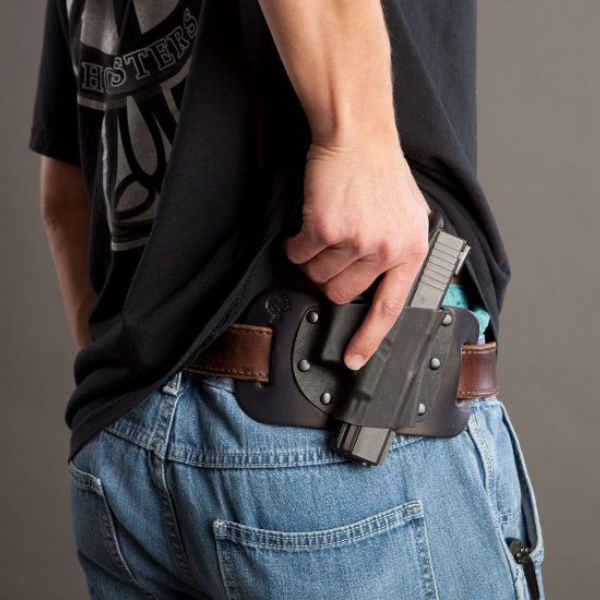
Quick answer: An OWB (outside the waistband) holster rides on the outside of your belt, so the gun barely touches your body. That makes it the most comfortable way to carry and the easiest to draw from, especially with a larger pistol. The trade-off is concealment: you need a cover garment long and loose enough to hide the whole gun. For concealed carry, choose an OWB holster that rides high and pulls the gun tight to your body, add a slight forward cant, and mount it on a stiff gun belt.
What Is an OWB Holster?
An outside-the-waistband holster attaches to the outside of your belt with loops, slots or a paddle, usually on the strong-side hip around 3 to 4 o’clock for a right-handed shooter. It’s the classic holster design and the standard for duty and range use. Because nothing sits between the gun and your belt line, you can carry a full-size pistol all day without it pressing into your side.
OWB vs IWB: Which Is Better for Concealed Carry?
| OWB (outside the waistband) | IWB (inside the waistband) | |
|---|---|---|
| Comfort | Highest; the gun sits off your body | Good once it’s set up; the holster sits against your skin |
| Concealment | Needs a jacket, overshirt or long loose shirt | Hides under a single untucked shirt |
| Draw | Easy, full grip from the start | Fast with practice; tighter to the body |
| Gun size | Handles full-size pistols comfortably | Easiest with compact and subcompact pistols |
| Pants fit | Your usual size | Often needs room in the waistband |
| Best for | Cooler weather, jackets, range days, bigger guns | Everyday concealment in light clothing |
In short, most people who carry concealed every day choose IWB in warm weather and many switch to OWB when jacket season arrives. Some trainers also like OWB for newer carriers because it keeps the muzzle a little farther from your body. For the IWB side of the decision, see our IWB holster guide; for every holster type side by side, see how to choose the best concealed carry holster.
Types of OWB Holsters
- Pancake / belt-slot holsters: two or three belt slots on wings that pull the gun tight against your body. They’re usually the most concealable OWB design, and the slot you choose often changes the ride height and cant.
- Belt slide holsters: the belt threads through an enclosed slot or loop. They’re stable and slim.
- Paddle holsters: a paddle slides inside your waistband and hooks on. They’re easy to put on and take off, but they usually sit farther from the body and print more than a belt-mounted design.
- Kydex, leather or hybrid: Kydex keeps its shape and gives a crisp draw and re-holster; leather is quieter and molds to you; hybrids combine a Kydex shell with a leather or padded backing.
What to Look For in an OWB Holster for Concealed Carry
- A high ride height, so the grip sits close to the belt and less of the gun hangs below it.
- A design that pulls the gun tight to your body: belt slots or loops spaced on either side of the gun, rather than a single loop or a paddle.
- Adjustable cant. A slight forward cant (muzzle back, grip forward) tucks the grip under your cover garment and helps prevent printing when you bend. Learn more in understanding holster cant.
- Full trigger guard coverage and real retention, adjustable if possible.
- A fit made for your exact gun, including your optic and weapon light. A light-bearing OWB holster has to be molded for your specific gun and light combination.
- Belt slots that match your belt width. Check whether the holster is cut for a 1.5-inch or 1.75-inch belt.
How to Conceal an OWB Holster
- Wear a cover garment long enough for the whole gun. An open overshirt, flannel, vest, light jacket or sport coat does it. In summer, a loose, untucked camp or button-up shirt with a long hem can work for compact guns.
- Move the holster back a little. Carrying just behind the hip bone (about 4 o’clock for a right-handed shooter) keeps the grip out of your arm swing.
- Add a slight forward cant so the grip tucks into the hollow of your back instead of pointing out.
- Keep it tight. A holster with good belt slots on a stiff belt keeps the gun from swinging away from your body.
- Check in a mirror. Bend, reach, sit and turn. If the grip shows or the hem lifts, adjust the cant or ride height before you change holsters.
- Plan for warm rooms. OWB depends on your cover garment. If you’ll be tempted to take the jacket off indoors, carry IWB that day.
The Belt Matters Even More With OWB
An OWB holster hangs its full weight on the outside of your belt. A soft belt lets the gun tip outward and sag, which both prints and slows your draw. A reinforced gun belt keeps it upright and tight.
- For everyday carry with a compact pistol, a 1.5-inch gun belt is standard. We carry Kore 1.5″ ratcheting gun belts, which adjust in quarter-inch steps.
- For a full-size pistol, a range day, or a holster plus mag pouch, a wider 1.75-inch belt is stiffer. The Kore Garrison 1.75″ nylon belt is rated to 10 lb, and there’s also a leather version.
More on picking one in our concealed carry belt guide.
OWB or Something Else?
If you want to carry under a single T-shirt, OWB isn’t the right tool. Look at an appendix (AIWB) holster or a strong-side IWB instead. If an IWB holster digs in when you sit, that’s what we make the Cloudster Pillow for: a soft, adjustable-fill memory-foam wedge that velcros to the back of an IWB or appendix holster, cushioning the edge and tucking the grip in. See how it compares with other IWB holster wedges. Not sure where on your body to carry at all? Start with our guide to the best carry position.
Quick Answers
Can you conceal carry with an OWB holster?
Yes, with a cover garment long enough to hide the whole gun: a jacket, open overshirt or long, loose shirt. A high-riding holster that holds the gun tight to your body makes it much easier.
Is OWB more comfortable than IWB?
Usually, yes. The gun sits outside your waistband, so there’s little or no pressure against your body, even with a full-size pistol.
Where should an OWB holster sit?
Most people carry at 3 to 4 o’clock on the strong side (8 to 9 o’clock for left-handed shooters), just behind the hip bone, with a slight forward cant.
What belt do I need for an OWB holster?
A reinforced gun belt that matches your holster’s belt slots, usually 1.5 inch for everyday carry or 1.75 inch for a full-size gun and extra gear.
Paddle or belt slot?
Belt slots and loops hold the gun tighter and conceal better. Paddles are quicker on and off but tend to stand farther from the body.
Written by the Cloudster Pillow team. We make holster wedges and carry Kore gun belts. We don’t sell holsters or firearms. This is general information, not a substitute for professional training; check the carry laws where you live.
