Holsters and Gear Recommendations
Cross Draw Holster Guide: When Cross Draw Carry Makes Sense
Quick answer: A cross draw holster carries the gun on your support side, around 9 to 10 o’clock for a right-handed shooter, canted forward so your strong hand reaches across your body to draw. It shines seated and driving, and for carriers with shoulder or mobility limits. It needs a holster that covers the trigger guard and holds the gun firmly.
What Is a Cross Draw Holster?
Holster maker Alien Gear defines it this way: “A cross draw holster positions the firearm on the opposite side of your dominant hand—typically around 9 o’clock for right-handed shooters. The gun is canted forward so you reach across your torso to draw.” It adds that the setup “remains one of the only draw methods that consistently works from a seated position.”
Cross draw describes the direction of the draw, not the holster type. Alien Gear notes it comes in both inside-the-waistband and outside-the-waistband versions, and Galco sells several holsters designed for both “Strongside/Crossdraw” carry. For traditional cross-draw revolver holsters, see our western holster guide. Our how to draw a gun guide covers clearing a jacket for a cross-draw holster.
When Does Cross Draw Make Sense?
- Driving and sitting. Kramer calls cross draw “an ideal choice for use when seated in a vehicle.” Alien Gear points out that drawing from the strong side in a car, “especially with a seatbelt on,” is awkward, while cross draw gives “clean, reliable access while seated.” Our tips for concealed carry while sitting cover the rest of the day.
- Shoulder or mobility limits. Alien Gear says cross draw “requires less shoulder extension and torso rotation.” RevKel makes the same point for users “with physical limitations or disabilities.”
- A backup gun on the support side. Alien Gear says the support-side holster “stays accessible if your strong arm is disabled or entangled.”
- Confined spaces. In Alien Gear’s words, cross draw holsters “Stay clear of interference on the strong-side hip.”
Cross Draw Pros and Cons
| Pros | Cons |
|---|---|
| Works seated and belted in a car | Alien Gear: “Where it struggles is draw speed and retention in close-quarters confrontations—unless you’re trained for it.” |
| Less shoulder extension and torso rotation | The holster sits “in a more exposed part of your waistline” (Alien Gear) |
| The gun stays in front of you, “under better visual control” (Alien Gear) | “Cross draw isn’t the first choice for deep concealment” (Alien Gear) |
Source: Alien Gear’s cross draw holster guide.
What to Look For in a Cross Draw Holster
- Full trigger guard coverage. Alien Gear warns that if the shell “doesn’t provide full trigger guard coverage, fabric or tool belts could press into the trigger area.”
- Solid retention. Because the holster sits in a more exposed spot, Alien Gear says weak retention lets the gun “rock out of position or be more vulnerable to disarmament.”
- The right cant. The forward cant is what makes the reach across natural (strong-side carry uses the FBI cant instead); Kramer describes its version as carrying the gun “at a moderate cross-draw angle.”
- A stable backing, so the holster doesn’t roll when you draw seated or crouched. Alien Gear recommends that an OWB backer “resist roll and wobble.”
- Practice the draw with an unloaded gun, standing and seated, before you carry it.
Can You Conceal a Cross Draw Holster?
Yes, with planning. Alien Gear says cross draw “isn’t the first choice for deep concealment, but it’s far from unusable—especially with compact pistols and the right garment structure.” Its example: a tucked shirt can catch on the grip, while “a lightweight flannel overshirt or unbuttoned jacket” breaks up the outline. A shorter grip or an angled cant helps too.
For IWB cross draw, Alien Gear places the gun “typically around the 10 to 11 o’clock position (for right-handed carriers).” Our guide to carry positions compares it with appendix and strong side, and our IWB vs OWB comparison covers the platform choice.
Comfort When You Carry Seated
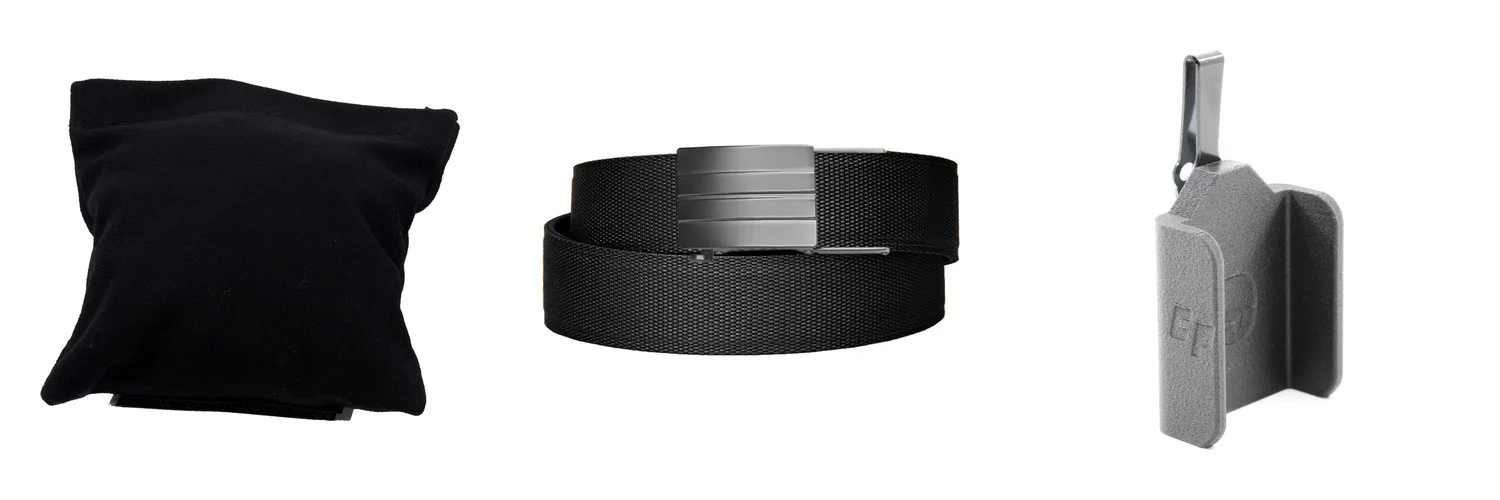
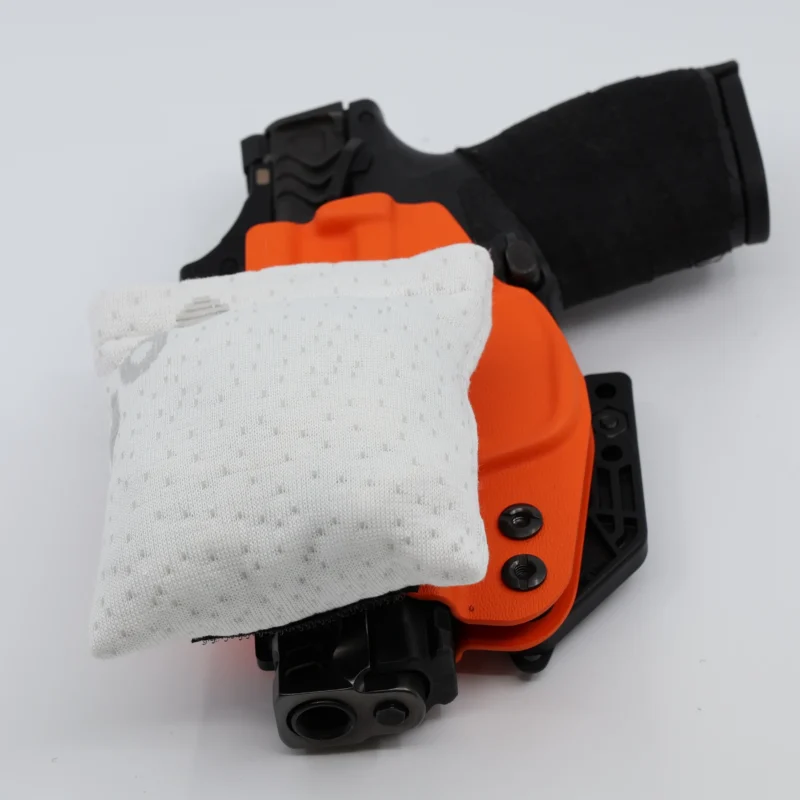
If you carry cross draw because you spend hours driving, long stretches seated can make an IWB holster’s edges press in. The Cloudster Pillow holster wedge attaches to the back of an IWB holster with hook-and-loop and cushions it with adjustable memory-foam fill. One customer wore one to an all-day class on carrying in a vehicle:
“I drove there wearing my holster with the Deluxe Cloudster Pillow AND training for 8-hours and it was very comfortable to drive in and wear for the training. I did not feel the edges of the holster digging into my pelvis at all.” (Eric M., North Adams, MI)
Any cross draw holster also needs a belt that holds it at the angle you set. The Kore gun belts we carry list a “Power-Core™ Center for Added Stiffness and Support” and a load rating of “Up to 6 lbs. • IWB, OWB or Appendix,” per Kore.
Cross Draw Holster: Questions People Ask
Is cross draw slower?
Alien Gear says it can be slower in pure competition draws, but that in cars and tight spaces it avoids the contortions a strong-side draw needs. Training is what makes it fast.
What o’clock is cross draw?
Around 9 o’clock OWB and 10 to 11 o’clock IWB for a right-handed shooter (Alien Gear); mirror it for left-handed. The opposite extreme is 6 o’clock, small of back carry.
Is cross draw good for driving?
It’s the main reason people choose it: Kramer calls it ideal when seated in a vehicle. See also our car holster guide.
Can a belly band carry cross draw?
Yes; many bands can be worn cross-draw. See our belly band holster guide.
Written by the Cloudster Pillow team. We make the Cloudster Pillow and carry Kore gun belts. We don’t sell holsters or firearms, and no maker paid to be mentioned here. This is general information, not a substitute for professional training; check the carry laws where you live.