
CCW Guns, Concealed Carry Firearms
Best Caliber for Concealed Carry: .380 vs 9mm vs .45, and What to Load
Quick answer: The strongest evidence points to 9mm as the best caliber for concealed carry. The FBI found select 9mm loads “outperforming most of the premium line .40 S&W and .45 Auto projectiles tested by the FBI,” with “higher magazine capacities, less recoil, lower cost.” A .380 needs carefully chosen ammo; a .45 costs capacity and adds recoil.
This guide uses two primary sources, quoted word for word. The first is the FBI Training Division’s memo explaining its move to 9mm (FBI 9mm justification memo, archived copy captured July 14, 2023). The second is Lucky Gunner Labs’ ballistic gel test of self-defense handgun ammo fired from compact carry pistols (Lucky Gunner Labs handgun ammo test). Where we counted results from their published tables, we say so.
What Makes the Best Caliber for Concealed Carry?
The FBI’s answer starts with the bullet, not the number on the box: “Projectiles are what ultimately wound our adversaries and the projectile needs to be the basis for the discussion on what ‘caliber’ is best.” It also says plainly: “Handgun stopping power is simply a myth.”
What does matter, per the memo:
- Penetration. “The single most important factor in effectively wounding a human target is to have penetration to a scientifically valid depth (FBI uses 12″ – 18″).”
- Shot placement. “Simply stated, shot placement is the most critical component to achieving either method of incapacitation.”
- Shooting it well. In FBI testing of similar-sized .40 S&W and 9mm Glocks, “the majority of the study participants have shot more quickly and more accurately with 9mm caliber Glock pistols.”
So the best caliber for concealed carry is the one with loads that reach 12 to 18 inches, in a gun you can shoot accurately, in a size you will actually carry every day.
380 vs 9mm: Is a .380 Enough to Stop an Attacker?
For many buyers, the best caliber for concealed carry comes down to these two. A .380 can be enough with the right load, but the load matters more than it does with 9mm. Lucky Gunner tested .380 from a Glock 42 with a 3.25-inch barrel and wrote: “.380 ACP turned in the weakest overall performance of the four calibers we tested, but a few loads fared surprisingly well. Most loads showed either good penetration but no expansion, or decent expansion with sub-par penetration.” Their bottom line: “careful ammo selection can help to mitigate its deficiencies to some degree.”
9mm, tested from a Smith & Wesson M&P9c with a 3.5-inch barrel, did better: “There were several 9mm loads showing adequate penetration with a decent amount of expansion as well.”
Our count of Lucky Gunner’s published averages shows the same gap:
| Caliber (test gun, barrel) | Loads | Averaged 12–18 in. | Under 12 in. | Over 18 in. | Bullet weights tested |
|---|---|---|---|---|---|
| .380 ACP (Glock 42, 3.25 in.) | 20 | 6 | 8 | 6 | 50 to 102 gr |
| 9mm (S&W M&P9c, 3.5 in.) | 52 | 23 | 2 | 27 | Mostly 124 gr and 147 gr |
| .45 ACP (Kahr CW45, 3.64 in.) | 35 | 16 | 2 | 17 | Mostly 230 gr and 185 gr |
Counted by Cloudster Pillow from the average penetration of each load in Lucky Gunner’s published charts (heavy-clothing barrier, synthetic gel), read November 16, 2026. Lucky Gunner itself says the 12–18 inch band “shouldn’t be read as a pass/fail test,” and that slight over-penetration “is generally considered acceptable if the alternative is under-penetration.”
Under 12 inches is the result to avoid. Lucky Gunner: “you will find few advocates of ammo that penetrates significantly less than 12 inches.” In our count, 8 of the 20 .380 loads averaged under 12 inches, against 2 of the 52 9mm loads.
Does a .380 kick harder than a 9mm?
Gel data can’t answer recoil. Lucky Gunner: “Ballistics testing doesn’t tell us anything about the felt recoil of a load.” What the data does show is that the .380 is the smaller cartridge: its bullets in their test weighed 50 to 102 grains, while most 9mm loads they tested used 124 or 147 grain bullets. Felt recoil also depends on the gun you shoot it in, so shoot both before you buy.
9mm vs 45: Is .45 or 9mm Better for Self-Defense?
The FBI memo says wounds from the common handgun calibers look the same: “an operating room surgeon or Medical Examiner cannot distinguish the difference between wounds caused by .35 to .45 caliber projectiles.” Its conclusion on agencies that moved to larger calibers: “they do so at the expense of reduced magazine capacity, more felt recoil, and given adequate projectile selection, no discernible increase in terminal performance.”
That doesn’t make .45 weak. Lucky Gunner: “the loads that expanded successfully did so with impressive results.” If you already carry a 1911 and shoot it well, the FBI’s trade-off is capacity and recoil, not wound performance. If you’re starting fresh, 9mm gives you more rounds in a similar-sized gun.
Is a .22 Enough for Self-Defense?
Lucky Gunner tested .22 LR from two guns and called it “a controversial subject.” Its advice for anyone who carries one: “ammo selection should be based on achieving as much penetration as possible. Bullet expansion is unlikely and if it does occur, penetration will almost certainly suffer.”
Barrel length mattered a lot. “On average, the 4.4-inch barrel yielded a velocity increase of 126 fps over the 1.9-inch snubby barrel.” By our count of their chart, 2 of the 8 loads averaged 12 inches or more from the 1.9-inch snub-nose revolver, and 6 of 8 from the 4.4-inch pistol. In the same tests, the centerfire calibers reached 12 inches far more often: by our count, 50 of 52 9mm loads did. That matters when you’re choosing the best caliber for concealed carry from scratch.
What Ammo Should You Load for Concealed Carry?
Picking the best caliber for concealed carry is half the job; the load you put in it is the other half.
- A hollow point made for defense. Lucky Gunner: hollow points “are designed to expand upon impact with soft tissue,” and “expansion also helps prevent overpenetration.”
- Penetration in the 12–18 inch range. This is the FBI standard, and it is what both sources measure loads against.
- Data from a short barrel. “Most armed citizens carry smaller guns with shorter barrels, which means the bullets they fire will fly at a lower velocity than what is advertised by the ammo manufacturer.” Look for tests run from a gun like yours.
- Proven in your own gun. “No gelatin test can tell you if a given load will run reliably in your own self-defense pistol. This is all stuff you’ll have to test on your own at the range with your gun.”
Lucky Gunner adds a fair reminder: “Choice of caliber and bullet are not the most important aspects of successful self-defense. Awareness, proper mindset, marksmanship, and discernment of when to use your firearm are generally far more critical.”
How Many Rounds Should You Carry?
The FBI notes that officers “strike an adversary with only 20 – 30 percent of the shots fired during a shooting incident,” and that “proper shot placement, adequate penetration, and multiple shots on target cannot be over emphasized.” Capacity is part of choosing the best caliber for concealed carry, and it was one of the FBI’s reasons for 9mm: “higher magazine capacities (similar sized weapons).”
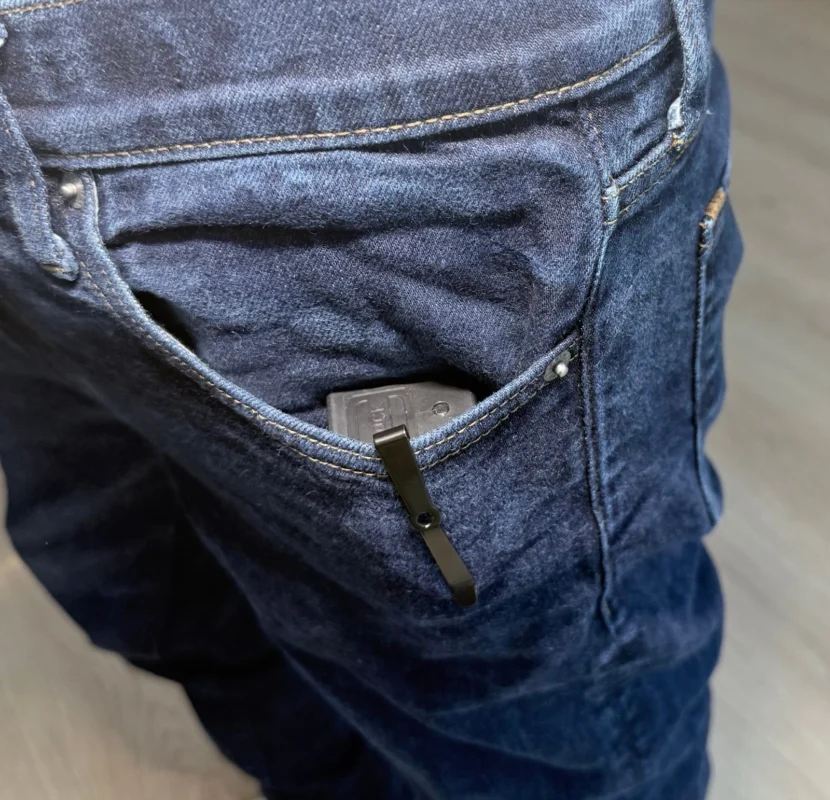
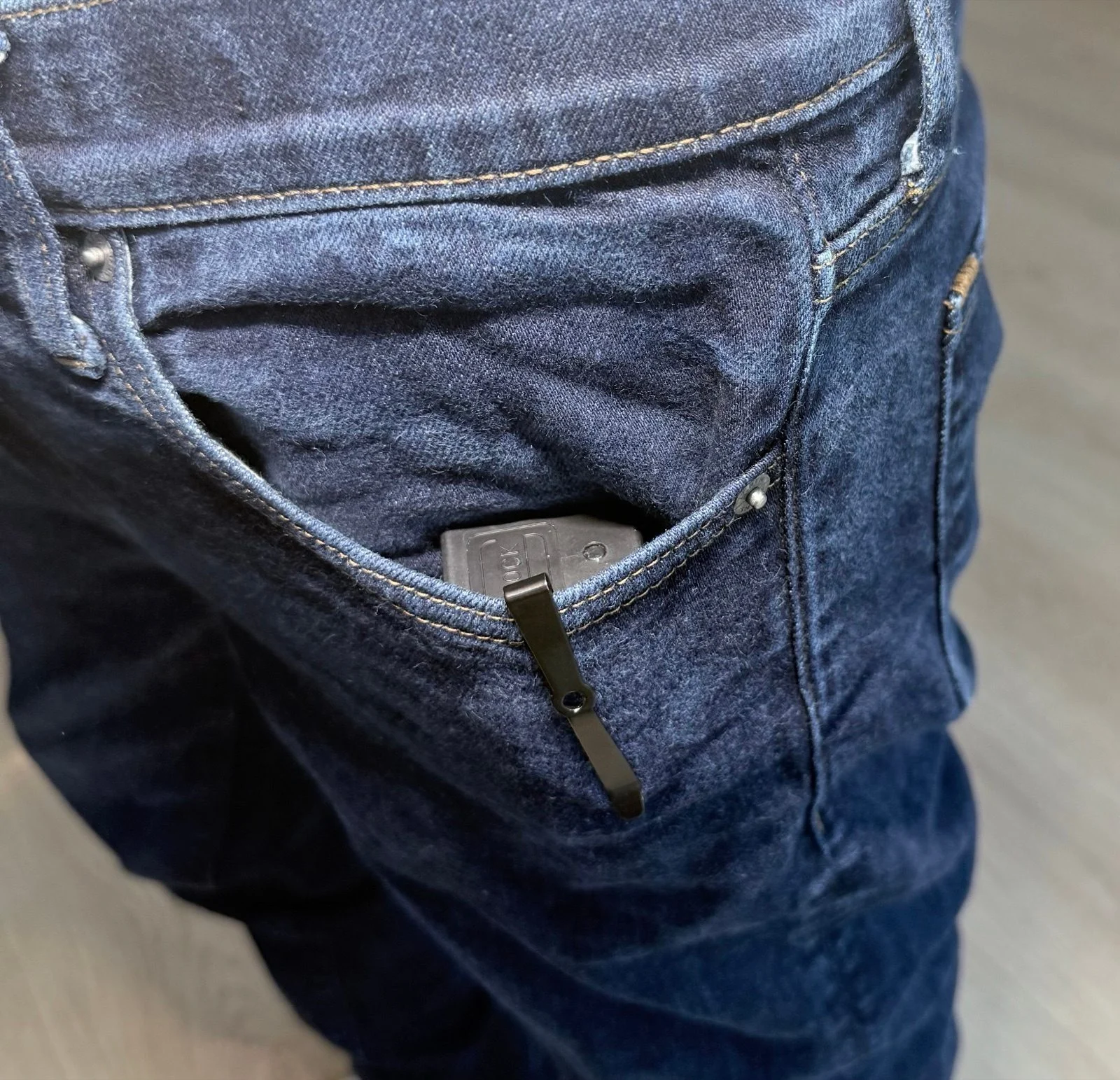
A spare magazine adds rounds to any carry gun. Our Cloudster magnetic mag carriers hold one with two magnets paired with two steel discs:
- 9mm carriers: “Fits most 9mm and .380 magazines.” Pocket, IWB/OWB and sling bag versions.
- .45 ACP carriers: “Fits .45 ACP 1911-style single-stack magazines.”
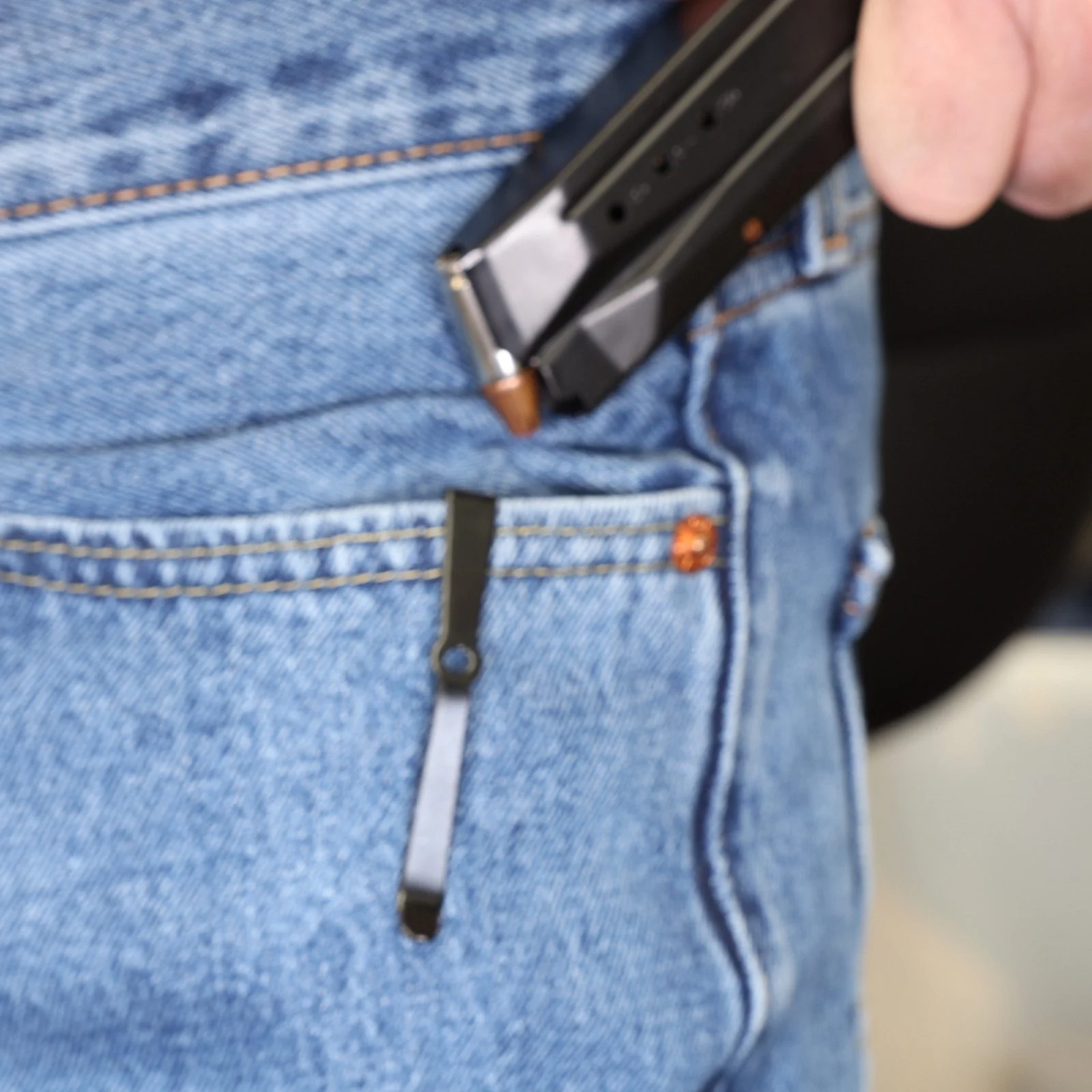
The 9mm pocket mag carrier ships with a deep-conceal clip attached, plus a titanium standard clip and three extra screws in the box. Our pocket mag carrier guide covers how to carry one.
Your Caliber Picks Your Carry Setup
Caliber decides the gun, and the gun decides everything you wear with it: holster, wedge, spare magazine and belt.
- The gun. Compare sizes in best carry pistols for 2026 and best pocket pistol.
- The holster. See the 380 holster guide or the 45 ACP holster guide.
- The wedge. The Cloudster Pillow holster wedge attaches with hook-and-loop Velcro to any IWB or AIWB holster, cushions the holster’s edges and tilts the grip in to stop printing. Its size goes by the gun’s size, as shown below.
- The belt. Carry it on a gun belt; we carry Kore gun belts.
| Gun size | Examples | Cloudster Pillow sizes to choose from |
|---|---|---|
| Micro-compact | Sig P365, Hellcat, Shield Plus | Standard or Deluxe |
| Subcompact | Glock 43X, Glock 26, Canik TP9 Elite SC | Standard or Deluxe |
| Compact | Glock 19, M&P 2.0 Compact, Walther PDP | Deluxe or Monster |
| Full-size | Glock 17, Sig P320, 1911 | Deluxe or Monster |
Read both sizes and choose. For larger body frames we recommend sizing up: a larger pillow can always be made to feel smaller by taking some fill out, but a smaller pillow can’t be made to feel bigger. Keith, who founded Cloudster Pillow, on his own carry: “Me personally, when I carry a Glock 17 or a 1911, the Monster is the only way that’s comfortable for me. A Deluxe definitely helps, but a Monster definitely feels better.” The full chart is in our size guide.
Best Caliber for Concealed Carry: Questions People Ask
Which caliber is best for concealed carry?
For most people, 9mm: the FBI found select 9mm loads outperforming most premium .40 and .45 loads it tested, with more capacity and less recoil. The best caliber for concealed carry is still the one you shoot well in a gun you carry every day.
Is a .380 enough to stop an attacker?
It can be with a carefully chosen load. In our count of Lucky Gunner’s test, 6 of 20 .380 loads averaged 12–18 inches of penetration and 8 fell short of 12.
Is .45 or 9mm better for self-defense?
Per the FBI, larger calibers bring “reduced magazine capacity, more felt recoil” and, with good bullets, “no discernible increase in terminal performance.” Both work; 9mm carries more rounds.
Is a .22 enough for self-defense?
Lucky Gunner calls it “a controversial subject.” If you carry one, pick the load that penetrates deepest; expansion is unlikely.
Can one mag carrier hold .380 and 9mm magazines?
Yes. Our 9mm Cloudster carriers fit most 9mm and .380 magazines.
Written by Keith at Cloudster Pillow. We make the Cloudster Pillow and the Cloudster magnetic mag carriers, and carry Kore belts. We don’t sell firearms or ammunition, and no ammo or gun maker paid to be mentioned here. This is general information, not legal or medical advice and not a substitute for professional training; check the carry laws where you live.
