Carry Techniques and Optimization, Holsters and Gear Recommendations
Chest Holster Guide: Who It Suits, Safety and the Best Options

Quick answer: A chest holster carries a handgun on the front of your chest from a harness, so the gun stays reachable while you wear a backpack hip belt, waders, a climbing harness or bulky layers. Chest holsters are made for the outdoors: hiking, hunting, fishing and riding (and trail running; see our running holster guide). They are not a concealed carry option under normal clothes. Pick one that fully covers the trigger guard, holds the gun firmly when you bend and climb, and lets you draw without the muzzle crossing your other arm.
Who a Chest Holster Is For
- Backpackers and hikers. A loaded pack’s hip belt sits exactly where a belt holster goes. (Hiking in a national park? See our national park carry guide.) RECOIL calls an OWB holster under a hip belt “virtually impossible” (RECOIL).
- Hunters. Gun Digest notes chest holsters “were developed for hikers and backcountry hunters” (Gun Digest). Watch for clashes with a binocular harness.
- Anglers in waders. The gun rides above the waterline and clear of wader straps.
- Riders. On horseback or an ATV, a chest rig keeps the gun in front of you rather than pinned against a saddle or seat. For carry on a motorcycle, see our motorcycle holster guide. If your vest or rig has MOLLE webbing, see our MOLLE holster guide.
- Bear and big-game country. Many chest holsters are built for large revolvers and heavy pistols.
Driving is a weaker fit. A cross-body draw behind a steering wheel is awkward, and many people find a holster set up for sitting works better in a car (see our car holster guide).
Chest Rig Holster vs Chest Holster
“Chest rig” usually means the same thing as a chest holster. RECOIL’s guide uses both terms: “Chest rigs use a harness that straps over the shoulder or behind the neck to support the weight of your firearm, positioning the weapon across the upper torso.” It traces the idea back to the 1940s: “World War II tank crews and paratroopers used basic versions of these holsters.” For that era’s tanker-style shoulder holsters, see our shoulder holster guide.
Some hunting brands also use “chest rig” for a harness pack that carries binoculars and gear, with a pistol holster added. FHF Gear describes its Chest Rig GEN2 as “a minimalist-style rig that is compact and designed to be worn high on your chest,” with attachment loops underneath for a holster. Marsupial Gear lists holsters among its chest pack components.
RECOIL’s case for a pistol chest rig:
- Weight: “A chest rig’s shoulder and sternum straps allow your torso to support the weight of your gun instead of your belt, preventing fatigue.”
- Layers: “With a few simple strap adjustments, most chest rigs will fit over bulky winter clothing.”
- Access: “A good chest rig provides improved accessibility for wheelchair-bound and other disabled shooters.”
It also notes that “chest rigs are designed for open carry,” so check your local laws.
Chest Holster Pros and Cons
| Pros | Cons |
|---|---|
| Works with a pack hip belt, waders and harnesses | Not concealable under everyday clothes; it’s essentially open carry |
| Gun is reachable sitting, kneeling or climbing | Can clash with binocular harnesses and chest straps |
| Carries heavy revolvers and long barrels comfortably | Lots of straps to adjust; some people find them warm or tiring all day |
| Keeps the gun out of mud, water and brush | The draw takes practice, and a careless draw can point the muzzle at your support arm |
Can You Conceal a Chest Holster?
Generally no. Makers and reviewers describe chest holsters as open carry gear; Alien Gear calls concealment “not practical under standard clothing” (Alien Gear). A heavy jacket over the rig will hide it, and whether that legally counts as “concealed” depends on your state. The exception is the chest pack: a small zippered bag worn on the chest with a pistol compartment inside, such as Hill People Gear’s kit bags. It looks like a gear pouch, but the draw is slower, and a soft compartment doesn’t protect the trigger the way a molded holster does.
For everyday concealed carry back in town, an IWB holster on a gun belt is still the standard.
Safety: What to Look For
- Full trigger guard coverage in rigid material. Kydex or well-made leather molded to your gun. Soft nylon pouches fail this test, and Gun Digest says nylon “should generally be avoided.”
- Retention you’ve tested. Shake test it with an unloaded gun, then bend over, crouch and climb. A retention strap or adjustable Kydex retention helps.
- A draw that keeps the muzzle off your arm. Shooting Illustrated warns you must be “extremely careful not to cover your offhand with the muzzle” when drawing from a chest rig. The reviewer holds the opposite chest strap with the support hand while drawing, which keeps that arm out of the way. Practice slowly with an unloaded gun.
- Optic and light fit. Not every chest holster accepts red dots or weapon lights. Galco, for example, lists its Kodiak as not optics-compatible.
- Slow reholstering. Look the gun into the holster and keep the muzzle pointed safely.
Popular Chest Holsters (2026)
Prices are from each maker’s site as of October 2026 unless noted. Stock changes often.
- GunfightersINC Kenai Chest Holster: Kydex shell on a nylon harness. About $140 to $160 at retailers.
- CrossBreed Chest Rig, from $149.95 (Nomad from $119.95): Kydex on leather, red-dot ready, lifetime warranty.
- Alien Gear Cloak Chest Holster, $154.99: hybrid shell with neoprene backing.
- Diamond D Denali, $119.99 (often on sale): padded 1050 ballistic nylon in many sizes, pack-compatible, with a mag pouch.
- Safariland Chest Rig, $105.50: mounts Safariland 6000 and 7TS duty holsters (holster sold separately); right-hand only.
- Galco Kodiak ($318) and Great Alaskan ($338): steerhide with a retention strap; the Great Alaskan is built for big revolvers.
- Hill People Gear Recon Kit Bag, $120 to $125: a chest pack rather than a holster, for a lower-profile look.
Hiking Holsters: Chest, Pack Hip Belt or Shoulder
A pack changes where a gun can ride. GunfightersINC’s backcountry guide sets the test: “You should be able to draw without loosening shoulder straps or shifting a waist belt.” Its problem with belt carry: “Most pack waist belts sit directly over your waistline, so you either trap the holster under the belt or push it outward.” And the case for the chest: “Because the holster sits above the belt line, pack waist belts don’t trap or displace it.”
A former Forest Service wilderness ranger tested four holster styles for Ammunition To Go, hiking with a 70-liter pack carrying about 40 pounds:
- Drop leg: easy to reach, but “it threw off my gait and stride.”
- Holster on the pack’s hip belt: stable, but “if I removed my backpack, my firearm and holster had to leave my side.”
- Shoulder holster with its straps clipped to the pack’s waist belt: “a very good extended distance hiking option.”
Hikers on the Northwest Firearms forum split the same way. One carries “outside in a kydex on my pack hip belt” on long backcountry hikes; another found “if wearing a pack, It ends up under the belt of my pack.” For pack-friendly carry, see also our guides to shoulder holsters and fanny pack holsters.
Chest Holster vs Hip Holster: Which Is Better With a Pack?
A hip or belt holster disappears under a pack hip belt the moment you cinch it down, and a shoulder rig buries the gun under the pack straps. Chest placement avoids waist belts and hip straps entirely.
The difference shows most when you stop moving. Drawing from the hip becomes difficult when sitting, while a chest holster keeps the draw consistent while seated or kneeling, so access stays reliable during glassing or resting. Cold weather works the same way: bulky jackets can interfere with hip access, while chest holsters remain accessible with proper layering.
Hip carry still has real advantages. It gives a familiar draw motion for most firearm owners, a simple setup with a standard belt, and easy access when standing without a pack. A hip holster may still work well for short hunts, minimal pack use, flat or lightly wooded terrain, and hunters who prioritize familiarity and simplicity.
A chest holster is also sold under other names. You will see “chest rig”, “pack holster” and “bino-harness holster” when the holster is built into a binocular harness.
Kydex vs Leather vs Nylon Chest Holsters
Rifle Configurator compares Kydex, leather and nylon chest holsters on draw speed, weather resistance and weight.
| Material | Draw | Weather | Weight | Best for |
|---|---|---|---|---|
| Kydex | Fastest, passive retention | Best | Light | 10mm autos and a fast draw |
| Leather | Slower, retention strap | Good | Heaviest | Big revolvers and all-day comfort |
| Nylon | Moderate, strap or tension | Good | Lightest | Budget rigs and built-in ammo storage |
Kydex is a thermoplastic that gives a precise fit to your specific firearm and the retention to keep it in place, and it is light enough that you carry as little weight as possible without giving up durability. In the same comparison, leather has a slower draw because of its retention strap, and it is the heaviest of the three. Nylon is the lightest, and the guide rates it best for budget builds and built-in ammo storage. Whatever the material, the trigger-guard test in the safety section above still applies.
Two hardware details matter outdoors. Look for corrosion-resistant hardware, and for buckles with serrated edges, which are easier to clip and unclip when your hands are cold, you are wearing gloves, or conditions are wet and slippery.
How to Wear and Adjust a Chest Holster
In one review, the first adjustment took a little doing, but once the buckles were set, slipping in and out of the holster was effortless.
- Start by loosening all straps on the holster.
- Slip the holster over your head.
- Tighten the straps until the holster feels secure but not overly tight. You should be able to breathe comfortably.
- Check that the firearm sits comfortably within reach and that the holster does not obstruct movement.
- Practice drawing the firearm until you can do it quickly and smoothly.
GunfightersINC recommends keeping the chest straps snug so the holster does not move when the gun is drawn. One reviewer who liked wearing a rig lower, near the solar plexus, to aid the draw found that with a heavy Smith & Wesson 500, cinching the holster back up to center chest kept everything far more stable. Drawing a long-barreled revolver from a high chest position takes a little practice and is not the quickest motion.
Some rigs give you a choice of position. Galco’s Great Alaskan has enough adjustment to be worn in the center of the chest or all the way down in the cross-draw position. The GunfightersINC Kenai has plenty of material for adjustment, even when worn over a thick winter jacket. A harness with stretchy elastic backing lets the rig move with your body, and in one review the rig’s single, well-padded shoulder strap did not interfere at all with the strap of the reviewer’s hunting backpack.
What to look for in the harness itself: three points of contact between holster and harness, a fully adjustable harness, a breathable mesh shoulder pad for long days, and adjustable retention so the gun stays snug. Quality chest holsters include adjustable passive retention with tension screws; some models add thumb breaks or active retention straps for added security.
Fitting Your Pistol: Revolvers, 10mm, Optics, Lights and Suppressors
Chest holsters cover the full range, from a subcompact 9mm to the largest hunting revolvers. Some are molded to one specific gun and others adjust to fit many; the Elite Survival Warden, for example, uses an adjustable universal fit.
If your pistol wears accessories, check the fit before ordering. Many chest rigs accommodate mounted lights, optics or extended barrels. The Vedder EverTrek offers light-bearing shells for the X300U, XC3 and TLR-6/7/8. For a threaded barrel with a suppressor attached, the Cole-TAC Varmint Wrangler XL is built to clear a mounted suppressor.
Among the holsters reviewed in Rifle Configurator’s hunting and hiking guide are the GunfightersINC Kenai (Kydex, passive draw, built for 10mm autos), the Vedder EverTrek (Kydex, molded for hundreds of pistols, with light-bearing options), the Galco Kodiak (leather and nylon, built for X-frame and large-bore revolvers) and the Elite Survival Warden. Alien Gear’s bear-country guide calls the Glock 20 in 10mm a top pick for bear defense and the Smith & Wesson Model 629 in .44 Magnum a go-to for stopping dangerous game, and notes the Ruger Super Redhawk’s frame is rated for .454 Casull loads. It says a dangerous-game rig must lock the sidearm in place so sprinting, falling or crawling will not jar it loose. Bear spray stays first; see the section above.
Seated, Water and Saddle Use
Strapped into a tree stand, seated on an ATV or perched in a kayak, a waistband or shoulder rig can be blocked by seat belts, harnesses or gear, while a chest holster gives fast access to the firearm even when you are wearing a pack, seated, or layered in cold-weather gear. People who mountain bike, kayak, or ride ATVs or horses will probably find belt carry awkward.
On the water, a chest holster stays clear of the waterline and does not interfere with casting, movement or a life vest. Worn high on the chest, it leaves the arms free, so a properly fitted rig does not interfere with bowhunting or fishing.
Are Chest Holsters Legal? (National Parks and State Rules)
Before wearing a chest holster, check your state’s open-carry rules and any regulations specific to the land you will be on. State law changes, so confirm it with your state’s official source rather than a holster maker’s page.
In national parks, the National Park Service states that an individual can possess a firearm if that individual is not otherwise prohibited by law from possessing it and if the possession complies with the laws of the state where the park area is located. Federal law prohibits possessing a firearm in NPS facilities, including government offices, visitor centers, ranger stations, fee collection buildings and maintenance facilities. Discharging a firearm in a park area is prohibited unless authorized, except in parks where hunting is specifically mandated or authorized by federal statute, where firearms may be used to hunt under NPS regulations and state law. (National Park Service, “Firearms in National Parks,” last updated December 14, 2017, citing 54 U.S.C. 104906, 18 U.S.C. 930 and 36 CFR 2.4; read November 4, 2026.)
Bear Country: Spray First
If bears are the reason you carry, know what the agencies say. The National Park Service states, “Bear spray is the recommended tool for self defense against a bear,” and that firearms are “not a substitute for proper bear avoidance practices” (NPS). Alaska’s interagency bear safety guidance says carrying and using a firearm is a personal decision, and that any deterrent should be carried “where it can be deployed within seconds” (Alaska Dept. of Fish and Game). Many people carry both: bear spray on one side and a chest-holstered handgun as a backup. Check whether firearms are allowed where you’re going; rules differ in national parks, wilderness areas and some state lands.
Back Home: Comfortable Everyday Carry
A chest rig is trail gear. For daily concealed carry in jeans or work pants, many people go back to an IWB holster, and that’s where comfort usually becomes the problem. Two things fix most of it:
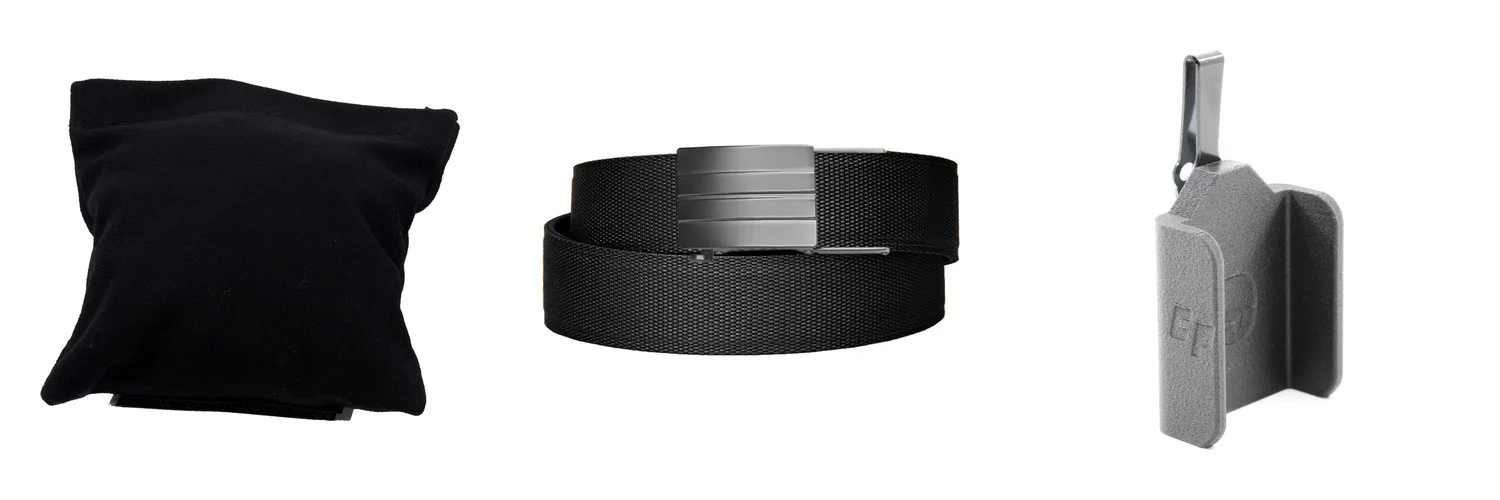
- A soft holster wedge cushions the holster against your body and tucks the grip in so it prints less. See the Cloudster Pillow →
- A stiff gun belt holds the holster in place without overtightening. Shop concealed carry belts →
Comparing other off-body and off-waist options? See our guides to shoulder holsters and belly band holsters.
Quick Answers
What is a chest holster used for?
Carrying a handgun outdoors when a belt holster doesn’t work: under a backpack hip belt, in waders, on horseback or with bulky layers. For a holster that sits below body armor or a vest, see our drop leg holster guide.
Chest holster or shoulder holster?
A chest holster sits in front and works with a pack; a shoulder holster sits under your arm and can be concealed under a jacket, but pack straps get in its way.
Can you conceal carry with a chest holster?
Not under normal clothes. A heavy outer layer can cover one, and a chest pack is lower profile, but for everyday concealed carry an IWB holster is the better choice.
What’s the best chest holster for hiking?
One molded for your gun that fully covers the trigger, holds tight when you bend and climb, and doesn’t fight your pack’s sternum strap. Kydex rigs like the Kenai and CrossBreed Chest Rig are popular choices.
Do chest holsters work with binoculars?
Often not well. Look for a rig designed to work with a binocular harness, or wear the holster under it and test the draw.
Is a chest holster good for bear defense?
It keeps a handgun reachable, but wildlife agencies recommend bear spray as the primary tool. Many people carry both.
Is a chest holster better than a hip holster for hunting?
With a pack, yes. A belt holster disappears under a pack hip belt as soon as you cinch it down, and drawing from the hip becomes difficult when sitting, while a chest holster keeps the draw consistent while seated or kneeling. A hip holster may still work well for short hunts, minimal pack use and flat or lightly wooded terrain.
What is the best material for a chest holster?
Kydex gives the fastest draw with passive retention, the best weather resistance and light weight. Leather is slower because of its retention strap and is the heaviest, but it suits big revolvers and all-day comfort. Nylon is the lightest, and Rifle Configurator rates it best for budget builds and built-in ammo storage.
How tight should a chest holster be?
Tighten the straps until the holster feels secure but not overly tight, and you should still be able to breathe comfortably. GunfightersINC recommends keeping the chest straps snug so the holster does not move when the gun is drawn. One reviewer carrying a heavy Smith & Wesson 500 found that cinching the holster up to center chest kept it far more stable.
Will a chest holster fit a pistol with a red dot or weapon light?
Many do. Many chest rigs accommodate mounted lights, optics or extended barrels, and the Vedder EverTrek offers light-bearing shells for the X300U, XC3 and TLR-6/7/8. Check the maker’s fit list for your exact pistol and accessory before ordering.
Can I wear a chest holster on an ATV, in a tree stand or in a kayak?
Yes. In a tree stand, on an ATV or in a kayak, a waistband or shoulder rig can be blocked by seat belts, harnesses or gear, while a chest holster gives fast access even when you are seated or wearing a pack. On the water it stays clear of the waterline and does not interfere with casting or a life vest.
Can I carry a chest holster in a national park?
The National Park Service says you can possess a firearm in a park if you are not otherwise prohibited by law and your possession complies with the laws of the state where the park is located. Firearms are prohibited in NPS buildings such as visitor centers and ranger stations. Check your state’s open-carry rules and any regulations for the specific land you will be on before wearing one.
Written by the Cloudster Pillow team. We make holster wedges and the Magnetic Pocket Mag Carrier, and carry Kore gun belts. We don’t sell holsters or firearms, and no holster maker paid to be mentioned here. Prices are from each maker’s site as of October 2026 unless noted. This is general information, not a substitute for professional training; check the carry laws and land rules where you’ll be.