Licensing and Cost-Saving Tips
North Carolina Concealed Carry Permit: Rules, How to Apply and SB 50 (2026)
Quick answer: Yes, North Carolina still requires a concealed handgun permit to carry a pistol concealed, as of November 4, 2026. You apply to the sheriff of the county where you live; you must be 21, a resident for 30 days and complete an approved course with live fire. The permit costs $80, is valid for five years, and the sheriff has 45 days to decide. Every point below is from North Carolina’s own statutes and official pages, read November 4, 2026.
Do you need a permit to carry concealed in North Carolina?
Yes, as of November 4, 2026. G.S. 14-269 makes it unlawful to willfully and intentionally carry a pistol concealed about your person, with exceptions that include being on your own premises and holding a concealed handgun permit issued under Article 54B. A first offense is a Class 2 misdemeanor, and a second or subsequent offense is a Class H felony. The North Carolina Department of Justice describes the permit program this way: since 1995, qualifying residents can obtain a permit to carry a concealed handgun from the sheriff of their home county, and the permit is valid for five years unless revoked.
Open carry is a separate question that this page does not cover in detail. The UNC School of Government notes that the right to carry firearms openly has been protected in North Carolina at least as far back as State v. Kerner, a 1921 case. For how carry rules work across states, see our guide to concealed carry laws in 2026.
Has North Carolina passed permitless (constitutional) carry?
Not as of November 4, 2026. Senate Bill 50 passed both chambers in 2025 and was vetoed by the Governor on June 20, 2025; the Senate overrode the veto on July 29, 2025, but the House has not taken its override vote. The most recent entry on the General Assembly’s bill page, recorded April 6, 2026, places it on the calendar for April 21, 2026, and no later action is listed (ncleg.gov, read November 4, 2026). Our constitutional carry states page tracks where SB 50 stands, with dates.
Who qualifies for a North Carolina concealed handgun permit?
Under G.S. 14-415.12, as shown on ncleg.gov on November 4, 2026 (last amended by S.L. 2025-51), the sheriff issues a permit to an applicant who:
- is a citizen of the United States or has been lawfully admitted for permanent residence, and has been a resident of the State for 30 days or longer immediately before filing;
- is 21 years of age or older;
- does not suffer from a physical or mental infirmity that prevents the safe handling of a handgun;
- has completed an approved firearms safety and training course that involves the actual firing of handguns and instruction in North Carolina law on carrying a concealed handgun and on the use of deadly force.
The statute approves three kinds of course: – courses certified by the North Carolina Criminal Justice Education and Training Standards Commission, the National Rifle Association or the United States Concealed Carry Association; – courses offered by a law enforcement agency, college, private or public institution or organization, or firearms training school, taught by instructors certified by the Commission, the United States Concealed Carry Association or the National Rifle Association; – certain courses approved through the North Carolina Private Protective Services Board.
The sheriff must deny a permit to anyone who: – is ineligible to own, possess or receive a firearm under State or federal law; – is under indictment for a felony, or faces a finding of probable cause for one; – has been convicted of a felony, with narrow exceptions such as restored firearms rights; – is a fugitive from justice; – is an unlawful user of, or addicted to, marijuana, alcohol, or any depressant, stimulant or narcotic drug; – has been adjudicated or administratively determined to be lacking mental capacity or mentally ill; – was discharged from the Armed Forces under conditions other than honorable; – was convicted of, or received a suspended sentence for, a misdemeanor crime of violence within three years before applying; – was convicted of certain listed misdemeanors, including violating a domestic violence protective order; – is barred under federal law because of a misdemeanor crime of domestic violence; – has a prayer for judgment continued for an offense that would disqualify them; – was convicted of an impaired driving offense within three years; – is free on bond or personal recognizance pending trial for a disqualifying offense.
The full list is in the statute.
How to get a NC concealed handgun permit, step by step
1. Take the approved course. The statute requires a course with live fire and legal instruction, certified as described above. A 2019 news report from ABC11 describes classes offered as a single eight-hour day or spread over three days, ending with a written test and a range test fired from 3, 5 and 7 yards. Our page on what a concealed carry course covers explains what to expect in general.
2. Apply to the sheriff of the county where you live. G.S. 14-415.13 says a person shall apply to the sheriff of the county in which the person resides. You submit: – an application completed under oath on the sheriff’s form; – the nonrefundable permit fee; – a full set of fingerprints administered by the sheriff; – the course completion certificate; – a release that allows the sheriff to obtain mental health records for the disqualification check.
The sheriff sends the fingerprints to the State Bureau of Investigation for a state and national records check. Randolph County, for example, takes applications online through the Sheriff’s Office website or by mail, books fingerprint appointments through its Permitium site, and mails approved permits.
3. Pay the fees. G.S. 14-415.19, as amended by S.L. 2025-72, sets the application fee at $80.00, the renewal fee at $75.00 and a duplicate permit fee at $15.00. Retired law enforcement officers and honorably discharged military veterans pay $45.00 for a new permit and $40.00 for a renewal. The sheriff may collect an additional fingerprint processing fee of up to $10.00. Randolph County lists a $90.00 non-refundable permit and fingerprint fee for a first-time permit.
4. Wait for the decision. G.S. 14-415.15 gives the sheriff 45 days after receiving the application items and the required mental health records to issue or deny the permit. The 2019 ABC11 report says background checks in practice took between 45 and 90 days at that time.
How long is a NC permit valid, and how do you renew it?
The permit is valid throughout the State for five years from the date of issuance. Under G.S. 14-415.16, you apply to renew within the 90-day period before the expiration date, with a renewal form from the sheriff, an affidavit that you still qualify, a new set of fingerprints and the renewal fee. No new fingerprints are required if yours were submitted to the State Bureau of Investigation’s Automated Fingerprint Information System after June 30, 2001, and the sheriff may waive the training requirement for a renewal. If you apply within 60 days after the permit expires, the sheriff may still waive the course, but this does not extend the permit’s expiration date.
Rules when you are carrying
- Carry the permit and ID. A permittee shall carry the permit together with valid identification whenever carrying a concealed handgun.
- Tell the officer. A permittee shall disclose to any law enforcement officer that the person holds a valid permit and is carrying a concealed handgun when approached or addressed by the officer. The NC Department of Justice repeats both rules on its reciprocity page.
- No alcohol. It is unlawful, with or without a permit, to carry a concealed handgun while consuming alcohol or while alcohol or a controlled substance remains in the body. There are two exceptions: a controlled substance that was lawfully obtained and taken in therapeutically appropriate amounts, and being on your own property.
- Penalties. Failing to carry the permit and ID, or failing to disclose, is an infraction under G.S. 14-415.21. Carrying in violation of the alcohol rule is a Class 1 misdemeanor. Violations of the permit article not covered by those provisions are Class 2 misdemeanors.
Where a permit does not let you carry
G.S. 14-415.11(c) lists the places a permit does not cover:
- Educational property. G.S. 14-269.2 makes it a Class I felony to knowingly possess or carry any firearm there. It has two exceptions for permit holders:
- The handgun stays in a closed compartment or container inside a locked vehicle, or in a locked container securely fixed to the vehicle, and the vehicle is unlocked only to get in or out.
- A limited exception for certain property that has both a school and a place of religious worship.
- Assemblies where an admission fee is charged and establishments where alcohol is sold and consumed, under G.S. 14-269.3, which has an exception for valid permit holders unless the person in control of the premises has posted a conspicuous notice prohibiting concealed handguns.
- The State Capitol, the Executive Mansion, the Western Residence of the Governor, their grounds, and any building housing a court, under G.S. 14-269.4, with an exception for a permit holder whose firearm stays in a closed compartment or container inside a locked vehicle.
- Parades, funeral processions, picket lines, and the other demonstrations and public places covered by G.S. 14-277.2.
- Any area prohibited by a rule adopted under G.S. 120-32.1.
- Law enforcement or correctional facilities, buildings housing only State or federal offices, and State or federal offices inside other buildings.
- Any area prohibited by 18 U.S.C. § 922 or other federal law.
- Any private premises where a conspicuous notice says concealed handguns are prohibited.
A permit holder may carry on the grounds or waters of a park in the State Parks System.
Visiting from another state, or taking your NC permit elsewhere
G.S. 14-415.24 says a valid concealed handgun permit or license issued by another state is valid in North Carolina, and the NC Department of Justice reminds visitors to learn North Carolina’s own rules, including carrying the permit with ID and telling officers. For which states honor a North Carolina permit, see the North Carolina section of our reciprocity guide, and our page on traveling with a firearm.
Carrying comfortably once your permit arrives
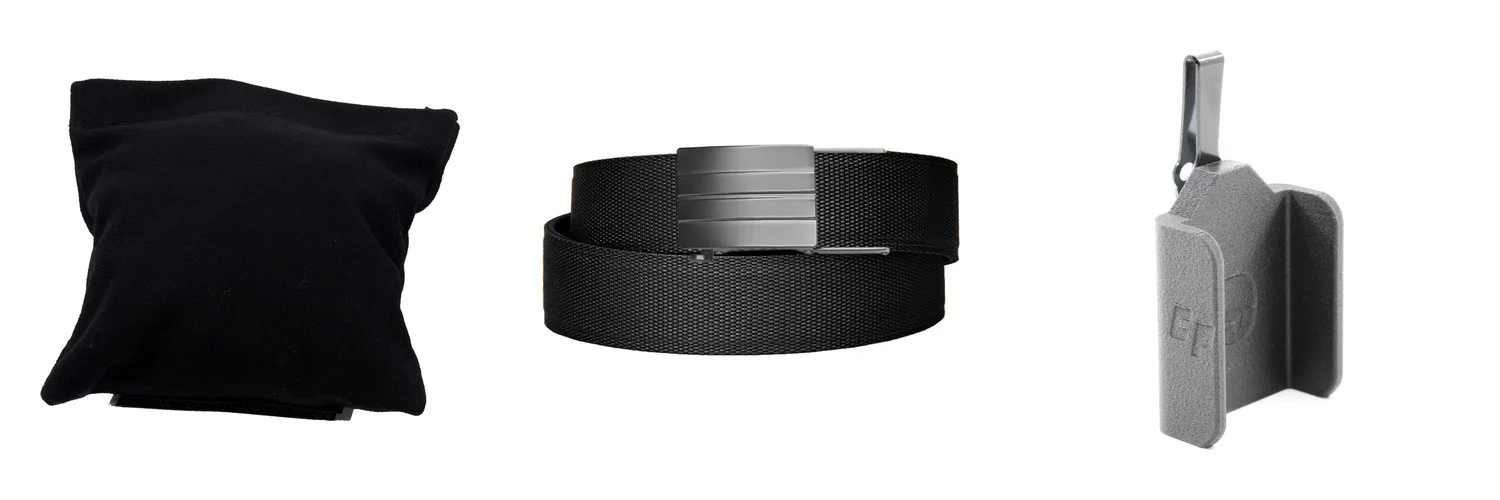
The Cloudster Pillow holster wedge mounts to the back of any IWB or AIWB holster with hook-and-loop, angles the grip into your body for better concealment and comfort, and has shredded cooling gel memory foam fill you can add or remove to set its thickness. Our Kore 1.5″ ratchet gun belts hold the holster steady. If you are new to carrying, our beginner’s guide to concealed carry covers the basics of gear and habits.
North Carolina Concealed Carry: Questions People Ask
Who issues the permit?
The sheriff of the county where you live. The permit is valid throughout the State.
What are the age, residency and training requirements?
You must be 21 or older, a U.S. citizen or lawful permanent resident, a North Carolina resident for at least 30 days before applying, and you must complete an approved course that includes live fire and instruction on North Carolina concealed carry law and the use of deadly force.
How much does a North Carolina concealed carry permit cost?
$80.00 for a new permit and $75.00 for a renewal under G.S. 14-415.19, plus a fingerprint fee of up to $10.00. Retired law enforcement officers and honorably discharged veterans pay $45.00 and $40.00.
How long does the sheriff have to decide?
45 days after receiving your application items and the required mental health records.
Can I carry in a restaurant that serves alcohol?
G.S. 14-269.3 bars guns in establishments where alcohol is sold and consumed, but it exempts valid permit holders unless the premises has a posted notice prohibiting concealed handguns. Carrying while consuming alcohol is unlawful with or without a permit.
Does North Carolina honor my out-of-state permit?
Yes. G.S. 14-415.24 says a valid permit or license issued by another state is valid in North Carolina.
Do I have to tell a police officer I am carrying?
Yes. A permittee must disclose that they hold a valid permit and are carrying a concealed handgun when approached or addressed by an officer, and must carry the permit with valid ID.
Sources, all read November 4, 2026: North Carolina General Statutes 14-269, 14-269.2, 14-269.3, 14-269.4, 14-277.2 and Article 54B (14-415.11 through 14-415.24) on ncleg.gov; the S50 bill page and Resolution 2026-6; NC Department of Justice concealed weapon reciprocity page; Randolph County Sheriff handgun permit page. Laws change, so confirm with your sheriff before you apply. This is general information, not legal advice.