Licensing and Cost-Saving Tips
Texas Concealed Carry: Permitless Carry and the License to Carry (2026)

Yes, in most cases. Since September 1, 2021, when House Bill 1927 took effect, Texas has allowed some people to carry a handgun in a public place without a License to Carry. The Texas State Law Library’s FAQ on this topic was last updated October 4, 2024.
Permitless carry does not mean no rules. You must meet an age requirement, you must not be a prohibited person, a visible handgun must be in a holster, and many places still ban handguns. The License to Carry program also still exists, and DPS lists benefits of holding one. This guide covers all of it, with the official Texas source for each point.
Laws change. Check the Texas Department of Public Safety (DPS) and the Texas State Law Library before you rely on anything here, and ask a Texas attorney about your own situation.
Who can carry without a license in Texas
Texas Penal Code 46.02 makes it an offense to carry a handgun if, at the time, the person is younger than 21 or has been convicted of certain offenses within the past five years, and is not on premises they own or control, or inside or directly on the way to a vehicle or boat they own or control. The listed offenses are assault causing bodily injury (22.01(a)(1)), deadly conduct (22.05), terroristic threat (22.07), and the disorderly-conduct offenses of discharging or displaying a firearm (42.01(a)(7) or (8)).
The State Law Library summarizes who is barred from carrying without a license as of October 4, 2024:
- anyone restricted under federal law (18 U.S.C. 922)
- anyone with a prior felony conviction (Penal Code 46.04)
- anyone with a recent conviction for certain types of misdemeanors (Penal Code 46.02 and 46.04)
- anyone subject to an unexpired protective order
- criminal street gang members carrying a gun in person or in a car or boat
- anyone who is intoxicated, except in certain situations
Carrying a handgun while prohibited under Penal Code 46.04 is a separate, more serious offense. The statute text used here is from the official Texas Legislature site, read November 4, 2026.
What is the minimum age for permitless carry in Texas?
The statute sets the age at 21. The State Law Library notes that a 2022 federal court decision, Firearms Policy Coalition, Inc. v. McCraw, ruled that Texas cannot prosecute 18-to-20-year-olds under this restriction solely because of their age. DPS says that, because of the same ruling, it “will therefore no longer deny applications solely on the basis that the applicants are 18-to-20 years old” for the License to Carry.
The statute still reads 21, and the court ruling limits prosecution of 18-to-20-year-olds based solely on age. The State Law Library suggests speaking to a lawyer about eligibility in light of this ruling. If you are 18 to 20, DPS says it no longer denies License to Carry applications solely because of age. This is an area that can change with a new court decision or legislative session, so check DPS before relying on it.
Does the handgun have to be in a holster?
If the handgun can be seen, yes. Penal Code 46.02(a-5) makes it an offense to carry a handgun and intentionally display it in plain view of another person in a public place, with an exception for a handgun that “was partially or wholly visible but was carried in a holster”. The State Law Library states the rule plainly: “If a handgun is partially or wholly visible, it must be in a holster”.
The statute does not add a holster requirement for a handgun that is fully concealed. For more on holsters, see our guide on whether you need a holster for concealed carry.
Our concealed carry vs open carry guide covers the trade-offs between the two.
Can you carry a handgun in your car without a license?
Yes, under the same conditions. Penal Code 46.02(a-1) makes it an offense to carry a handgun in a vehicle or boat you own or control if the handgun is in plain view, “unless the person is 21 years of age or older or is licensed to carry a handgun … and the handgun is carried in a holster”. It is also an offense if you are engaged in criminal activity other than a Class C traffic or boating violation, or are prohibited by law from possessing a firearm.
So a concealed handgun in your car is lawful for an eligible adult, and a visible one must be holstered.
Where are handguns still prohibited in Texas?
Penal Code 46.03 lists places where a person commits an offense by possessing or going with a firearm, subject to exceptions written into the statute. As of the official statute text read November 4, 2026, they include:
- schools and postsecondary institutions, their grounds and buildings where a school-sponsored activity is being conducted, and their passenger transportation vehicles
- polling places on election day and during early voting
- government courts and court offices
- racetracks
- the secured area of an airport
- within 1,000 feet of a designated execution site on a day a death sentence is set to be imposed, after notice
- businesses that get 51 percent or more of their income from on-premises alcohol sales
- high school, collegiate or professional sporting events and interscholastic events
- correctional facilities and civil commitment facilities
- licensed hospitals and nursing facilities
- mental hospitals
- amusement parks
- rooms where a governmental entity holds an open meeting
Several of these have exceptions and notice requirements inside the statute, so read 46.03 itself before you assume a place is open or closed to you. Our constitutional carry states page explains the general pattern of places permitless carry never covers.
Can a business ban guns, and what do the signs mean?
Yes. The State Law Library says private property owners can ban firearms by “spoken or written communication, including signage,” and the signs have required wording and layout. Three different Penal Code sections apply, and which one matters depends on whether you hold a license. The statute text below is from the official Texas Legislature site, read November 4, 2026:
- 30.05 (criminal trespass). This is the general trespass section, and it covers people carrying without a license. The sign reads, in part, “Pursuant to Section 30.05, Penal Code (criminal trespass), a person may not enter this property with a firearm.” It must be in English and Spanish, in block letters at least one inch high, in contrasting colors. A license holder carrying a handgun concealed or in a holster has a defense to this section when entry was forbidden because of the handgun.
- 30.06 (license holder, concealed handgun). Applies only to license holders. The required wording says a person licensed under the handgun licensing law “may not enter this property with a concealed handgun”.
- 30.07 (license holder, openly carried handgun). Applies only to license holders. The required wording says a licensed person “may not enter this property with a handgun that is carried openly”.
The practical point: a 30.05 sign applies to an unlicensed carrier. A license holder carrying a handgun concealed or in a holster has a defense under 30.05 and is covered by 30.06 and 30.07 notices. Notice can also be given by oral communication from the owner or someone with apparent authority to act for the owner. The State Law Library adds that property owners can typically “choose whether to prohibit unlicensed carry, open carry by license holders, concealed carry by license holders, or some combination of those options”.
Do you still need a License to Carry in Texas?
No, not to carry, but DPS lists several benefits of holding a license. As of the DPS benefits page dated July 30, 2021:
- Reciprocity. Texas license holders can carry in states that have a reciprocity agreement with Texas or that recognize the Texas license by state law.
- Campus carry. DPS says a license is still required to carry on university campuses and that campus carry is unchanged.
- Buying a gun. The license can be used as an alternative to the NICS background check when purchasing a firearm.
- Businesses. Businesses may choose to allow licensed carry on their premises. See the sign rules above.
- Airports. License holders have protections related to accidentally carrying into a secured airport area.
- Government meetings. License holders can carry in a governmental meeting.
- Identification. The license is a designated document for voter ID.
DPS lists the states that have agreements with Texas on its reciprocity page, which shows a page date of September 11, 2020. The page warns that “License holders are responsible for knowing and following the laws of the state in which they are carrying”. The State Law Library adds that some recognition is one-way: Texas honors that state’s license, but that state may not honor the Texas LTC. Our reciprocity guide explains how to check a state before a trip.
What does a Texas LTC cost, and how long is it valid?
As of the DPS application FAQ (publication date shown September 29, 2020): “The standard fee for an original LTC is $40. The standard fee for a renewal of a LTC is $40”. Fingerprinting carries an additional fee, and Texas law provides some discounts for applicants who meet certain special conditions. Fees are non-refundable.
“Initial licenses are valid for four years. Renewal licenses are valid for five years”.
Training: before applying, “applicants must complete four to six hours of classroom training, pass a written examination, and pass a proficiency demonstration (shooting) with a certified LTC Instructor”. Applications are submitted online through RSD Connect, the licensing platform DPS launched for LTC applications on October 1, 2026 (DPS handgun licensing page, checked November 4, 2026), followed by a fingerprint appointment. DPS lists processing at about 60 days for an original license and 45 days for a renewal. The texas.gov handgun license page gives the same $40 fees and the same four-to-six-hour training requirement.
Fees and processing times change. Re-check DPS before applying.
Who is eligible for a Texas LTC?
The State Law Library says that “Normally, Texans must be at least 21 years old in order to get a license to carry a handgun (LTC).” Since 2021, HB 918 has let Texans aged 18 to 20 get an LTC if they are protected under certain protective orders or magistrate’s emergency protective orders (as of October 14, 2026). Separately, DPS says it no longer denies applications solely because the applicant is 18 to 20, following the federal court ruling in Firearms Policy Coalition v. McCraw.
DPS eligibility rules also include:
- a five-year ineligibility period after a DWI conviction or a Class A or B misdemeanor conviction
- deferred adjudication treated the same as a conviction
- possible denial for delinquent child support
- Medical Advisory Board review for certain medical conditions
Applicants must meet federal qualifications to purchase a handgun.
Can non-residents get a Texas LTC?
Yes. DPS states that “legal residents of another state or persons who relocate to Texas with the intent to establish residency may obtain an LTC”. Out-of-state applicants submit form LTC-6, two passport-style photos and a copy of their out-of-state driver license or state ID, and must complete the required training in Texas. The State Law Library notes that a Texas LTC may be useful for anyone who wants to carry in another state that has a reciprocity agreement with Texas.
For visitors who do not hold a license, Penal Code 46.02 sets its conditions on age, criminal history and prohibited-person status rather than on residency. The State Law Library says anyone carrying a firearm in Texas, including visitors, is still subject to the other laws and restrictions on carrying a firearm in Texas.
Carrying without a license still means carrying well
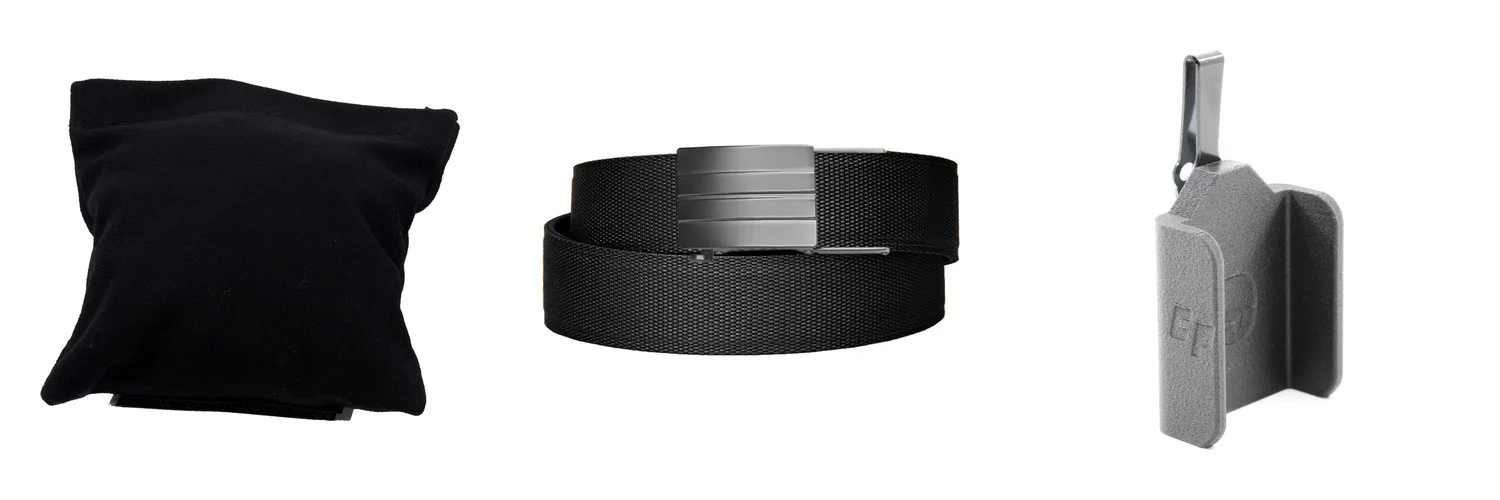
If you are new to carrying, start with choosing the right holster and our guide to concealed carry for beginners. For all-day comfort, the Cloudster Pillow holster wedge mounts to the back of any IWB or AIWB holster with hook-and-loop and has shredded cooling gel memory foam fill you can add or remove to set its thickness, and our Kore 1.5″ ratchet gun belts keep the holster steady. For Texas heat, see our concealed carry in shorts guide.
Texas Concealed Carry: Questions People Ask
Can I carry a handgun in Texas without a License to Carry?
Yes, if you are 21 or older and not a prohibited person. Texas has allowed permitless carry since September 1, 2021, under HB 1927. A visible handgun must be in a holster, and banned places still apply.
Who is barred from carrying without a license?
People prohibited under federal law, felons, people with certain recent misdemeanor convictions, people under an unexpired protective order, criminal street gang members carrying in person or in a car or boat, and anyone intoxicated except in certain situations.
Do you need a license to carry concealed in Texas?
No, but DPS lists benefits of the LTC, including reciprocity in other states, campus carry, a NICS alternative when buying a gun, and carrying in businesses that choose to allow licensed carry.
Sources, all read November 4, 2026: Texas Penal Code chapters 30 and 46 (official Texas Legislature site); Texas DPS handgun licensing pages (application FAQ, eligibility FAQ, LTC benefits, state reciprocity); Texas State Law Library permitless carry FAQ, License to Carry guide and reciprocity FAQ; texas.gov handgun license page. Laws change, so check DPS before you rely on anything here. This is general information, not legal advice.