Appendix Carry
AIWB Holster Guide: How to Choose the Best Appendix Carry Holster

Quick answer: The best appendix carry holster is a rigid Kydex holster, or a hybrid with a rigid mouth, that fully covers the trigger guard, has adjustable retention, and uses a claw or wing plus a wedge to tuck the grip. Set ride height and cant to your body, and mount it on a stiff 1.5-inch gun belt.
What Is an Appendix Carry (AIWB) Holster?
AIWB stands for appendix inside the waistband: the gun rides in front of your hip, roughly between the 12 and 2 o’clock positions for a right-handed shooter. American Rifleman’s appendix carry primer gives two reasons people choose it: “One of the primary advantages of appendix carry, from a defensive standpoint, is speed,” and “With appendix carry, a holstered gun is on a portion of the body that is rarely exposed, because we don’t often find ourselves bending backward at the waist.” An appendix holster is built for that spot. The holster mouth, clip placement and concealment features are designed around the front of your body, not your hip. For the short version, see what AIWB means; for the full picture of carrying this way, see our appendix carry guide.
What to Look For in an Appendix Carry Holster
| Feature | Why it matters in appendix carry |
|---|---|
| Rigid shell (Kydex or hybrid with a rigid mouth) | The mouth stays open after the draw, so you can re-holster one-handed without anything folding into the trigger guard. Soft nylon and leather holsters tend to collapse. |
| Full trigger guard coverage | Nothing should be able to reach the trigger while the gun is holstered. |
| Adjustable retention | Holds the gun when you bend, sit or run, but still lets it out with a clean draw. |
| Claw or wing | Pushes against the belt to rotate the grip in toward your body. PHLster’s appendix guide calls it “a wing to convert belt pressure into grip rotation.” |
| A wedge | Sits low on the body side of the holster and pushes the muzzle out, which tips the grip in. It also stops the bottom edge from digging in. |
| Adjustable ride height and cant | Lets you set how high the grip sits and how it angles. Vedder’s guide says adjustable ride height lets you “choose either deep concealment or to have your gun ride higher on your waistband.” |
| Cut for your exact optic and light | A light-bearing holster has to be molded for your specific gun and light combination, not just the gun. |
| Optional sidecar | A holster with an attached magazine carrier puts a spare mag on the same platform. It’s wider, so it suits some bodies better than others. |
Vedder Holsters’ appendix carry guide puts the safety point plainly: “Because most appendix carry accidents happen during holstering, nylon and leather holsters are not recommended.” PHLster’s guide says the same about the holster mouth: “The holster must have a rigid, unobstructed mouth that stays open when the gun is drawn, so you can reholster one-handed without sweeping any part of your body with the muzzle.”
How to Set Up an Appendix Holster So It Doesn’t Print or Dig
- Set the ride height. American Rifleman describes the usual setup as “exposing enough of the frontstrap above the belt line to allow for a full strong-hand firing grip before beginning withdrawal from the holster.” It notes some holsters let a gun sit lower for concealment, “but usually at the expense of draw speed or grip confidence.”
- Start with little or no cant. The same primer says the slide usually rests “in a vertical position or slightly canted toward the body’s center line.”
- Use the claw. If your holster has a claw or wing, make sure it’s actually pressing against the belt. That’s what tucks the grip.
- Add a wedge. Put it low on the body side of the holster, toward the muzzle. Our wedge placement guide shows exactly where, and our claw vs wedge vs pillow guide explains what each part does.
- Tighten the belt one notch. Appendix carry needs a snug, stiff belt; a loose one lets the holster tip away from your body.
Still printing? Work through our appendix printing fixes and our deep concealment holster guide. If it hurts to sit, see why appendix carry is uncomfortable and how to fix it.
Five AIWB Holsters, in Their Makers’ Words
We don’t make or sell holsters, and we haven’t lab-tested these. These are well-known appendix holsters; each description comes from the maker’s own page, checked November 2026.
- Tier 1 Concealed Axis Elite: Tier 1 calls it “our flagship appendix carry holster,” “fastened together with military-grade shock cord, allowing the firearm and magazine to flex independently.” Using a Cloudster Pillow with Tier 1.
- Tenicor VELO5: Tenicor says it “is designed for appendix inside-the-waistband (AIWB) carry,” with models for Glock, SIG SAUER, Staccato, S&W M&P, Heckler & Koch and Walther. Using a Cloudster Pillow with Tenicor.
- T.REX ARMS Sidecar and Raptor: T.REX says the Sidecar lets you “carry a full-size handgun comfortably alongside a spare magazine, or the available attachment of your choice,” with the pistol mag carrier as the default attachment. The Raptor “is a Kydex inside-the-waistband holster for appendix or 4 o’clock carry” with “a smaller footprint than our Sidecar.” Using a Cloudster Pillow with T.REX.
- Vedder LightTuck and SideTuck: Vedder says each LightTuck “is handcrafted to your precise gun model,” and describes the SideTuck as “an advanced IWB Kydex holster combining features from our popular LightTuck™ and classic MagTuck™ magazine holster.” Using a Cloudster Pillow with Vedder.
- PHLster Enigma: PHLster calls it “The beltless carry system that adapts to your body, your clothes, and your life,” useful for gym clothes and other times you don’t wear a belt.
Models and options change, so check the maker’s fit list for your exact gun, optic and light before you order. For gun-specific picks, see our guides for the Glock 19, Glock 43X and Hellcat Pro.
How to Re-holster Safely When You Carry Appendix
Re-holstering is the riskiest moment in appendix carry, because the muzzle passes close to your body. What the sources say:
- Finger off the trigger, straight along the frame, the whole time. USPSA’s range officer institute notes that on striker-fired pistols “The safeties on those pistols are engaged as long as the finger remains off the trigger.”
- Don’t rush. PHLster: “Slow down. Give yourself time to see and respond.” An NRA Blog article adds: “There will never be a contest on the planet to see who can get their gun back in the holster the fastest.”
- Clear your shirt completely with your support hand. Vedder warns: “If you fail to clear your garment completely or hold your gun incorrectly, your finger or clothing may accidentally get caught on the trigger and cause the weapon to fire.”
- Angle the muzzle away from your body. PHLster notes that a wedge angled under the muzzle end “tilts the gun’s muzzle away from the body, giving you a safer reholstering path with less exaggerated leaning.”
- Look the gun in, and stop if anything resists. Pull the gun out, find the obstruction, and try again. The NRA Blog article suggests you “rest your thumb on the back of slide or the hammer for both safety purposes and to ensure proper seating in your holster.”
If you’re new to appendix carry, you can also take the holster off, holster the unloaded gun off your body, and put the whole rig back on. Get training from a qualified instructor either way. Our holstering guide covers the steps in more detail.
Your Belt Matters as Much as the Holster
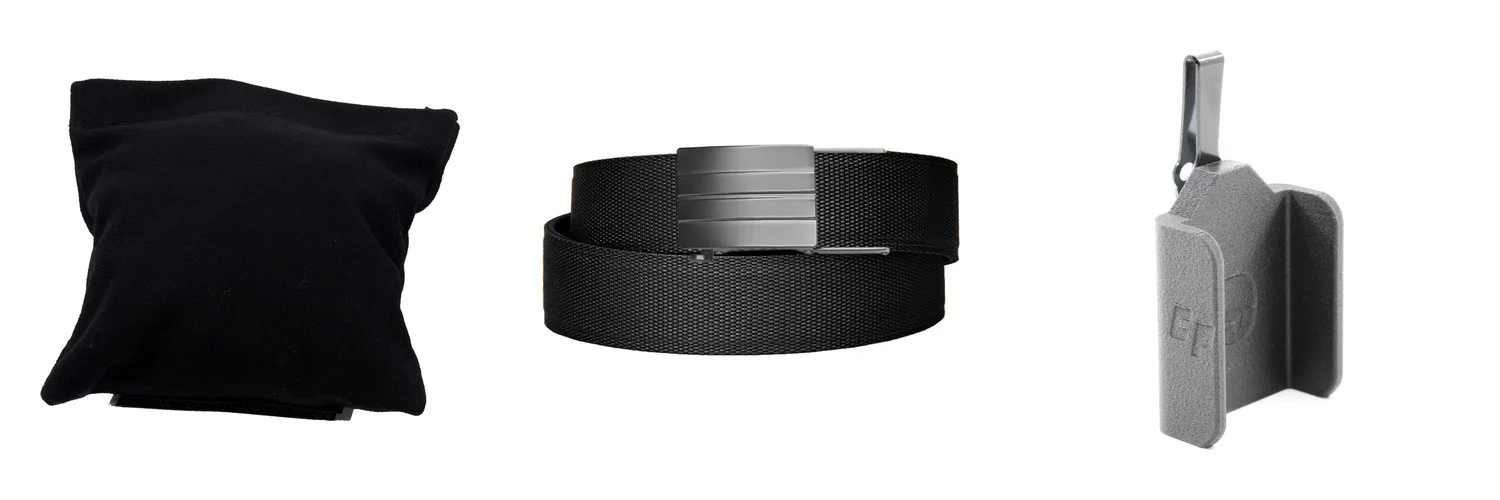
An appendix holster wants to rotate outward every time you sit or bend. A soft dress belt lets it. Vedder’s guide explains: “Gun belts are designed to be thicker, stiffer, and made from better materials to prevent belt sag.” We carry Kore ratcheting gun belts; Kore lists “40+ positions” in quarter-inch steps on its tactical belts, so you can tighten a notch when you put the holster on and let it out when you sit. More in our concealed carry belt guide.
Making Any Appendix Holster Comfortable
If the bottom edge of the holster presses in when you sit, that’s the problem we built the Cloudster Pillow to solve. It mounts to any flat-back IWB or AIWB holster with hook-and-loop, angles the grip into your body, and has memory-foam fill you can add or remove to set its thickness. See how it compares with other IWB holster wedges. Some people search for this same cushioning as a holster pad — our holster pad guide covers sizing and mounting on Kydex, hybrid and leather holsters.
For the right size, check the size guide on the product page (it’s chosen by your gun and holster) or just ask us.

Quick Answers
Is appendix carry safe?
PHLster’s guide says: “Appendix carry does come with higher stakes in regard to safety, but safe practices are easy to learn and apply.” Vedder says most appendix carry accidents happen during holstering, so that’s where to focus your practice.
What’s the difference between AIWB and IWB?
IWB just means inside the waistband, anywhere around the belt. AIWB is IWB at the appendix position in front of the hip. Appendix holsters add features like a claw and wedge because the front of the body moves more when you sit and bend.
Do I need a claw on an appendix holster?
PHLster lists a wing among the features to look for, because it converts belt pressure into grip rotation. Many AIWB holsters include one or have it as an option.
Can bigger guys carry appendix?
Often, yes, with the right ride height, cant and wedge. See holsters for bigger guys and appendix carry for larger frames.
Is a holster with a mag sidecar better?
It keeps your spare magazine on one platform, but it’s wider. If a sidecar doesn’t fit your build, a separate mag carrier works, such as a magnetic IWB magazine holster on its own belt clip. See our mag carrier guide.
Written by the Cloudster Pillow team. We make holster wedges and carry Kore gun belts. We don’t sell holsters or firearms, and no holster maker paid to be mentioned here. This is general information, not a substitute for professional training.