Holsters and Gear Recommendations
Best Concealed Carry Holster: How to Choose the Right One for You

Quick answer: For most people, the best concealed carry holster is a rigid inside-the-waistband (IWB) holster, worn at appendix or on the strong-side hip, on a stiff 1.5-inch gun belt. It should fully cover the trigger guard, hold the gun securely, and have a claw or wedge to tuck the grip against your body. The “best” model is the one that fits your exact gun, your body and your clothes. That’s why people who carry every day often go through several holsters before they settle on one.
Concealed Carry Holster Types Compared
| Holster type | Best for | Trade-offs |
|---|---|---|
| Appendix IWB (AIWB) | Fast access sitting or standing; conceals well under one shirt | Needs a claw and wedge to tuck the grip; demands careful re-holstering |
| Strong-side IWB (3–4 o’clock) | A familiar hip draw that works for most body types | The grip can print when you bend; slower to reach when seated |
| Outside the waistband (OWB) | Comfort, range days, cooler weather with a jacket | Needs a longer cover garment to stay hidden |
| Pocket holster | Small pistols, dress clothes, quick trips | Only fits small guns; slow to draw while seated |
| Belly band | Workouts, athletic clothes, no belt | Soft material; check that the trigger guard stays fully covered |
| Shoulder holster | Long drives, people who always wear a jacket | Needs a jacket at all times; the draw sweeps the muzzle across others |
| Ankle holster | A backup gun, or when nothing can go at the waist | The slowest draw; only suits small guns and loose trousers |
Not sure where on your body to carry? Start with our guide to the best carry position for comfort and concealment, then choose a holster built for that spot.
What Every Good Concealed Carry Holster Has
- Full trigger guard coverage. Nothing should be able to reach the trigger while the gun is holstered.
- A fit made for your exact gun, including your optic and weapon light if you run them. A “universal” holster that fits a dozen guns rarely fits any of them well.
- Real retention. The gun stays put when you run, sit or bend, but comes out cleanly on the draw. Adjustable retention lets you tune it.
- A mouth that stays open. Rigid Kydex, or a hybrid with a reinforced mouth, lets you re-holster one-handed without anything folding into the trigger guard.
- Adjustable ride height and cant, so you can set where the grip sits and how it angles.
- A claw or wing (for IWB and appendix) to rotate the grip in toward your body so it doesn’t print.
How to Choose the Right Holster for You
- Start with your clothes and your day. Office, jeans and a T-shirt, gym clothes, or a jacket every day? Your wardrobe narrows the choice faster than anything else.
- Pick a carry position. Appendix and strong-side IWB cover most people most days. Add a second option (pocket or belly band) only for the situations your main holster can’t handle.
- Buy for your exact gun. Check the maker’s fit list for your model, optic and light. If you’re still choosing a gun, see our Glock 17 vs 19 and Glock 43 vs 43X comparisons.
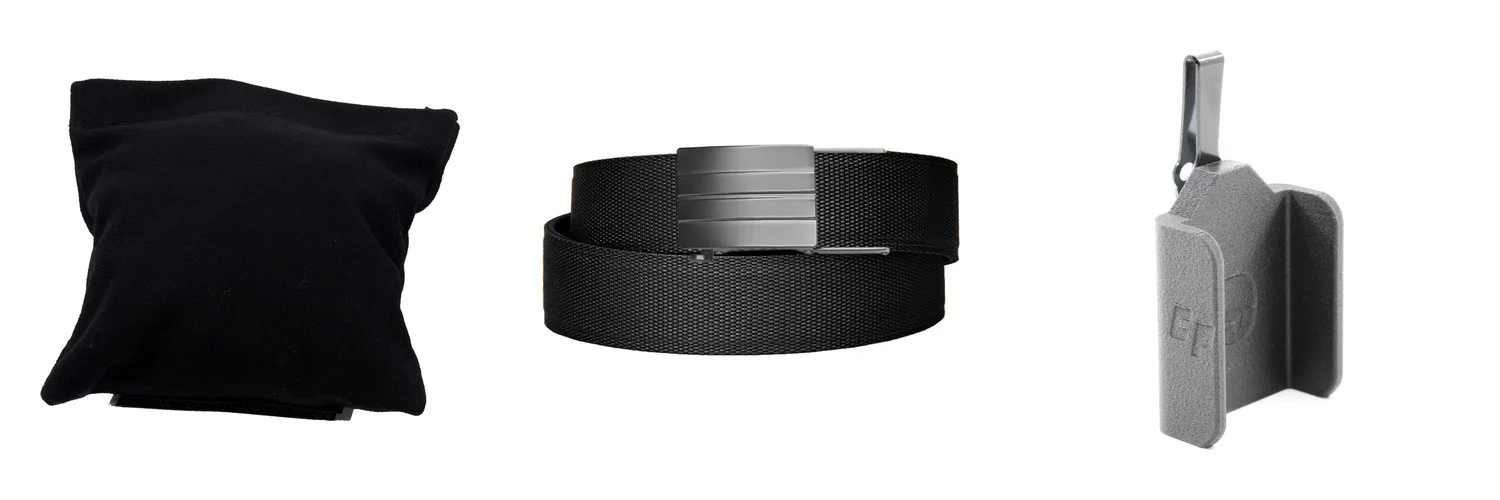
- Budget for the belt too. A soft belt lets any IWB holster sag and tip away from your body. A 1.5-inch reinforced gun belt fixes that. The Kore 1.5″ gun belts we carry lock into the buckle in quarter-inch steps, with over 40 sizing positions, so you can tighten a little when the holster goes on and let it out when you sit down.
- Give it a week, then adjust. Most holsters ship at settings that suit nobody in particular. Adjusting ride height, cant and retention, and adding a wedge, fixes more “bad holsters” than replacing them.
Which Holster Is Most Comfortable for Concealed Carry?
Comfort comes from how the holster is set up on your body more than from the brand (our guide to the most comfortable concealed carry holster covers it in depth). The things that make the biggest difference:
- Something soft between the holster and your body. The bottom edge of a rigid holster is what usually digs in when you sit. A padded backing (hybrid holsters) or a foam wedge takes that pressure off.
- The right ride height. A grip that sits too high jabs your stomach or side when you sit; too low and you can’t get a full grip.
- A stiff, snug belt that holds the holster in one place so it isn’t shifting and rubbing all day.
- A gun that suits your frame. A smaller gun is easier to carry all day, but a bigger grip is easier to shoot. Choose the balance that means you’ll actually carry it.
That first point is exactly why we make the Cloudster Pillow. It’s a soft, adjustable-fill memory-foam wedge that attaches with velcro to the back of any IWB or appendix holster. It cushions the edge that digs in and tilts the grip toward your body so it stops printing. You can add or remove fill to tune it to your gun and your build. To pick a size, check the size guide on the product page (it’s chosen by your gun and holster) or just ask us.
What Is a Holster?
A holster is a sheath, usually leather, for carrying a handgun. The word probably comes from the Old English “heolster”, and an even earlier form meant concealment or a hiding place. Hybrid holsters combine a molded Kydex shell with a leather backing. A good holster fully covers the trigger guard, keeps the handgun in it until you choose to draw, and stays attached to your body.
Buy a Holster Made for Your Exact Gun (9mm and Other Calibers)
Urban Carry Holsters explains that slide width, rail shape, frame contour and trigger guard geometry all decide how the gun locks into place. It adds that a Glock 19 and a Glock 17 are similar in shape but not identical in length and balance. Even generations differ. Rifle Configurator notes that a holster for a Glock 19 Gen5 may not fit a Gen3.
Accessories make the fit more specific. Optics-ready slides, suppressor-height sights, threaded barrels and weapon lights can all stop a holster built for the base gun from fitting. A light-bearing holster must match the exact light. A holster cut for a Surefire X300U will not fit a Streamlight TLR-7A. Universal holsters may have a place for temporary or occasional use, but Urban Carry says they are usually a compromise in retention, concealment or draw consistency.
The alternative, carrying without a holster, leaves the trigger exposed to belt loops, clothing and body movement, any of which can cause a negligent discharge.
Custom vs. Off-the-Shelf Holsters: When Custom Is Worth It
Custom makes the most sense in a few cases. The Firearm Blog (article dated July 7, 2026) says a custom holster is often the only option for an obscure pistol. It also lets left-handed shooters get exactly what they want instead of settling for the few left-handed stock options, and its benefits add up because a daily holster is worn for hundreds or thousands of hours. Dara Holsters lists the modifications that usually send people to custom: an optic with suppressor-height sights, an extended magazine release or slide stop, or a light or laser on the carry gun. Its rule is that if you spend money to modify the gun, spend money on a holster made for the modified gun.
What you can specify includes carry position, cant, ride height, sweat guard, belt width, holster shape, material (leather, Kydex or a blend) and color. You can also choose IWB or OWB, optic cuts, light-bearing designs, and less common positions such as cross draw or small of back.
The costs are price, lead time and, for professionals, approval. One maker, FALCO Holsters, quotes as little as 10 working days, longer in peak periods. If your employer keeps a list of approved holsters, a custom version is unlikely to be on it.
How to Holster Your Handgun Safely
Putting the gun away is the step where mistakes happen. Rick Hogg, writing on Safariland’s blog, puts it this way: your finger has no business inside the trigger guard while the pistol is going back into the holster. NRA Family (article dated August 31, 2022) explains why: jamming a gun into a holster with your finger in the trigger guard stands a good chance of driving the finger back onto the trigger.
- Take your finger out of the trigger guard and point it away from the pistol.
- If the gun has a manual safety, such as a 1911, be certain it is engaged before reholstering.
- Clear your cover garment completely so nothing can enter the holster mouth with the gun.
- Look the pistol into the holster and visually confirm the mouth is clear.
- Take your time. NRA Family notes there is no benefit to rapidly stuffing a firearm into a holster, and that Gunsite Academy treats speed reholstering as a safety violation.
- If the gun does not feel aligned or the holster mouth is obstructed, stop. Do not force it. Back out, fix the problem, and start again.
American Rifleman says a carry holster should ideally be rigid and stay open, ready to receive the handgun after the draw.
Test a Holster Before You Carry It Every Day
American Rifleman’s advice is to test your holsters at home before using them. Wear the holster with the unloaded gun through a normal day’s movements. Sit, drive, bend, reach overhead and walk, and check that the gun stays put, that nothing can reach the trigger, and that the grip does not print through the clothes you actually wear. Outdoor Life’s standard is simple: you should be able to sit, stand and do anything you would normally do while carrying.
Expect to end up with more than one. American Rifleman notes it is not uncommon to keep more than one holster system for different activities and modes of dress. If you plan to carry cross draw, remember that many ranges limit or prohibit it, so arrange practice before you commit.
Guides by Holster Type
- Appendix carry (AIWB) holsters: what to look for, setup, and safe re-holstering
- Best IWB holsters: what to look for, setup, and making one comfortable
- Deep concealment holsters: how to set one up so nothing prints
- MOLLE holsters: mounting a holster on a vest, chest rig, battle belt or pack
- Paddle holsters: how they stay on, and paddle vs belt-loop OWB
- OWB holsters for concealed carry
- Pocket holsters
- Shoulder holsters
- Ankle holsters
Guides by Gun and Body Type
- Glock: Glock 19 holsters · Glock 43X holsters
- Springfield: Hellcat Pro holsters
- Bigger guys: the best holster for a bigger build
- Women: concealed carry holsters for women
Your Belt Matters as Much as the Holster
An inside-the-waistband holster is only as steady as the belt holding it. We carry Kore ratcheting gun belts, which adjust in quarter-inch steps instead of holes, so you can tighten a notch when you put the holster on and let it out when you sit. More in our concealed carry belt guide.
Quick Answers
What is the most popular type of concealed carry holster?
Inside-the-waistband holsters, worn at appendix or on the strong-side hip. They offer the best balance of concealment and access for everyday clothes.
Kydex, leather or hybrid?
Kydex is rigid, keeps its shape and makes re-holstering easy. Leather is quieter and softer but can soften and collapse over time. Hybrids pair a Kydex shell with a soft backing for comfort. For appendix carry, most people choose Kydex or a hybrid with a rigid mouth.
What’s the best concealed carry holster for sitting?
One set at the right ride height with padding at the bottom edge. Appendix holsters often need a wedge so the muzzle end doesn’t press in when you sit; strong-side IWB can print less when seated if you add a little forward cant.
How many holsters do I need?
Most people are well served by one main holster for daily wear and one for situations it can’t cover, such as a pocket holster or a belly band for workouts.
Will any 9mm holster fit my 9mm pistol?
No. Slide width, rail shape, frame contour and trigger guard geometry decide how a gun fits a holster, and even similar models such as the Glock 19 and 17 differ. A holster for a Glock 19 Gen5 may not fit a Gen3, and a light-bearing holster must match the exact light.
How do I put a gun back in the holster safely?
Finger out of the trigger guard, manual safety on if the gun has one, cover garment cleared, then look the gun into the holster and take your time. If anything feels misaligned, stop and start again. Gunsite Academy treats speed reholstering as a safety violation.
Are custom holsters worth it?
Often, yes, if you carry an uncommon pistol, are left-handed, or run an optic with suppressor-height sights, a light or a laser. Expect a higher price and a lead time of as little as 10 working days at one maker, longer in peak periods. Employer-approved holster lists are unlikely to include custom versions.
What does “holster” mean?
A holster is a sheath, usually leather, for carrying a handgun. The word probably comes from the Old English “heolster”, from an earlier form meaning concealment or a hiding place. Hybrid holsters combine a Kydex shell with a leather backing.
Written by the Cloudster Pillow team. We make holster wedges and carry Kore gun belts. We don’t sell holsters or firearms, and no holster maker paid to be mentioned here. This is general information, not a substitute for professional training.