Holsters and Gear Recommendations
Duty Holster Guide: Retention Levels, Ride Height and Belt Fit
Quick answer: A duty holster is a belt-mounted holster with active retention, made for police, security and military work. Choose in this order: what your agency allows, retention level (Alien Gear says most agencies prefer Level 2 or 3), ride height (Safariland’s most popular for patrol is mid-ride), a fit for your gun and light, and a belt loop matching your belt.
What Is a Duty Holster?
Safariland’s overview of holster types puts it simply: “Patrol or duty holsters are generally going to be belt and hip mounted.” What sets them apart is the locking hardware. In Alien Gear’s words, “Duty holsters use active retention mechanisms like thumb swipes or ejection port locks.”
Safariland treats them separately from plainclothes holsters, which it calls “concealment based”: “you’ll see paddles, or paddle ride UBLs or belt slide kits.” See our paddle holster guide for that style, and our IWB vs OWB comparison for carry under a shirt.
Start With Your Agency’s Policy
Your agency may issue the holster or set rules for it, so check your policy before you buy. Safariland notes, on ride height, that “Departments may regulate the height as part of its uniform code.” Our duty belt setup guide covers where the holster goes on the belt and what sits around it.
Retention Level: Level 1, 2 or 3?
Safariland rates its duty holsters “based on the number of hand movements required to clear the security mechanisms before the firearm can be drawn,” and adds that “At Safariland, passive retention is not considered a retention level.” Other makers use their own tests: Safariland warns that “Manufacturers use different methods, tests, and terminology for their ratings.”
| Level | What it means (Safariland) | Example: Blade-Tech Valor draw steps |
|---|---|---|
| Level 1 | 1 distinct hand motion | Pull button back |
| Level 2 | 2 distinct hand motions | Push button down, pull button back |
| Level 3 | 3 distinct hand motions | Clear button cover, push button down, pull button back |
For police work, Alien Gear states that “Most law enforcement agencies prefer a Level 2 or Level 3 retention holster,” and explains the step between them: “A Level 2 duty holster combines passive retention with one active retention device, such as a thumb release. A Level 3 holster adds a second locking point, like an ejection port lock or rotating hood.” Each added step is one more motion to clear on the draw, so train with the exact holster you will wear. Our guide to holster retention levels explains each level and the hardware behind it.
Ride Height: Low, Mid or High
Safariland’s ride height guide describes three heights for its duty belt loops:
- Mid-ride: “the most popular, and suitable choice for all-around duty or patrol use.” It “places the butt of the pistol even with the belt line.”
- Low-ride: sits “approximately 1.5” lower than the mid-ride option” and “clears body armor the best,” but Safariland calls it “not ideal for all-purpose duty because its lower position on the belt makes it uncomfortable for sitting in chairs or car seats.”
- High-ride: sits “approximately 1.5” higher than the mid-ride option” and is “very comfortable for sitting in a vehicle or doing office work.” Safariland adds that it “is often called “detective carry.””
If body armor still blocks the hip, a drop leg holster moves the gun down to the thigh; see our drop leg holster guide.
Lights, Optics and Fit
Duty holsters are ordered for a specific gun. Safariland’s product pages ask you to “SELECT FIREARM MAKE,” and note the holster “may look different based on your gun and light selections.” Makers also design around lights and red dots:
- Blade-Tech says the Valor “securely retains your firearm with or without a weapon-mounted light,” and “The open bottom design allows you to run a compensator, threaded barrel, or extended slide.”
- Mission First Tactical’s Duty Holster has “An auto-closing optic cover” that “protects red dot sights without manual input.”
- Safariland offers optic-ready versions: “Protect your sights with our RDS and optic compatible holsters.” For the trade-offs of carrying an optic, see our concealed carry red dot guide.
Examples of Duty Holsters, From the Makers
| Holster | Retention | What the maker says |
|---|---|---|
| Safariland 6360 | Level III (ALS + SLS), mid-ride | “It locks the weapon in all directions upon holstering, it’s operable with the thumb, and the weapon can be drawn straight out of the holster with no twisting required.” |
| Safariland 6390 | Level I (ALS), mid-ride | “The ALS is an internal locking mechanism that secures the gun when holstered and is released using a thumb lever.” |
| Blade-Tech Valor | Level I, II or III | “Designed, Manufactured, Assembled, and Distributed from our headquarters in Streetsboro, OH.” |
| Alien Gear Rapid Force | Level II or Level III models | Police1’s tester found its Level III draw lets the user “defeat two of the three forms of retention with one straight-down press of their thumb.” |
| Mission First Tactical Duty Holster | Up to Level 4 | “Compatible with the industry-standard 3-hole pattern,” with a convex mount where “The convex design prevents hot spots, while the flared bottom minimizes gouging legs.” |
Many duty holsters can move between mounts. Police1’s tester notes the Rapid Force works with Alien Gear’s Quick Disconnect System, “allowing the user to transition their holster easily and quickly between four different configurations”: “a belt slide, paddle, MOLLE and swivel drop leg.” See our MOLLE holster guide.
Match the Holster to Your Duty Belt
A duty holster’s belt loop is sized for a belt width. Safariland, for example, offers the CUBL belt loop for its 6360 in 2.25″, 2″ and 1.75″ versions. So decide the belt first, then order the holster and every pouch for that width. For the cuff case, see our handcuff holster guide.
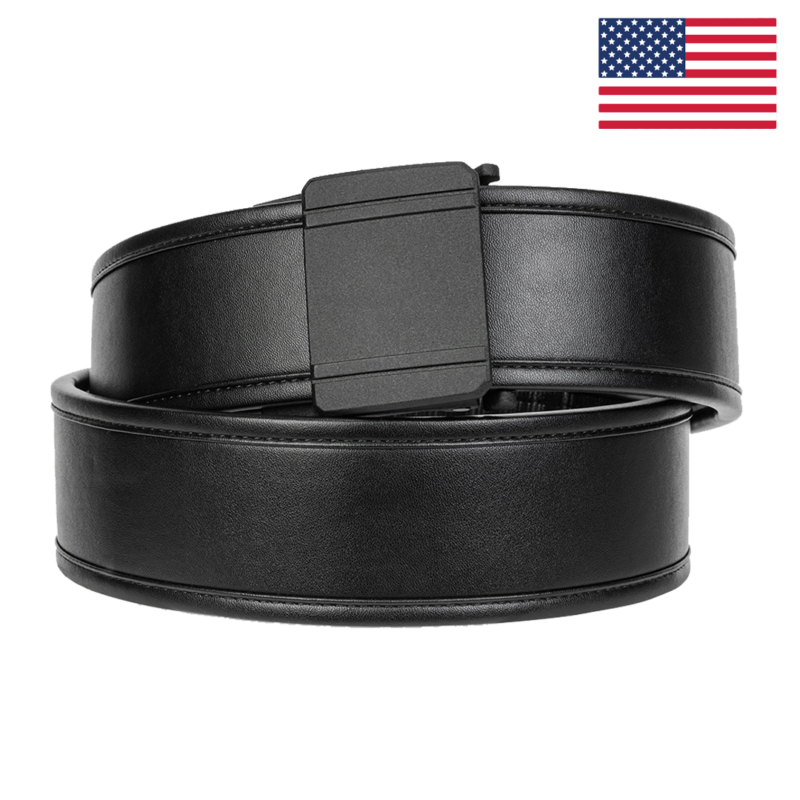
The Kore duty belts we carry come in both common widths:
- 2.25″ duty belts: “Belt Width / Thickness 2.25” / 7mm,” regular fits 24″–48″ and XL fits 48″–60″.
- 2″ patrol belts: “Belt Width / Thickness 2” / 7 mm,” one size fits 24″–48″.
Kore rates both for “Up to 30 lbs.” of gear, and each kit’s list of what’s included has the 1.5″ inner belt. Kore’s track system “allows 1/4″ micro-adjustments without removing the belt,” and Kore notes its duty belts “must be used in conjunction with our unique Kore Inner Liner Belts to achieve the micro adjustable feature.” Our Kore belt sizing guide explains how to measure.
Duty Holster: Questions People Ask
What retention level do police use?
If your agency sets a level, follow it. Alien Gear states that “Most law enforcement agencies prefer a Level 2 or Level 3 retention holster.”
What is the difference between a Level 2 and a Level 3 duty holster?
One more locking device to clear. On the Blade-Tech Valor, Level 3 adds a button cover in front of the two steps of Level 2.
Which ride height should I choose?
Safariland calls mid-ride the most popular choice for patrol. Low-ride clears armor best but is less comfortable sitting in a car; Safariland calls high-ride very comfortable for sitting in a vehicle.
Will a duty holster fit a 2-inch belt?
Only with a belt loop made for 2″. Check the belt loop width when you order, and match every pouch to the same belt.
Can civilians use a duty holster?
Alien Gear says “civilians can also use them for open carry, training, or range use,” and that “it’s important to follow state and local laws regarding carry methods.” See also our open carry holster guide.
Written by the Cloudster Pillow team. We make the Cloudster Pillow and the Cloudster magnetic mag carriers, and carry Kore belts. We don’t sell holsters or firearms, and no maker paid to be mentioned here. This is general information, not a substitute for professional training or your agency’s policy.